
Pulp Fiction, 1926 · page 12 of 184
Argosy All-Story Weekly, December 4, 1926 — page 12: what you’re looking at
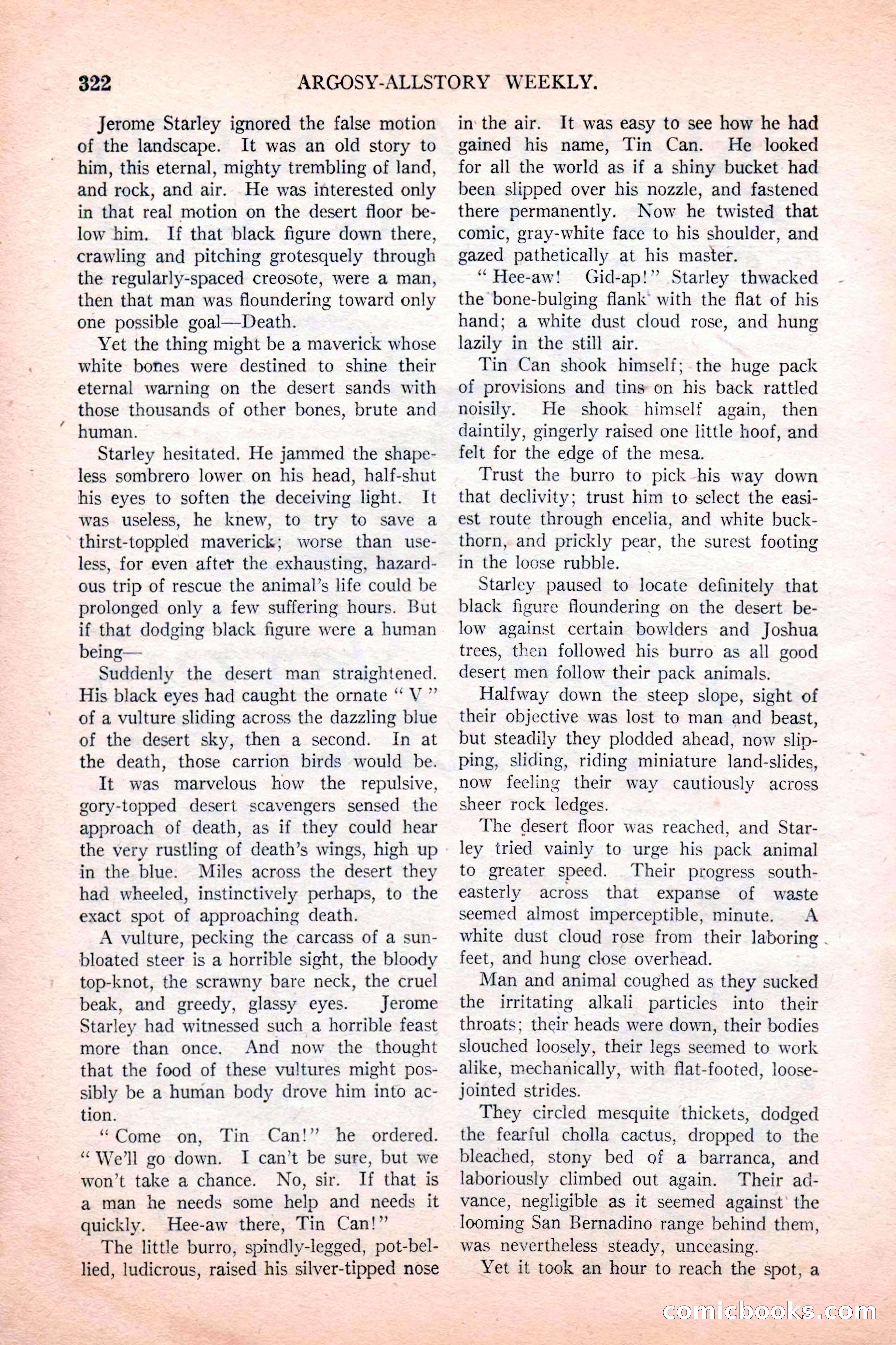
A restored page from Pulp Fiction, 1926. Page through the whole issue in the reader above.
📄 Transcribed text from this page (OCR, searchable)
Machine-transcribed from the original scan — historical spelling and the odd misread are preserved.
322 Jerome Starley ignored the false motion of the landscape. It was an old story to him, this eternal, mighty trembling of land, and rock, and air. He was interested only in that real motion on the desert floor be- low him. If that black figure down there, crawling and pitching grotesquely through the regularly-spaced creosote, were a man, then that man was floundering toward only one possible goal—Death. : Yet the thing might be a maverick whose white bones were destined to shine their eternal warning on the desert sands with those thousands of other bones, brute and human. Starley hesitated. He jammed the shape- less sombrero lower on his head, half-shut his eyes to soften the deceiving light. It was useless, he knew, to try to save a thirst-toppled maverick; worse than use- less, for even after the exhausting, hazard- ous trip of rescue the animal’s life could be prolonged only a few suffering hours. But if that dodging black figure were a human being— Suddenly the desert man straightened. His black eyes had caught the ornate “ V ” of a vulture sliding across the dazzling blue of the desert sky, then a second. In at the death, those carrion birds would be. It was marvelous how the repulsive, gory-topped desert scavengers sensed the approach of death, as if they could hear the very rustling of death’s wings, high up in the blue. Miles across the desert they had wheeled, instinctively perhaps, to the exact spot of approaching death. A vulture, pecking the carcass of a sun- bloated steer is a horrible sight, the bloody top-knot, the scrawny bare neck, the cruel beak, and greedy, glassy eyes. Jerome Starley had witnessed such a horrible feast more than once. And now the thought that the food of these vultures might pos- sibly be a human body drove him into ac- tion. “Come on, Tin Can!” he ordered. “We'll go down. I can’t be sure, but we won’t take a chance. No, sir. If that is a man he needs some help and needs it quickly. Hee-aw there, Tin Can!” The little burro, spindly-legged, pot-bel- lied, ludicrous, raised his silver-tipped nose ARGOSY-ALLSTORY WEEKLY. in the air. It was easy to see how he had gained his name, Tin Can. He looked for all the world as if a shiny bucket had been slipped over his nozzle, and fastened there permanently. Now he twisted that comic, gray-white face to his shoulder, and gazed pathetically at his master. ‘“Hee-aw! Gid-ap!” Starley thwacked the bone-bulging flank with the flat of his hand; a white dust cloud rose, and hung lazily in the still air. Tin Can shook himself; the huge pack of provisions and tins on his back rattled noisily. He shook himself again, then daintily, gingerly raised one little hoof, and felt for the edge of the mesa. Trust the burro to pick -his way down that declivity; trust him to select the easi- est route through encelia, and white buck- thorn, and prickly pear, the surest footing in the loose rubble. Starley paused to locate definitely that black figure floundering on the desert be- low against certain bowlders and Joshua trees, then followed his burro as all good desert men follow their pack animals. Halfway down the steep slope, sight of their objective was lost to man and beast, but steadily they plodded ahead, now slip- ping, sliding, riding miniature land-slides, now feeling their way cautiously across sheer rock ledges. The desert floor was reached, and Star- ley tried vainly to urge his pack animal to greater speed. Their progress south- easterly across that expanse of waste seemed almost imperceptible, minute. <A white dust cloud rose from their laboring . feet, and hung close overhead. Man and animal coughed as they sucked the irritating alkali particles into their throats; their heads were down, their bodies slouched loosely, their legs seemed to work alike, mechanically, with flat-footed, loose- jointed strides. They circled mesquite thickets, dodged the fearful cholla cactus, dropped to the bleached, stony bed of a barranca, and laboriously climbed out again. Their ad- vance, negligible as it seemed against’ the looming San Bernadino range behind them, was nevertheless steady, unceasing. Yet it took an hour to reach the spot, a (C@) AMUCLOOOLKS (C@)