
Pulp Fiction, 1926 · page 137 of 184
Argosy All-Story Weekly, December 4, 1926 — page 137: what you’re looking at
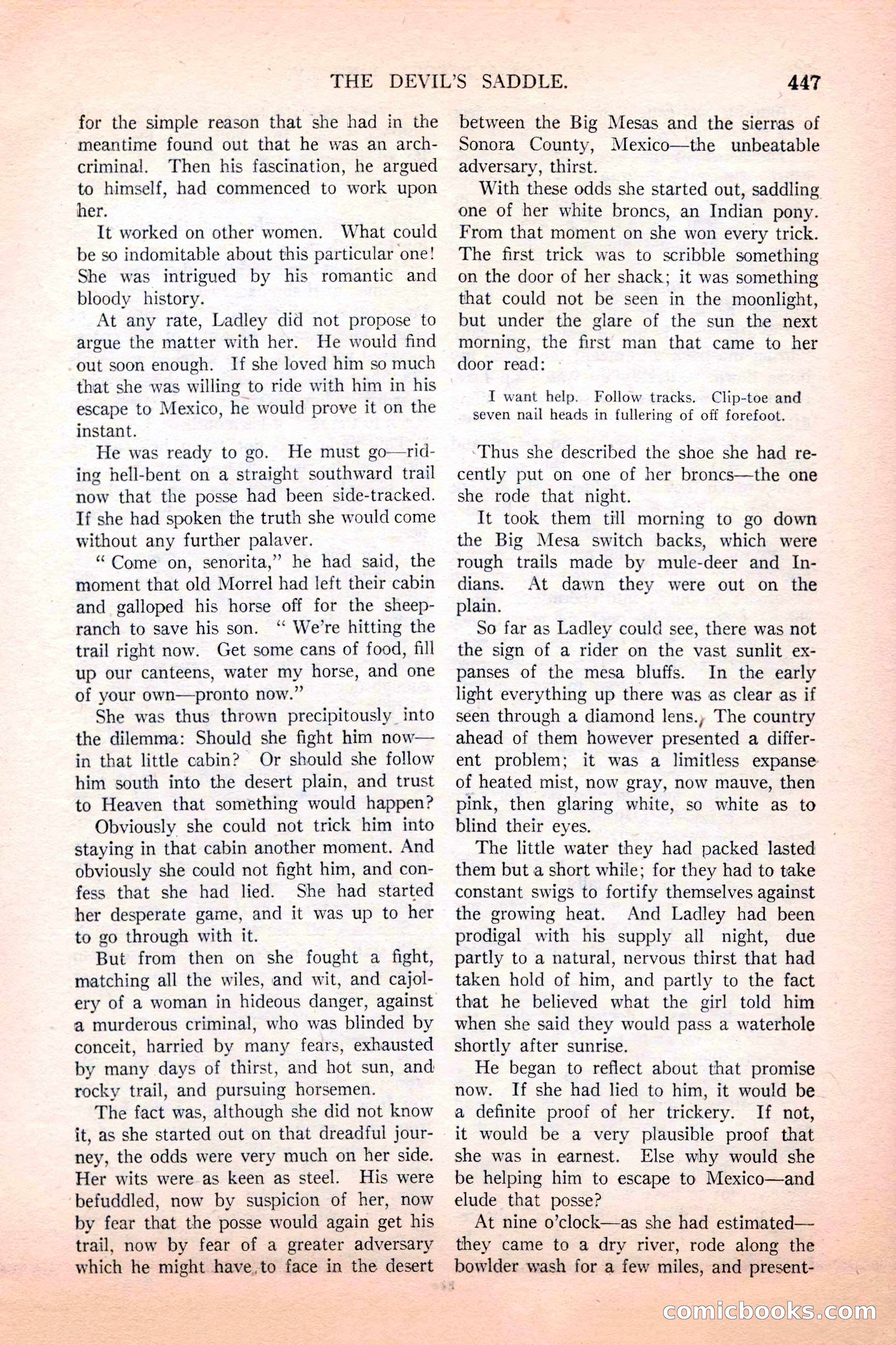
A restored page from Pulp Fiction, 1926. Page through the whole issue in the reader above.
📄 Transcribed text from this page (OCR, searchable)
Machine-transcribed from the original scan — historical spelling and the odd misread are preserved.
THE DEVIL’S SADDLE. for the simple reason that she had in the meantime found out that he was an arch- criminal. Then his fascination, he argued to himself, had commenced to work upon her. It worked on other women. What could be so indomitable about this particular one! She was intrigued by his romantic and bloody history. At any rate, Ladley did not propose to argue the matter with her. He would find out soon enough. If she loved him so much that she was willing to ride with him in his escape to Mexico, he would prove it on the instant. He was ready to go. He must go—rid- ing hell-bent on a straight southward trail now that the posse had been side-tracked. If she had spoken the truth she would come without any further palaver. “Come on, senorita,” he had said, the moment that old Morrel had left their cabin and galloped his horse off for the sheep- ranch to save his son. “ We're hitting the trail right now. Get some cans of food, fill up our canteens, water my horse, and one of your own—pronto now.” She was thus thrown precipitously into the dilemma: Should she fight him now— in that little cabin? Or should she follow him south into the desert plain, and trust to Heaven that something would happen? Obviously she could not trick him into staying in that cabin another moment. And obviously she could not fight him, and con- fess that she had lied. She had started her desperate game, and it was up to her to go through with it. But from then on she fought a fight, matching all the wiles, and wit, and cajol- ery of a woman in hideous danger, against a murderous criminal, who was blinded by conceit, harried by many fears, exhausted by many days of thirst, and hot sun, and rocky trail, and pursuing horsemen. The fact was, although she did not know it, as she started out on that dreadful jour- ney, the odds were very much on her side. Her wits were as keen as steel. His were befuddled, now by suspicion of her, now by fear that the posse would again get his trail, now by fear of a greater adversary which he might have,to face in the desert 447 between the Big Mesas and the sierras of Sonora County, Mexico—the unbeatable adversary, thirst. With these odds she started out, saddling one of her white broncs, an Indian pony. From that moment on she won every trick. The first trick was to scribble something on the door of her shack; it was something that could not be seen in the moonlight, but under the glare of the sun the next morning, the first man that came to her door read: IT want help. Follow tracks. Clip-toe and seven nail heads in fullering of off forefoot. Thus she described the shoe she had re- cently put on one of her broncs—the one she rode that night. It took them till morning to go down the Big Mesa switch backs, which were rough trails made by mule-deer and In- dians. At dawn they were out on the plain. So far as Ladley could see, there was not the sign of a rider on the vast sunlit ex- panses of the mesa bluffs. In the early light everything up there was as clear as if seen through a diamond lens., The country ahead of them however presented a differ- ent problem; it was a limitless expanse of heated mist, now gray, now mauve, then pink, then glaring white, so white as to blind their eyes. The little water they had packed lasted them but a short while; for they had to take constant swigs to fortify themselves against the growing heat. And Ladley had been prodigal with his supply all night, due partly to a natural, nervous thirst that had taken hold of him, and partly to the fact that he believed what the girl told him when she said they would pass a waterhole shortly after sunrise. He began to reflect about that promise now. If she had lied to him, it would be a definite proof of her trickery. If not, it would be a very plausible proof that she was in earnest. Else why would she be helping him to escape to Mexico—and elude that posse? At nine o’clock—as she had estimated— they came to a dry river, rode along the bowlder wash for a few miles, and present- (E00) .DOOKS ANIUCE (E)