
Pulp Fiction, 1926 · page 26 of 184
Argosy All-Story Weekly, December 4, 1926 — page 26: what you’re looking at
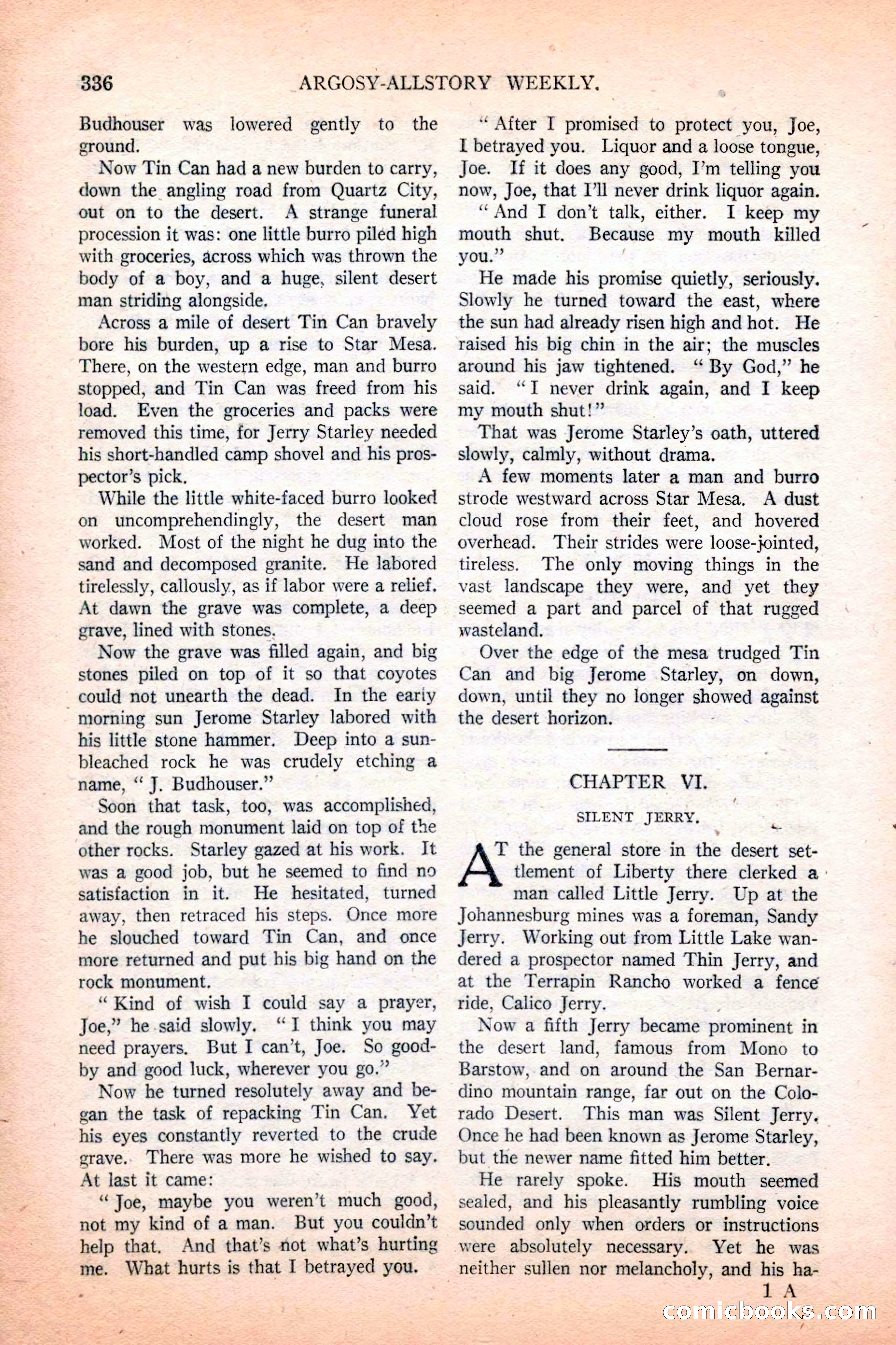
A restored page from Pulp Fiction, 1926. Page through the whole issue in the reader above.
📄 Transcribed text from this page (OCR, searchable)
Machine-transcribed from the original scan — historical spelling and the odd misread are preserved.
336 Budhouser was lowered gently to the ground. Now Tin Can had a new burden to carry, down the angling road from Quartz City, out on to the desert. A strange funeral procession it was: one little burro piled high with groceries, across which was thrown the body of a boy, and a huge, silent desert man striding alongside. Across a mile of desert Tin Can bravely bore his burden, up a rise to Star Mesa. There, on the western edge, man and burro stopped, and Tin Can was freed from his load. Even the groceries and packs were removed this time, for Jerry Starley needed his short-handled camp shovel and his pros- pector’s pick, While the little white-faced burro looked on uncomprehendingly, the desert man worked. Most of the night he dug into the sand and decomposed granite. He labored tirelessly, callously, as if labor were a relief. At dawn the grave was complete, a deep grave, lined with stones. Now the grave was filled again, and big stones piled on top of it so that coyotes could not unearth the dead. In the eariy morning sun Jerome Starley labored with his little stone hammer. Deep into a sun- bleached rock he was crudely etching a name, “‘ J. Budhouser.” Soon that task, too, was accomplished, and the rough monument laid on top of the other rocks. Starley gazed at his work. It was a good job, but he seemed to find no satisfaction in it. He hesitated, turned away, then retraced his steps. Once more he slouched toward Tin Can, and once more returned and put his big hand on the rock monument. “Kind of wish I could say a prayer, Joe,” he-said slowly. “I think you may need prayers. But I can’t, Joe. So good- by and good luck, wherever you go.” Now he turned resolutely away and be- gan the task of repacking Tin Can. Yet his eyes constantly reverted to the crude grave. There was more he wished to say. At last it came: “ Joe, maybe you weren’t much good, not my kind of a man. But you couldn’t help that, And that’s not what’s hurting me. What hurts is that I betrayed you. ARGOSY-ALLSTORY WEEKLY. ‘ After I promised to protect you, Joe, L betrayed you. Liquor and a loose tongue, Joe. If it does any good, I’m telling you now, Joe, that I’ll never drink liquor again. “And I don’t talk, either. I keep my mouth shut. Because my mouth killed you.” : He made his promise quietly, seriously. Slowly he turned toward the east, where the sun had already risen high and hot. He raised his big chin in the air; the muscles around his jaw tightened. ‘“ By God,” he said. “TI never drink again, and I keep my mouth shut!” That was Jerome Starley’s oath, uttered slowly, calmly, without drama. A few moments later a man and burro strode westward across Star Mesa, <A dust cloud rose from their feet, and hovered overhead. Their strides were loose-jointed, tireless. The only moving things in the vast landscape they were, and yet they seemed a part and parcel of that rugged wasteland. Over the edge of the mesa trudged Tin Can and big Jerome Starley, on down, down, until they no longer howe against the desert horizon. CHAPTER VI. SILENT JERRY, ~- T the general store in the desert set- tlement of Liberty there clerked a: man called Little Jerry. Up at the Johannesburg mines was a foreman, Sandy Jerry. Working out from Little Lake wan- dered a prospector named Thin Jerry, and at the Terrapin Rancho worked a fence ride, Calico Jerry. Now a fifth Jerry became prominent in the desert land, famous from Mono to Barstow, and on around the San Bernar- dino mountain range, far out on the Colo- rado Desert. This man was Silent Jerry. Once he had been known as Jerome Starley, but the newer name fitted him better. He rarely spoke. His mouth seemed sealed, and his pleasantly rumbling voice sounded only when orders or instructions were absolutely necessary. Yet he was neither sullen nor melancholy, and his ha- 1A (©) EOPMIE MOO KS /