
Pulp Fiction, 1926 · page 74 of 184
Argosy All-Story Weekly, December 4, 1926 — page 74: what you’re looking at
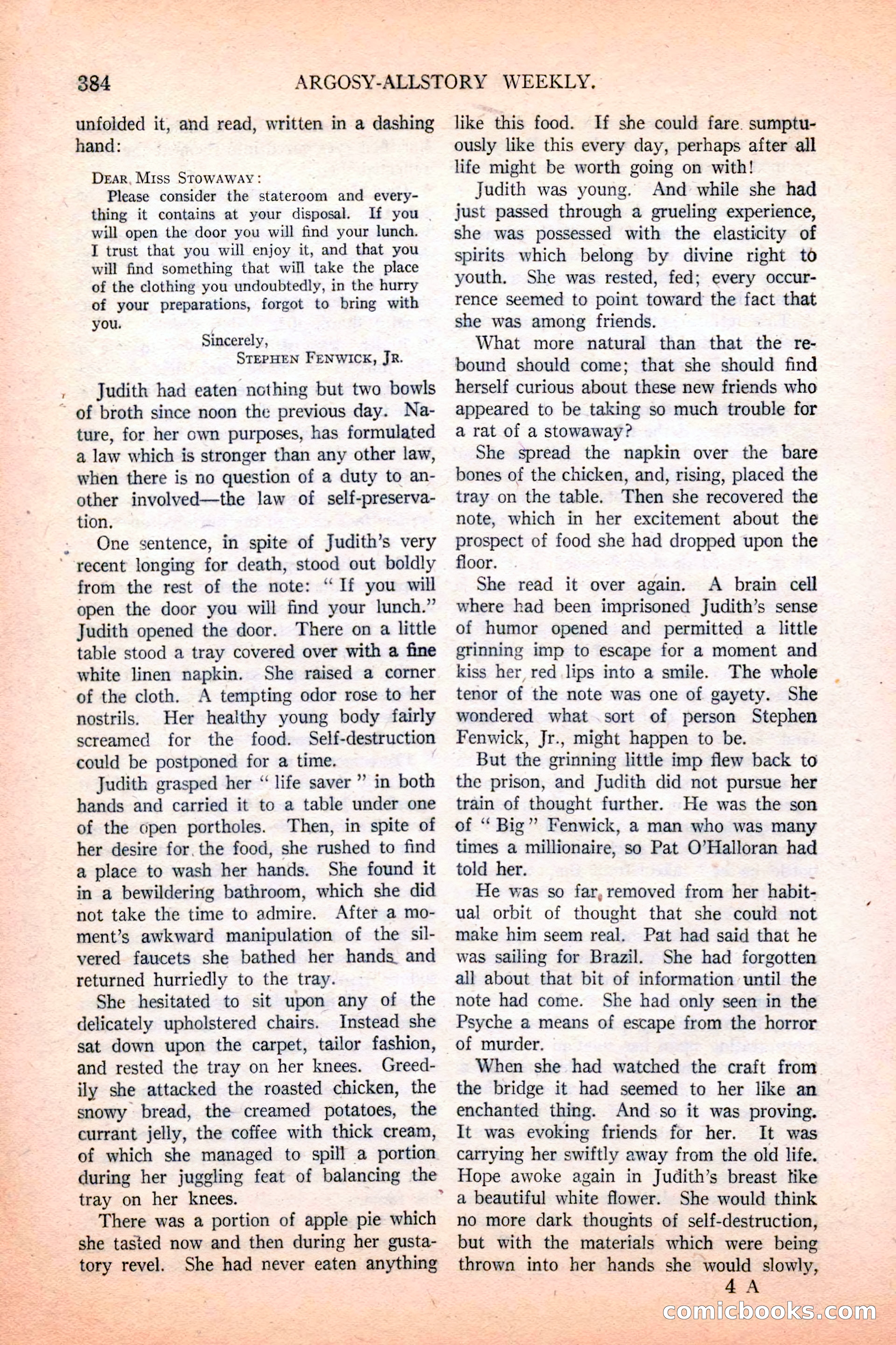
A restored page from Pulp Fiction, 1926. Page through the whole issue in the reader above.
📄 Transcribed text from this page (OCR, searchable)
Machine-transcribed from the original scan — historical spelling and the odd misread are preserved.
T of broth since noon the previous day. Na- 384 unfolded it, and read, written in a dashing hand: Dear, Miss STOWAWAY : Please consider the stateroom and every- thing it contains at your disposal. If you | will open the door you will find your lunch. I trust that you will enjoy it, and that you will find something that will take the place of the clothing you undoubtedly, in the hurry of your preparations, forgot to bring with you. | Sincerely, STEPHEN FENWICK, JR. Judith had eaten nothing but two bowls ture, for her own purposes, has formulated a law which is stronger than any other law, when there is no question of a duty to an- other involved—the law of self-preserva- tion. One sentence, in spite of Judith’s very ~ recent longing for death, stood out boldly from the rest of the note: “If you will open the door you will find your lunch.” Judith opened the door. There on a little table stood a tray covered over with a fine white linen napkin. She raised a corner of the cloth. A tempting odor rose to her nostrils. Her healthy young body fairly screamed for the food. Self-destruction could be postponed for a time. Judith grasped her “ life saver ” in both hands and carried it to a table under one of the open portholes. Then, in spite of her desire for. the food, she rushed to find a place to wash her hands. She found it in a bewildering bathroom, which she did not take the time to admire. After a mo- ment’s awkward manipulation of the sil- vered faucets she bathed her hands and returned hurriedly to the tray. She hesitated to sit upon any of the delicately upholstered chairs. Instead she sat down upon the carpet, tailor fashion, and rested the tray on her knees. Greed- ily she attacked the roasted chicken, the snowy bread, the creamed potatoes, the currant jelly, the coffee with thick cream, of which she managed to spill a portion during her juggling feat of balancing the tray on her knees. There was a portion of apple pie which she tasted now and then during her gusta- tory revel. She had never eaten anything ‘ ARGOSY-ALLSTORY WEEKLY. like this food. If she could fare. sumptu- ously like this every day, perhaps after all life might be worth going on with! Judith was young. And while she had just passed through a grueling experience, she was possessed with the elasticity of spirits which belong by divine right to youth. She was rested, fed; every occur- rence seemed to point toward the fact that she was among friends. _ What more natural than that the re- bound should come; that she should find herself curious about these new friends who appeared to be taking so much trouble for a rat of a stowaway? She spread the napkin over the bare bones of the chicken, and, rising, placed the tray on the table. Then she recovered the note, which in her excitement about the prospect of food she had dropped upon the floor. She read it over again. <A brain cell where had been imprisoned Judith’s sense of humor opened and permitted a little grinning imp to escape for a moment and kiss her red lips into a smile. The whole tenor of the note was one of gayety. She wondered what sort of person Stephen Fenwick, Jr., might happen to be. But the grinning little imp flew back to the prison, and Judith did not pursue her train of thought further. He was the son of ‘“ Big” Fenwick, a man who was many times a millionaire, so Pat O’Halloran had told her. He was so far, removed from her habit- ual orbit of thought that she could not make him seem real. Pat had said that he was sailing for Brazil. She had forgotten all about that bit of information until the note had come. She had only seen in the Psyche a means of escape from the horror of murder. When she had watched the craft from the bridge it had seemed to her like an enchanted thing. And so it was proving. It was evoking friends for her. It was carrying her swiftly away from the old life. Hope awoke again in Judith’s breast Tike a beautiful white flower. She would think no more dark thoughts of self-destruction, but with the materials which were being thrown into her hands she would slowly, } aA (©) Eomichbooks