
Pulp Fiction, 1926 · page 95 of 184
Argosy All-Story Weekly, December 4, 1926 — page 95: what you’re looking at
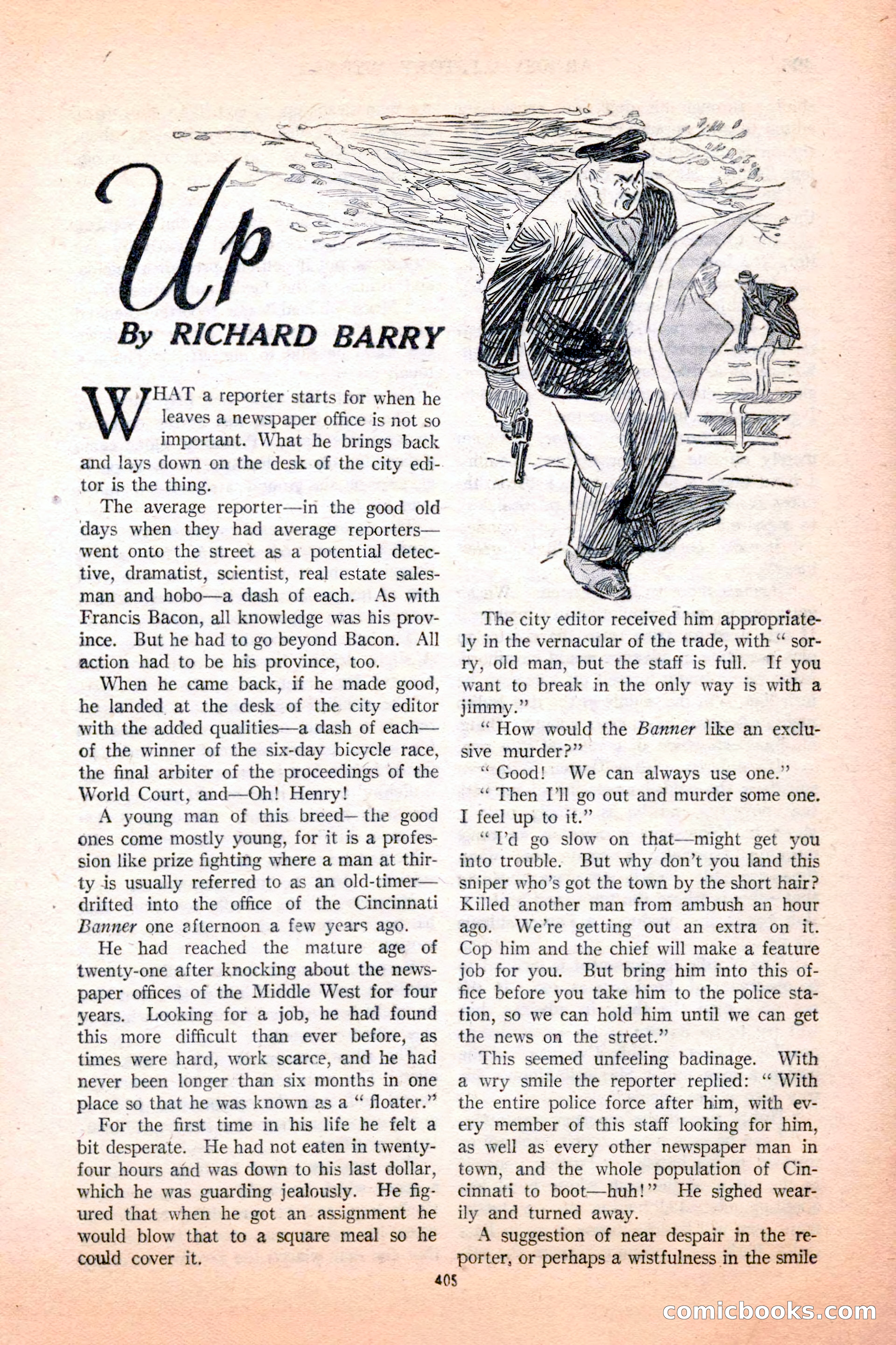
A restored page from Pulp Fiction, 1926. Page through the whole issue in the reader above.
📄 Transcribed text from this page (OCR, searchable)
Machine-transcribed from the original scan — historical spelling and the odd misread are preserved.
By RICHARD BARRY W i a reporter starts for when he leaves a newspaper office is not so important. What he brings back and lays down on the desk of the city edi- tor is the thing. The average reporter—in the good old days when they had average reporters— went onto the street as a potential detec- tive, dramatist, scientist, real estate sales- man and hobo—a dash of each. As with Francis Bacon, all knowledge was his prov- ince. But he had to go beyond Bacon. All action had to be his province, too. When he came back, if he made good, he landed at the desk of the city editor with the added qualities—a dash of each— of the winner of the six-day bicycle race, the final arbiter of the proceedings of the World Court, and—Oh! Henry! A young man of this breed— the good ones come mostly young, for it is a profes- sion like prize fighting where a man at thir- ty is usually referred to as an old-timer— drifted into the office of the Cincinnati Banner one afternoon a few years ago. He had reached the mature age of twenty-one after knocking about the news- paper offices of the Middle West for four years. Looking for a job, he had found this more difficult than ever before, as times were hard, work scarce, and he had never been longer than six months in one place so that he was known as a “ floater.” For the first time in his life he felt a bit desperate. He had not eaten in twenty- four hours and was down to his last dollar, which he was guarding jealously. He fig- ured that when he got an assignment he would blow that toe a square meal so he could cover it. The city editor received him appropriate- ly in the vernacular of the trade, with “ sor- ry, old man, but the staff is full. If you want to break in the only way is with a jimmy.” “ How would the Banner like an exclu- sive murder?” “Good! We can always use one.” “Then I'll go out and murder some one. I feel up to it.” “T’d go slow on that—might get you into trouble. But why don’t you land this sniper who’s got the town by the short hair? Killed another man from ambush an hour ago. Cop him and the chief will make a feature job for you. But bring him into this of- fice before you take him to the police sta- tion, so we can hold him until we can get the news on the street.” This seemed unfeeling badinage. With a wry smile the reporter replied: “ With the entire police force after him, with ev- ery member of this staff looking for him, as well as every other newspaper man in tewn, and the whole population of Cin- cinnati to boot—huh!” He sighed wear- ily and turned away. A suggestion of near despair in the re- porter, or perhaps a wistfulness in the smile 405 We're getting out an extra on it. com boo! = - mo A - ~ “( E(@) | : > -| ‘ %2 * >