
Pulp Fiction, 1926 · page 98 of 184
Argosy All-Story Weekly, December 4, 1926 — page 98: what you’re looking at
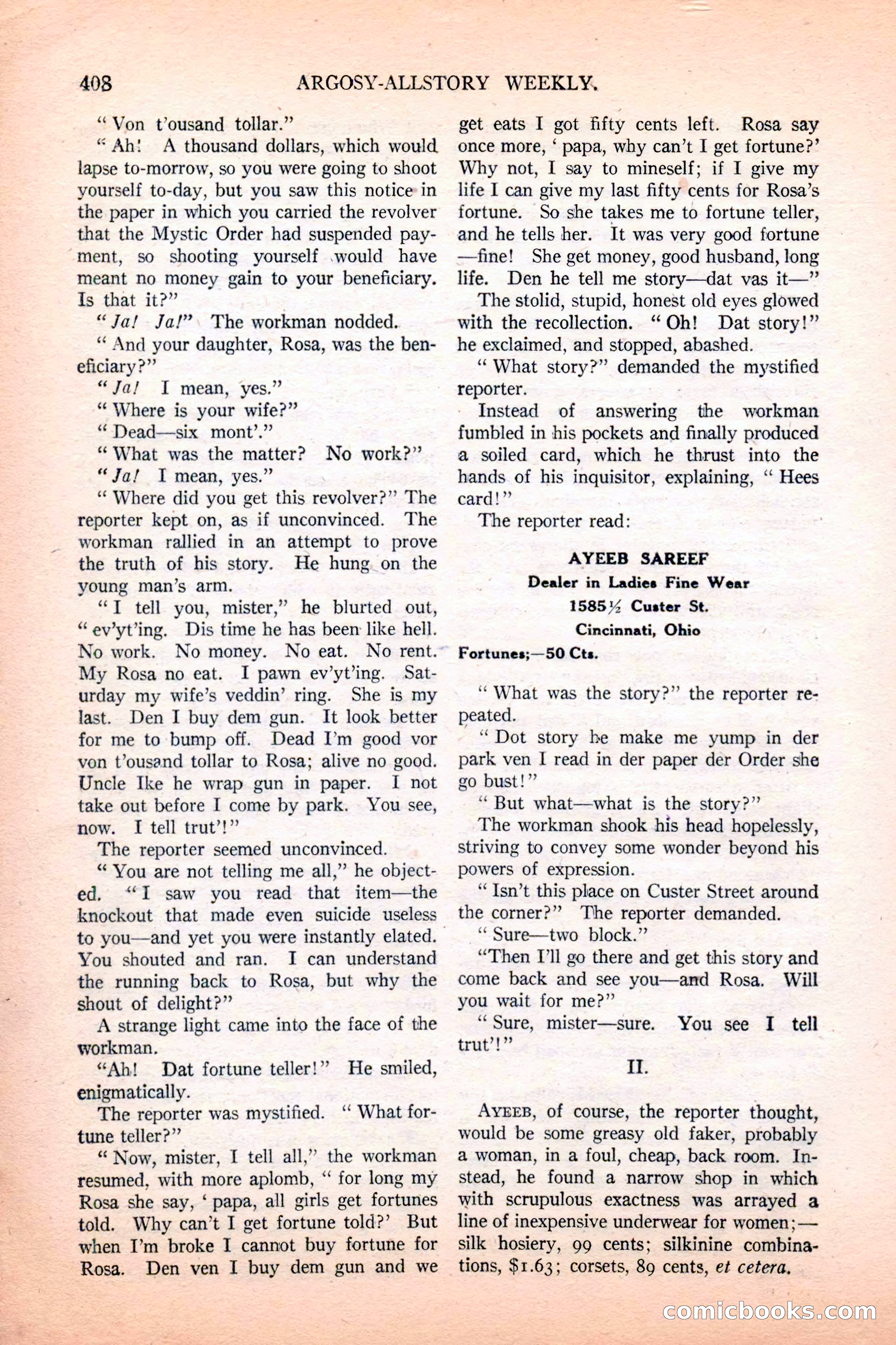
A restored page from Pulp Fiction, 1926. Page through the whole issue in the reader above.
📄 Transcribed text from this page (OCR, searchable)
Machine-transcribed from the original scan — historical spelling and the odd misread are preserved.
408 “Von t’ousand tollar.” “Ah! A thousand dollars, which would lapse to-morrow, so you were going to shoot yourself to-day, but you saw this notice in the paper in which you carried the revolver that the Mystic Order had suspended pay- ment, so shooting yourself would have meant no money gain to your beneficiary. Is that it?” “Ja! Jal’. The workman nodded. “ And your daughter, Rosa, was the ben- eficiary?”’ “Ja! I mean, yes.” “Where is your wife?” “ Dead—six mont’.” “What was the matter? “Ja! I mean, yes.” “Where did you get this revolver?’”’ The reporter kept on, as if unconvinced. The workman rallied in an attempt to prove the truth of his story. He hung on the young man’s arm. “TI tell you, mister,” he blurted out, “ey’yt’ing. Dis time he has been like hell. No work. No money. No eat. No rent. My Rosa no eat. I pawn ev’yt’ing. Sat- urday my wife’s veddin’ ring. She is my last. Den I buy dem gun. It look better for me to bump off. Dead I’m good vor von t’ousand tollar to Rosa; alive no good. Uncle Ike he wrap gun in paper. I not take out before I come by park. You see, now. I tell trut’!” The reporter seemed unconvinced. “ You are not telling me all,” he object- ed, “I saw you read that item—the knockout that made even suicide useless No work?” to you—and yet you were instantly elated. You shouted and ran. I can understand the running back to Rosa, but why the shout of delight?” A strange light came into the face of the workman. “Ah! Dat fortune teller!” enigmatically. The reporter was mystified. ‘‘ What for- tune teller?” “ Now, mister, I tell all,” the workman resumed, with more aplomb, “ for long my Rosa she say, ‘ papa, all girls get fortunes told. Why can’t I get fortune told?’ But when I’m broke I cannot buy fortune for Rosa. Den ven I buy dem gun and we He smiled, ARGOSY-ALLSTORY WEEKLY, get eats I got fifty cents left. Rosa say once more, ‘ papa, why can’t I get fortune?’ Why not, I say to mineself; if I give my life I can give my last fifty cents for Rosa’s fortune. So she takes me to fortune teller, and he tells her. It was very good fortune —fine! She get money, good husband, long life. Den he tell me story—dat vas it—”’ The stolid, stupid, honest old eyes glowed with the recollection. ‘Oh! Dat story!” he exclaimed, and stopped, abashed. “What story?” demanded the mystified reporter. Instead of answering the workman fumbled in his pockets and finally produced a soiled card, which he thrust into the hands of his inquisitor, explaining, “ Hees card!” The reporter read: AYEEB SAREEF Dealer in Ladies Fine Wear 1585% Custer St. Cincinnati, Ohio Fortunes;—50 Cts. ‘What was the story?” the reporter re- peated. ‘Dot story he make me yump in der park ven I read in der paper der Order she go bust!” ‘“ But what—what is the story?” The workman shook his head hopelessly, striving to convey some wonder beyond his powers of expression. ‘““Isn’t this place on Custer Street around the corner?” The reporter demanded. ‘“ Sure—two block.” “Then [ll go there and get this story and come back and see you—and Rosa. Will you wait for me?” ‘“‘ Sure, mister—sure. trut’!” You see I tell IT. AYEEB, of course, the reporter thought, would be some greasy old faker, probably a woman, in a foul, cheap, back room. In- stead, he found a narrow shop in which with scrupulous exactness was arrayed a line of inexpensive underwear for women;— silk hosiery, 99 cents; silkinine combina- tions, $1.63; corsets, 89 cents, et cetera. v.OOK (C@) AMI (E@)