
Pulp Fiction, 1927 · page 14 of 168
Argosy All-Story Weekly, February 12, 1927 — page 14: what you’re looking at
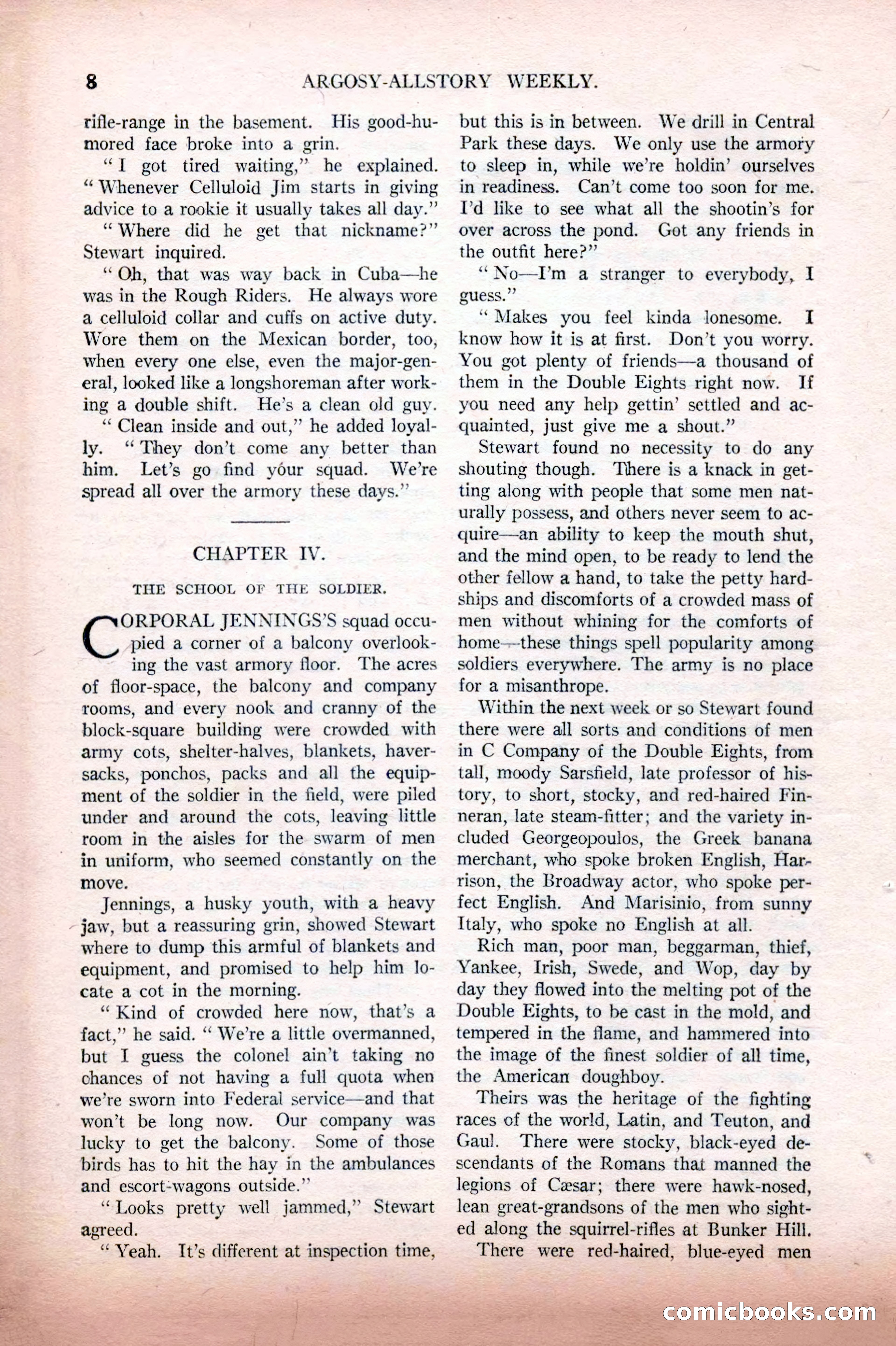
A restored page from Pulp Fiction, 1927. Page through the whole issue in the reader above.
📄 Transcribed text from this page (OCR, searchable)
Machine-transcribed from the original scan — historical spelling and the odd misread are preserved.
8 ARGOSY-ALLSTORY WEEKLY. rifle-range in the basement. His good-hu- mored face broke into a grin. “JT got tired waiting,’ he explained. “Whenever Celluloid Jim starts in giving advice to a rookie it usually takes all day.” “Where did he get that nickname?” Stewart inquired. “Oh, that was way back in Cuba—he was in the Rough Riders. He always wore a celluloid collar and cuffs on active duty. Wore them on the Mexican border, too, when every one else, even the major-gen- eral, looked like a longshoreman after work- ing a double shift. He’s a clean old guy. ‘““ Clean inside and out,” he added loyal- ly. “They don’t come any better than him. Let’s go find your squad. We're spread all over the armory these days.” CHAPTER IV. THE SCHOOL OF THE SOLDIER. ORPORAL JENNINGS’S squad occu- pied a corner of a balcony overlook- ing the vast armory floor. The acres of floor-space, the balcony and company rooms, and every nook and cranny of the block-square building were crowded with army cots, shelter-halves, blankets, haver- sacks, ponchos, packs and all the equip- ment of the soldier in the field, were piled under and around the cots, leaving little room in the aisles for the swarm of men in uniform, who seemed constantly on the move. Jennings, a husky youth, with a heavy - jaw, but a reassuring grin, showed Stewart where to dump this armful of blankets and equipment, and promised to help him lo- cate a cot in the morning. “ Kind of crowded here now, that’s a fact,” he said. ‘ We’re a little overmanned, but I guess the colonel ain’t taking no chances of not having a full quota when we’re sworn into Federal service—and that won’t be long now. Our company was lucky to get the balcony. Some of those birds has to hit the hay in the ambulances and escort-wagons outside.” “Looks pretty well jammed,” Stewart agreed. “Yeah. It’s different at inspection time, > 4 but this is in between. We drill in Central Park these days. We only use the armory to sleep in, while we’re holdin’ ourselves in readiness. Can’t come too soon for me. I'd like to see what all the shootin’s for over across the pond. Got any friends in the outfit here?” ‘““No—I’m a stranger to everybody, I guess.” ‘Makes you feel kinda lonesome. I know how it is at first. Don’t you worry. You got plenty of friends—a thousand of them in the Double Eights right now. If you need any help gettin’ settled and ac- quainted, just give me a shout.” Stewart found no necessity to do any shouting though. Tihere is a knack in get- ting along with people that some men nat- urally possess, and others never seem to ac- quire—an ability to keep the mouth shut, and the mind open, to be ready to lend the other fellow a hand, to take the petty hard- ships and discomforts of a crowded mass of men without whining for the comforts of home—these things spell popularity among soldiers everywhere. The army is no place for a misanthrope. Within the next week or so Stewart found there were all sorts and conditions of men in C Company of the Double Eights, from tall, moody Sarsfield, late professor of his- tory, to short, stocky, and red-haired Fin- neran, late steam-fitter; and the variety in- cluded Georgeopoulos, the Greek banana merchant, who spoke broken English, Har- rison, the Broadway actor, who spoke per- fect English. And Marisinio, from sunny Italy, who spoke no English at all. Rich man, poor man, beggarman, thief, Yankee, Irish, Swede, and Wop, day by day they flowed into the melting pot of the Double Eights, to be cast in the mold, and tempered in the flame, and hammered into the image of the finest soldier of all time, the American doughboy. Theirs was the heritage of the fighting races of the world, Latin, and Teuton, and Gaul. There were stocky, black-eyed de- scendants of the Romans that manned the legions of Caesar; there were hawk-nosed, lean great-grandsons of the men who sight- ed along the squirrel-rifles at Bunker Hill. There were red-haired, blue-eyed men ~ z Soe a MIS ee ne ee : % —— — “f wt : z et al 4 _ > e as 4 ~~ i b> oO as eo é > - pe » aos en pe eS ae ee a eS tg Se —_ ~