
Pulp Fiction, 1927 · page 17 of 168
Argosy All-Story Weekly, February 12, 1927 — page 17: what you’re looking at
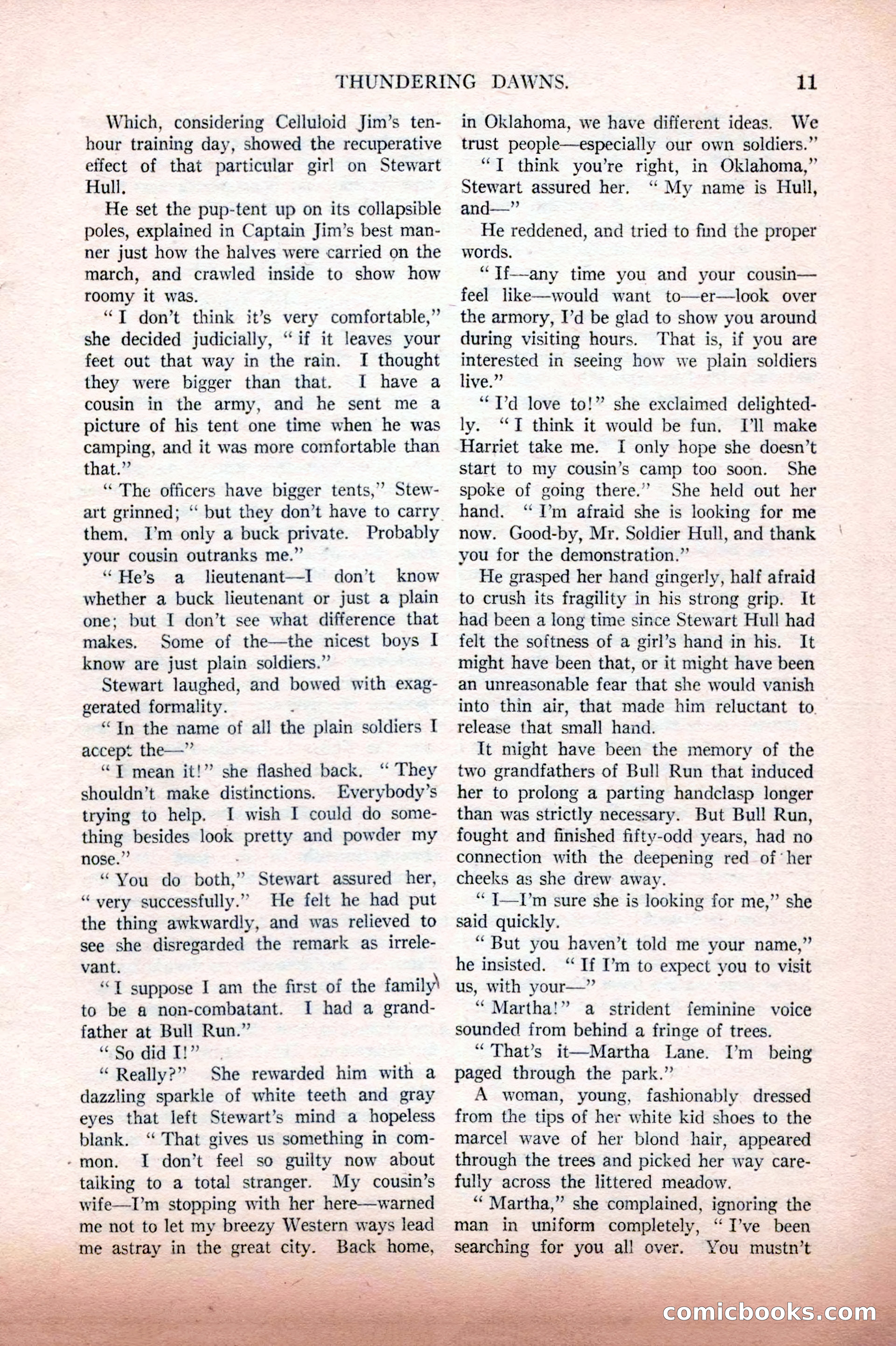
A restored page from Pulp Fiction, 1927. Page through the whole issue in the reader above.
📄 Transcribed text from this page (OCR, searchable)
Machine-transcribed from the original scan — historical spelling and the odd misread are preserved.
THUNDERING DAWNS. 11 Which, considering Celluloid Jim’s ten- hour training day, showed the recuperative effect of that particular girl on Stewart Hull, He set the pup-tent up on its collapsible poles, explained in Captain Jim’s best man- ner just how the halves were carried on the march, and crawled inside to show how roomy it was. “T don’t think it’s very comfortable,” she decided judicially, “if it leaves your feet out that way in the rain. I thought they were bigger than that. I have a cousin in the army, and he sent me a picture of his tent one time when he was camping, and it was more comfortable than that.” “ The officers have bigger tents,” Stew- art grinned; “ but they don’t have to carry them, I’m only a buck private. Probably your cousin outranks me.” — “He’s a lieutenant—I don’t know whether a buck lieutenant or just a plain one; but I don’t see what difference that makes. Some of the—the nicest boys I know are just plain soldiers.” Stewart laughed, and bowed with exag- gerated formality. “Tn the name of all the plain soldiers I accept the—” “T mean it!” she flashed back. ‘“ They shouldn’t make distinctions. Everybody’s trying to help. I wish I could do some- thing besides look pretty and powder my nose.’ “You do both,’ ” Stewart assured her, “very successfully.” He felt he had put the thing awkwardly, and was relieved to see she disregarded the remark as irrele- vant. ‘“T suppose I am the first of the family) to be a non-combatant. I had a grand- father at Bull Run.” “So'did I!” : “ Really?” She rewarded him with a dazzling sparkle of white teeth and gray eyes that left Stewart’s mind a hopeless blank. “ That gives us something in com- -mon. I don’t feel so guilty now about taiking to a total stranger. My cousin’s wife—I’m stopping with her here—warned me not to let my breezy Western ways lead _ me ES in the great Le Back some, <a for you al! over. in Oklahoma, we have different ideas. We trust people—especially our own soldiers.”’ “T think you’re right, in Oklahoma,” Stewart assured her. “ My name is Hull, and—”’ He reddened, and tried to find the proper words. “If—any time you and your cousin— feel like—would want to—er—look over the armory, I’d be glad to show you around during visiting hours. That is, if you are interested in seeing how we plain soldiers live.” ‘Td love to!” she exclaimed delighted- ly. “TI think it would be fun, I'll make Harriet take me. I only hope she doesn’t Start to my cousin’s camp too soon. She spoke of going there.” She held out her hand. “I’m afraid she is looking for me now. Good-by, Mr. Soldier Hull, and thank you for the demonstration.” He grasped her hand gingerly, half afraid to crush its fragility in his strong grip. It had been a long time since Stewart Hull had felt the softness of a girl’s hand in his. It might have been that, or it might have been an unreasonable fear that she would vanish into thin air, that made him reluctant to. release that small hand. It might have been the memory of the two grandfathers of Bull Run that induced her to prolong a parting handclasp longer than was strictly necessary. But Bull Run, fought and finished fifty-odd years, had no connection with the deepening red of’ her cheeks as she drew away. ‘“ J—I’m sure she is looking for me,” she said quickly. “But you haven’t told me your name,” he insisted. ‘If I’m to expect you to visit us, with your—” “Martha!” a strident feminine voice sounded from behind a fringe of trees. “That’s it—Martha Lane. I’m _ being paged through the park.” A woman, young, fashionably dressed from the tips of her white kid shoes to the marcel wave of her blond hair, appeared through the trees and picked her way care- fully across the littered meadow. “‘ Martha,” she complained, ignoring the man in uniform completely, “I’ve been You mustn’t = Fr eGmicbeote com