
Pulp Fiction, 1927 · page 33 of 168
Argosy All-Story Weekly, February 12, 1927 — page 33: what you’re looking at
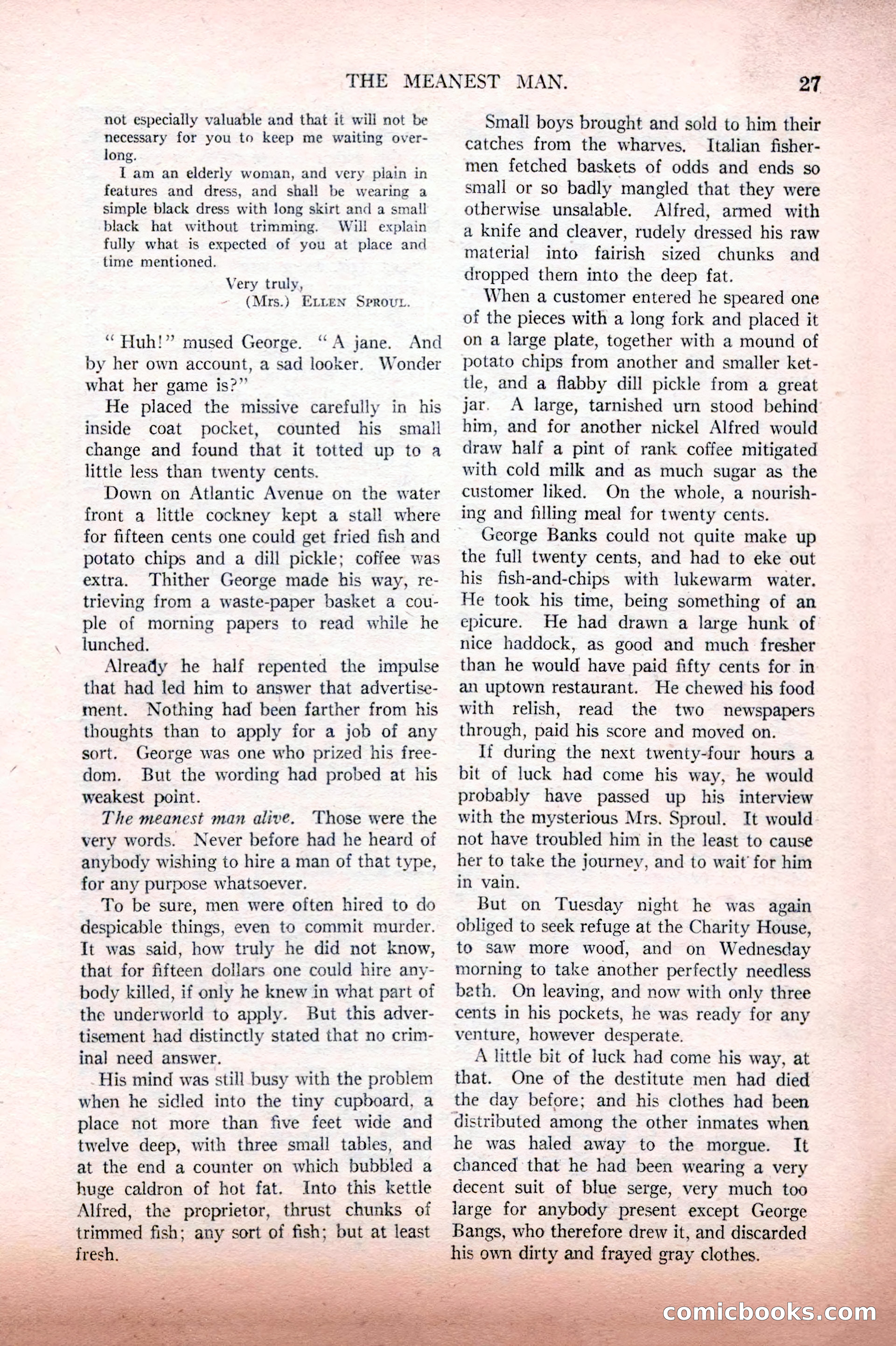
A restored page from Pulp Fiction, 1927. Page through the whole issue in the reader above.
📄 Transcribed text from this page (OCR, searchable)
Machine-transcribed from the original scan — historical spelling and the odd misread are preserved.
THE MEANEST not especially valuable and that it will not be necessary for you to keep me waiting over- long. 1 am an elderly woman, and very plain in features and dress, and shall be wearing a simple black dress with long skirt and a small black hat without trimming. Will explain fully what is expected of you at place and time mentioned. Very truly, (Mrs.) ELten Sprovt. “Huh!” mused George. “A jane. And by her own account, a sad looker. Wonder what her game is?” He placed the missive carefully in his inside coat pocket, counted his small change and found that it totted up to a little less than twenty cents. Down on Atlantic Avenue on the water front a little cockney kept a stall where for fifteen cents one could get fried fish and potato chips and a dill pickle; coffee was extra. hither George made his way, re- trieving from a waste-paper basket a cou- ple of morning papers to read while he lunched. Already he half repented the impulse that had led him to answer that advertise- ment. Nothing had been farther from his thoughts than to apply for a job of any sort. George was one who prized his free- dom. But the wording had probed at his weakest point. The meanest man alive. Those were the very words. Never before had he heard of anybody wishing to hire a man of that type, for any purpose whatsoever. To be sure, men were often hired to do despicable things, even to commit murder. It was said, how truly he did not know, that for fifteen dollars one could hire any- body killed, if only he knew in what part of the underworld to apply. But this adver- tisement had distinctly stated that no crim- inal need answer. -His mind was still busy with the problem when he sidled into the tiny cupboard, a place not more than five feet wide and twelve deep, with three small tables, and at the end a counter on which bubbled a huge caldron of hot fat. Into this kettle Alfred, the preprietor, thrust chunks of trimmed fish; any sort of fish; but at least his 9 + “= 27 Small boys brought and sold to him their catches from the wharves, Italian fisher- men fetched baskets of odds and ends so small or so badly mangled that they were otherwise unsalable. Alfred, armed with a knife and cleaver, rudely dressed his raw material into fairish sized chunks and dropped thern into the deep fat. When a customer entered he speared one of the pieces with a long fork and placed it on a large plate, together with a mound of potato chips from another and smaller ket- tle, and a flabby dill pickle from a great jar. A large, tarnished urn stood behind him, and for another nickel Alfred would draw half a pint of rank coffee mitigated with cold milk and as much sugar as the customer liked. On the whole, a nourish- ing and filling meal for twenty cents. George Banks could not quite make up the full twenty cents, and had to eke out his fish-and-chips with lukewarm water. He took his time, being something of an epicure. He had drawn a large hunk of nice haddock, as good and much fresher than he would have paid fifty cents for in an uptown restaurant. He chewed his food with relish, read the two newspapers through, paid his score and moved on. If during the next twenty-four hours a bit of luck had come his way, he would probably have passed up his interview MAN. with the mysterious Mrs. Sproul. It would not have troubled him in the least to cause her to take the journey, and to wait’ for him in vain. But on Tuesday night he was again obliged to seek refuge at the Charity House, to saw more wood, and on Wednesday morning to take another perfectly needless beth. On leaving, and now with only three cents in his pockets, he was ready for any venture, however desperate. A little bit of luck had come his way, at that. One of the destitute men had died the day before; and his clothes had been distributed among the other inmates when he was haled away to the morgue. It chanced that he had been wearing a very decent suit of blue serge, very much too large for anybody present except George Bangs, who therefore drew it, and discarded frayed Sn ene < oe Ee a gray clothes.