
Pulp Fiction, 1927 · page 41 of 168
Argosy All-Story Weekly, February 12, 1927 — page 41: what you’re looking at
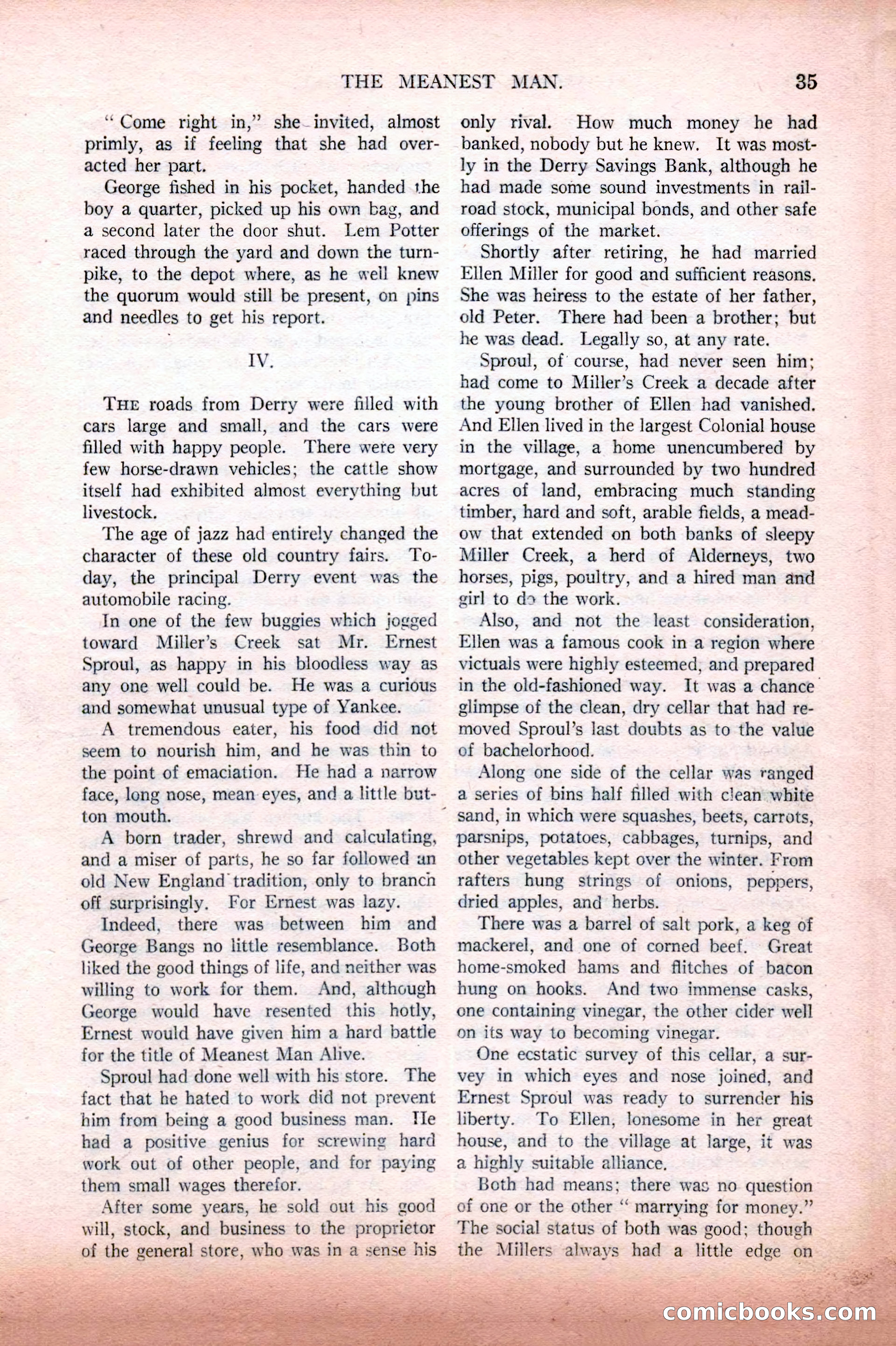
A restored page from Pulp Fiction, 1927. Page through the whole issue in the reader above.
📄 Transcribed text from this page (OCR, searchable)
Machine-transcribed from the original scan — historical spelling and the odd misread are preserved.
THE MEANEST MAN. “Come right in,’ she_invited, almost primly, as if feeling that she had over- acted her part. George fished in his pocket, handed the boy a quarter, picked up his own bag, and a second later the door shut. Lem Potter raced through the yard and down the turn- pike, to the depot where, as he well knew the quorum would still be present, on pins and needles to get his report. IV. THe roads from Derry were filled with cars large and small, and the cars were filled with happy people. There were very few horse-drawn vehicles; the cattle show itself had exhibited almost everything but livestock. The age of jazz had entirely changed the character of these old country fairs. To- day, the principal Derry event was the automobile racing. In one of the few buggies which jogged toward Miller’s Creek sat Mr. Ernest Sproul, as happy in his bloodless way as any one well could be. He was a curious and somewhat unusual type of Yankee. A tremendous eater, his food did not seem to nourish him, and he was thin to the point of emaciation. He had a narrow face, long nose, mean eyes, and a little but- ton mouth. A born trader, shrewd and calculating, and a miser of parts, he so far followed an old New England tradition, only to branch off surprisingly. For Ernest was lazy. Indeed, there was between him and George Bangs no little resemblance. Both liked the good things of life, and neither was willing to work for them. And, although George would have resented this hotly, Ernest would have given him a hard battle for the title of Meanest Man Alive. 3 Sproul had done well with his store. The fact that he hated to work did not prevent him from being a good business man. Tle had a positive genius for screwing hard work out of other people, and for paying them small wages therefor. After some years, he sold out his good will, stock, and business to the proprietor os the general store, who was in a sense his 35 only rival. How much money he had banked, nobody but he knew. It was most- ly in the Derry Savings Bank, although he had made some sound investments in rail- road stock, municipal bonds, and other safe offerings of the market. Shortly after retiring, he had married Ellen Miller for good and sufficient reasons, She was heiress to the estate of her father, old Peter. There had been a brother; but he was dead. Legally so, at any rate. Sproul, of course, had never seen him; had come to Miller’s Creek a decade after the young brother of Ellen had vanished. And Ellen lived in the largest Colonial house in the village, a home unencumbered by mortgage, and surrounded by two hundred acres of land, embracing much standing timber, hard and soft, arable fields, a mead- ow that extended on both banks of sleepy Miller Creek, a herd of Alderneys, two horses, pigs, poultry, and a hired man and girl to do the work. Also, and not the least consideration, Ellen was a famous cook in a region where victuals were highly esteemed, and prepared in the old-fashioned way. It was a chance glimpse of the clean, dry cellar that had re- moved Sproul’s last doubts as to the value of bachelorhood. Along one side of the cellar was ranged a series of bins half filled with clean white ~ sand, in which were squashes, beets, carrots, parsnips, potatoes, cabbages, turnips, and other vegetables kept over the winter. From rafters hung strings of onions, peppers, dried apples, and herbs. _ There was a barrel of salt pork, a keg of mackerel, and one of corned beef. Great home-smoked hams and flitches of bacon hung on hooks. And two immense casks, one containing vinegar, the other cider well on its way to becoming vinegar. One ecstatic survey of this cellar, a sur- vey in which eyes and nose joined, and Ernest Sproul was ready to surrender his liberty. To Ellen, lonesome in her great house, and to the village at large, it was a highly suitable alliance, Both had means; there was no question of one or the other “ marrying for money.” The social status of both was good; though the Millers sears had a little — ge = _ <x eo oF ¢, r ee — aa" = — Fnte$ — yy = - se * Bes Lass = a — =a rz are ~~ Ss ae =¥ ye et eos = ay ee = o a= a 7 Sy te ——— ee = oe *— = a Se a bes. - ee —- i, <x = LS = a > —— . ~ ~ x2 o> - ri a aaa = ECORICRGOLe com