
Pulp Fiction, 1927 · page 49 of 168
Argosy All-Story Weekly, February 12, 1927 — page 49: what you’re looking at
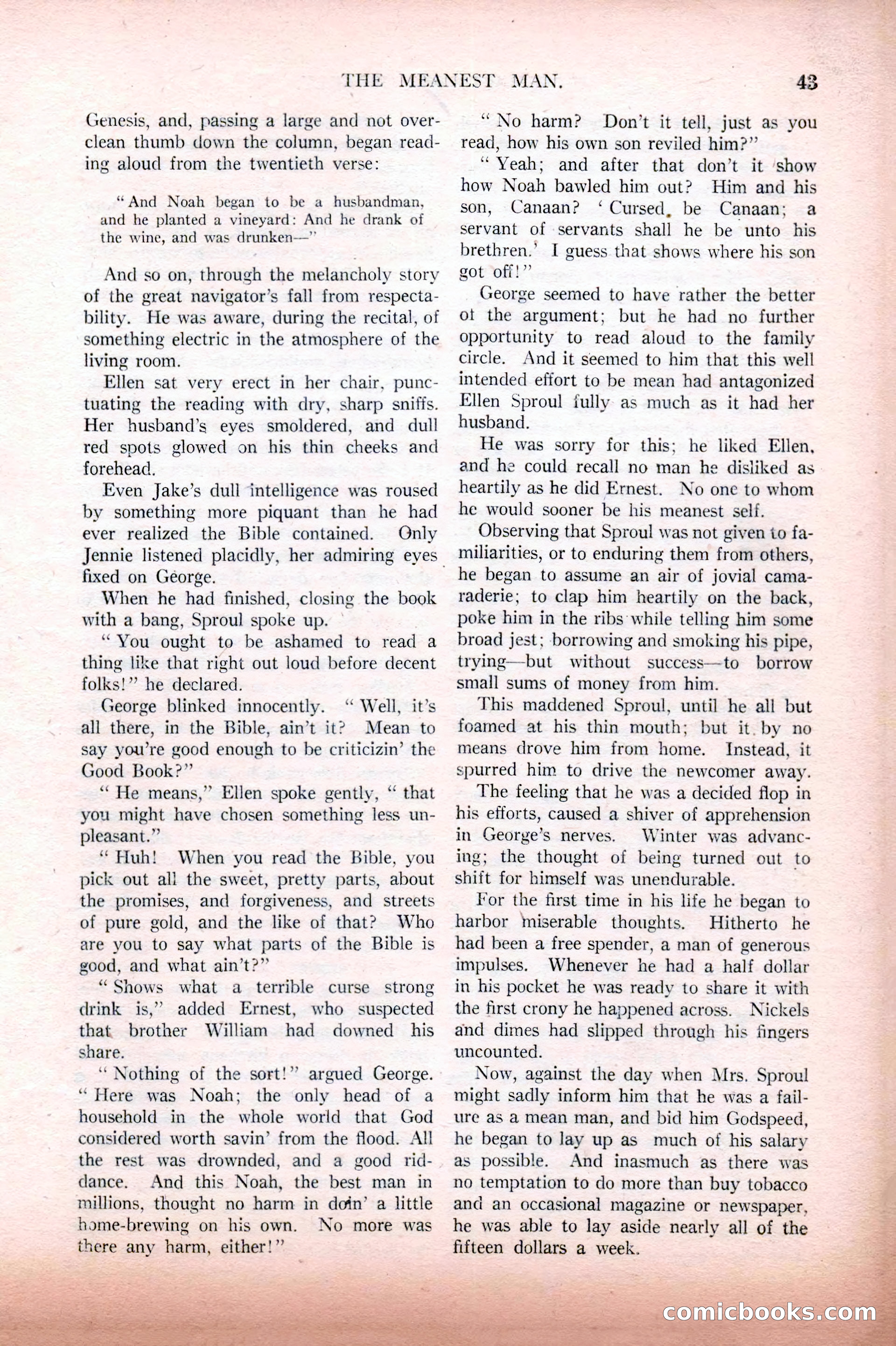
A restored page from Pulp Fiction, 1927. Page through the whole issue in the reader above.
📄 Transcribed text from this page (OCR, searchable)
Machine-transcribed from the original scan — historical spelling and the odd misread are preserved.
THE MEANEST Genesis, and, passing a large and not over- clean thumb down the column, began read- ing aloud from the twentieth verse: “And Noah began to be a husbandman, and he planted a vineyard: And he drank of the wine, and was drunken—”’ And so on, through the melancholy story of the great navigator’s fall from respecta- bility. He was aware, during the recital, of something electric in the atmosphere of the living room. Ellen sat very erect in her chair, punc- tuating the reading with dry, sharp sniffs. Her husband’s eyes smoldered, and dull red spots glowed on his thin cheeks and forehead. Even Jake’s dull intelligence was roused by something more piquant than he had ever realized the Bible contained. Only Jennie listened placidly, her admiring eyes” fixed on George. When he had finished, closing the book with a bang, Sproul spoke up. — “You ought to be ashamed to read a thing like that right out loud before decent folks!” he declared. George blinked innocently. ‘‘ Well, it’s all there, in the Bible, ain’t it? Mean to say you’re good enough to be criticizin’ the Good Book?” ‘“‘ He means,” Ellen spoke gently, “ that you might have chosen something less un- pleasant.” “ Huh! When you read the Bible, you pick out all the sweet, pretty parts, about the promises, and forgiveness, and streets of pure gold, and the like of that? Who are you to say what parts of the Bible is good, and what ain’t?”’ “Shows what a terrible curse strong drink is,” added Ernest, who suspected that brother William had downed his share. ‘Nothing of the sort!” argued George. “ Here was Noah; the only head of a household in the whole world that God considered worth savin’ from the flood. All the rest was drownded, and a good rid- dance. And this Noah, the best man in millions, thought no harm in doin’ a little home-brewing on his own. No more was there any harm, either!” te > » 2 So a me : : a Mn ee re eS > A a oe - = ~. = ors ae gt a ee gg NS Ses a oe nde eo — . Pana hl ed ora rom pee Fx ere ay al a TE a Op ae ta Cee pee = ‘¢ 2g i —= Oe ot ee ae “No harm? Don’t it tell, just as you read, how his own son reviled him?” “Yeah; and after that don’t it ‘show how Noah bawled him out? Him and his son, Canaan? ‘ Cursed, be Canaan; a servant of servants shall he be unto his brethren.’ I guess that shows where his son got off!” George seemed to have rather the better ot the argument; but he had no further opportunity to read aloud to the family circle. And it seemed to him that this well intended effort to be mean had antagonized Ellen Sproul fully as much as it had her husband. He was sorry for this; he liked Ellen, and he could recall no man he disliked as heartily as he did Ernest. No one to whom he would sooner be his meanest self. Observing that Sproul was not given to fa- miliarities, or to enduring them from others, he began to assume an air of jovial cama- raderie; to clap him heartily on the back, poke him in the ribs while telling him some broad jest; borrowing and smoking his pipe, trying—but without success—to borrow small sums of money from him. This maddened Sproul, until he all but foamed at his thin mouth; but it. by no means drove him from home. Instead, it spurred him to drive the newcomer away. The feeling that he was a decided flop in his efforts, caused a shiver of apprehension in George’s nerves. Winter was advanc- ing; the thought of being turned out to shift for himself was unendurable. : For the first time in his life he began to harbor miserable thoughts. Hitherto he had been a free spender, a man of generous impulses. Whenever he had a half dollar in his pocket he was ready to share it with the first crony he happened across. Nickels and dimes had slipped through his fingers uncounted. Now, against the day when Mrs. Sproul might sadly inform him that he was a fail- ure as a mean man, and bid him Godspeed, he began to lay up as_ much of his salary as possible. And inasmuch as there was no temptation to do more than buy tobacco and an occasional magazine or newspaper, he was able to lay aside nearly all of the fifteen dollars a week. \ Pa’ im ‘ ed BR Dad of) oA a. rat