
Pulp Fiction, 1927 · page 64 of 168
Argosy All-Story Weekly, February 12, 1927 — page 64: what you’re looking at
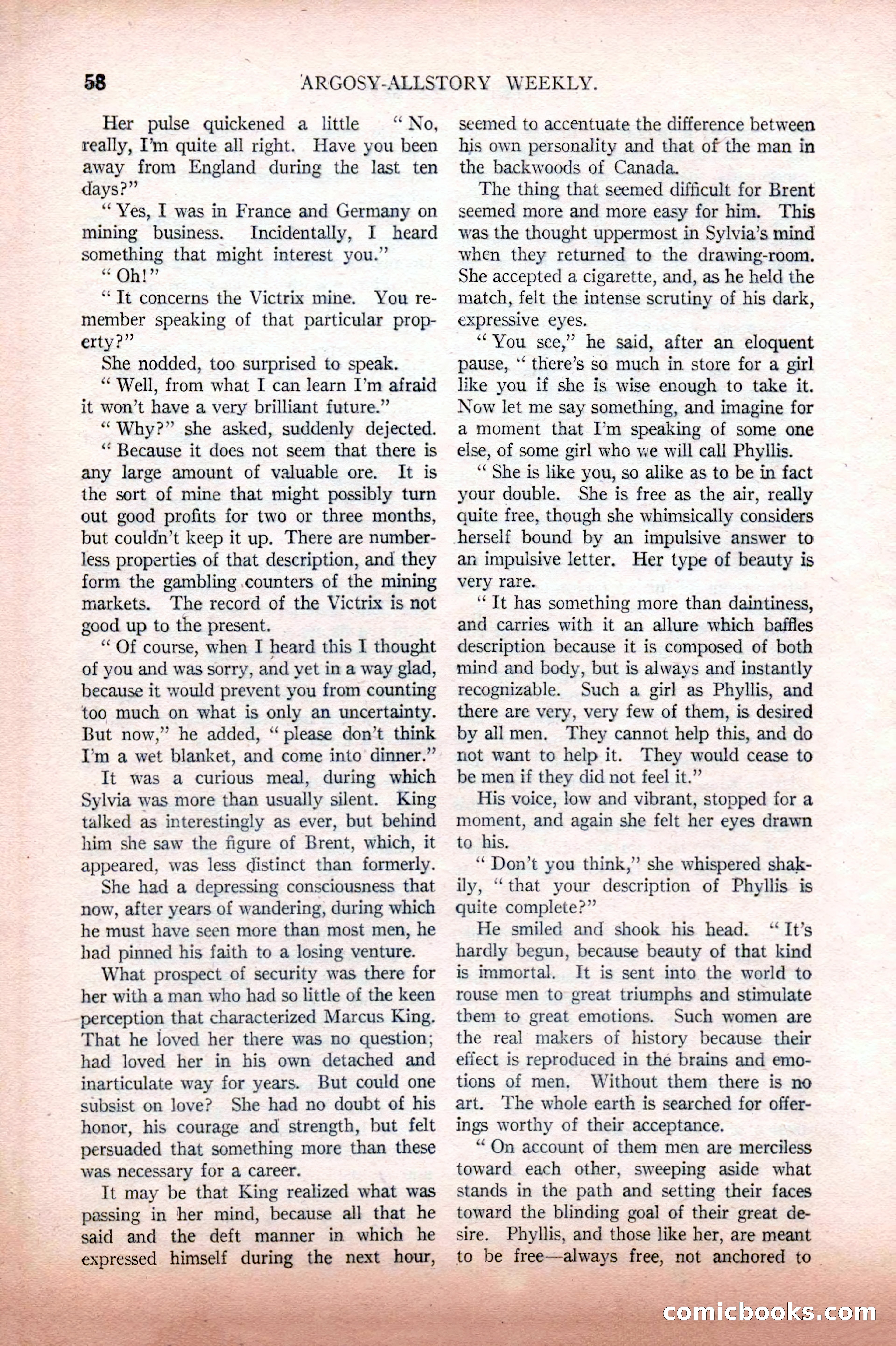
A restored page from Pulp Fiction, 1927. Page through the whole issue in the reader above.
📄 Transcribed text from this page (OCR, searchable)
Machine-transcribed from the original scan — historical spelling and the odd misread are preserved.
= soo! eee sug es. > hour, 58 ARGOSY-ALLSTORY WEEKLY. Her pulse quickened a little “No, really, I’m quite all right. Have you been away from England during the last ten days?” “Yes, I was in France and Germany on mining business. Incidentally, I heard something that might interest you.” cc Oh! 7 “Tt concerns the Victrix mine. You re- member speaking of that particular prop- erty?” She nodded, too surprised to speak. “Well, from what I can learn I’m afraid it won’t have a very brilliant future.” “Why?” she asked, suddenly dejected. ‘“‘ Because it does not seem that there is any large amount of valuable ore. It is the sort of mine that might possibly turn out good profits for two or three months, but couldn’t keep it up. There are number- less properties of that description, and they form the gambling .counters of the mining markets. The record of the Victrix is not good up to the present. “Of course, when I heard this I thought of you and was sorry, and yet in a way glad, because it would prevent you from counting too much on what is only an uncertainty. But now,” he added, “‘ please don’t think I’m a wet blanket, and come into dinner.” It was a curious meal, during which Sylvia was more than usually silent. King talked as interestingly as ever, but behind him she saw the figure of Brent, which, it appeared, was less distinct than formerly. She had a depressing consciousness that now, after years of wandering, during which he must have seen more than most men, he had pinned his faith to a losing venture. What prospect of security was there for her with a man who had so little of the keen ‘perception that characterized Marcus King. That he loved her there was no question; had loved her in his own detached and inarticulate way for years. But could one subsist on love? She had no doubt of his honor, his courage and strength, but felt persuaded that something more than these was necessary for a career. It may be that King realized what was passing in her mind, because all that he said and the deft manner in which he seemed to accentuate the difference between his own personality and that of the man in the backwoods of Canada. The thing that seemed difficult for Brent seemed more and more easy for him. This was the thought uppermost in Sylvia’s mind when they returned to the drawing-room. She accepted a cigarette, and, as he held the match, felt the intense scrutiny of his dark, expressive eyes. “You see,” he said, after an eloquent pause, ‘‘ there’s so much in store for a girl like you if she is wise enough to take it. Now let me say something, and imagine for a moment that I’m speaking of some one else, of some girl who we will call Phyllis. ‘« She is like you, so alike as to be in fact your double. She is free as the air, really quite free, though she whimsically considers herself bound by an impulsive answer to an impulsive letter. very rare. ‘It has something more than daintiness, and carries with it an allure which baffles description because it is composed of both mind and body, but is always and instantly recognizable. Such a girl as Phyllis, and there are very, very few of them, is desired by all men. They cannot help this, and do not want to help it. They would cease to be men if they did not feel it.” His voice, low and vibrant, stopped for a moment, and again she felt her eyes drawn to his. ‘Don’t you think,” she whispered shak- ily, ‘“‘that your description of Phyllis is quite complete?” He smiled and shook his head. “It’s hardly begun, because beauty of that kind is immortal. It is sent into the world to rouse men to great triumphs and stimulate them to great emotions. Such women are the real makers of history because their effect is reproduced in thé brains and emo- tions of men, Without them there is no art. The whole earth is searched for offer- ings worthy of their acceptance. “On account of them men are merciless toward each other, sweeping aside what stands in the path and setting their faces toward the blinding goal of their great de- sire. Phyllis, and those like her, are meant Her type of beauty is >" = —— ——— ee 5 LPS = nae sa a, tS ee — a . ae, ee > | PeGmichooke: cor wate be _iege-aiweys ae Zot shor. ae = ~— 22