
Pulp Fiction, 1927 · page 79 of 168
Argosy All-Story Weekly, February 12, 1927 — page 79: what you’re looking at
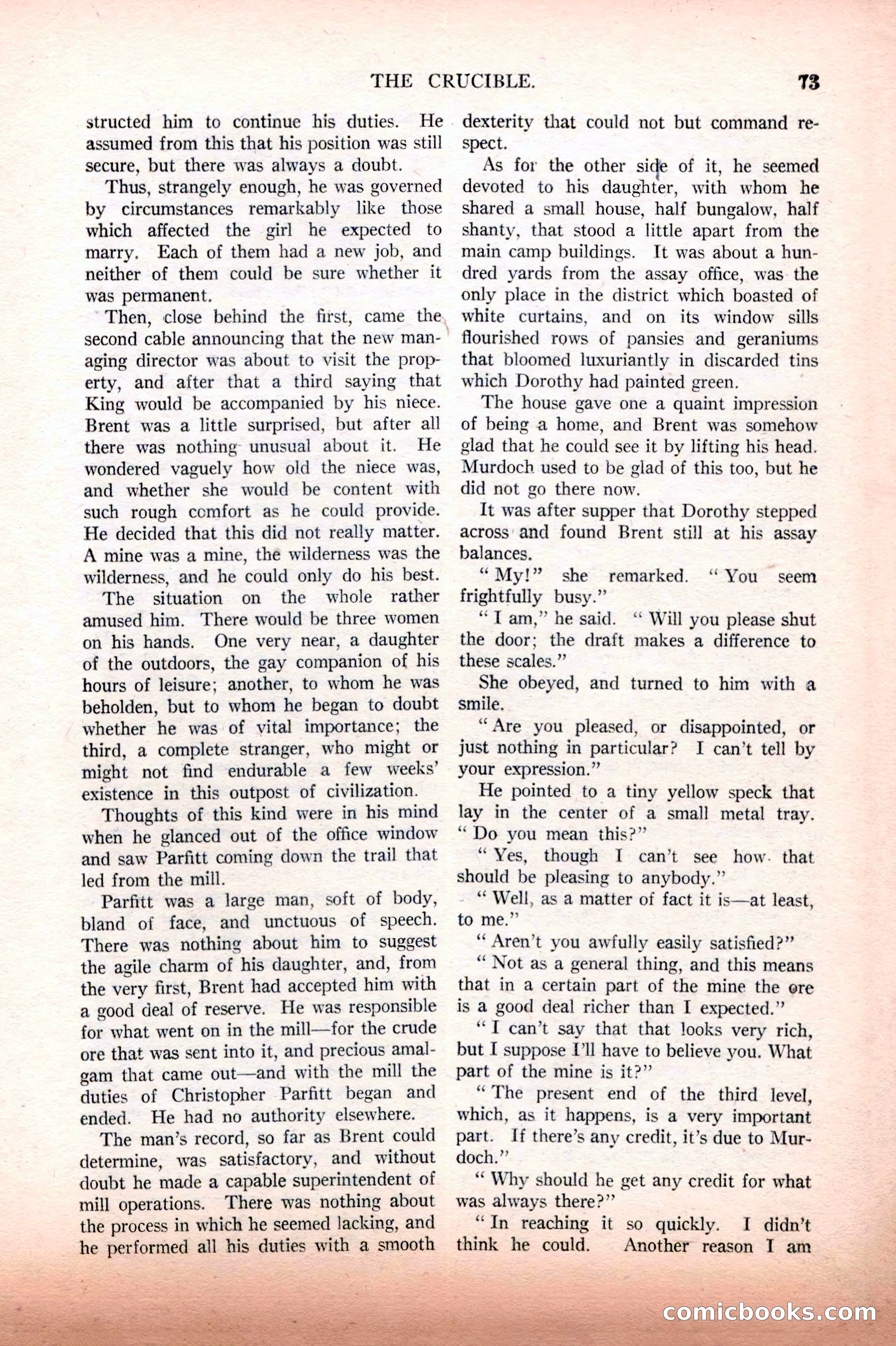
A restored page from Pulp Fiction, 1927. Page through the whole issue in the reader above.
📄 Transcribed text from this page (OCR, searchable)
Machine-transcribed from the original scan — historical spelling and the odd misread are preserved.
THE CRUCIBLE. structed him to continue his duties. He assumed from this that his position was still secure, but there was always a doubt. Thus, strangely enough, he was governed by circumstances remarkably like those which affected the girl he expected to marry. Each of them had a new job, and neither of them could be sure whether it was permanent. Then, close behind the first, came the second cable announcing that the new man- aging director was about to visit the prop- erty, and after that a third saying that King would be accompanied by his niece. Brent was a little surprised, but after all there was nothing unusual about it. He wondered vaguely how old the niece was, and whether she would be content with such rough comfort as he could provide. He decided that this did not really matter. A mine was a mine, the wilderness was the wilderness, and he could only do his best. The situation on the whole rather amused him. There would be three women on his hands. One very near, a daughter of the outdoors, the gay companion of his hours of leisure; another, to whom he was beholden, but to whom he began to doubt whether he was of vital importance; the third, a complete stranger, who might or might not find endurable a few weeks’ existence in this outpost of civilization. Thoughts of this kind were in his mind when he glanced out of the office window and saw Parfitt coming down the trail that led from the mill. Parfitt was a large man, soft of body, bland of face, and unctuous of speech. There was nothing about him to suggest the agile charm of his daughter, and, from the very first, Brent had accepted him with a good deal of reserve. He was responsible for what went on in the mill—for the crude ore that was sent into it, and precious amal- gam that came out—and with the mill the duties of Christopher Parfitt began and ended. He had no authority elsewhere. The man’s record, so far as Brent could determine, was satisfactory, and without doubt he made a capable superintendent of mill operations. There was nothing about the process in which he seemed lacking, and 13 dexterity that could not but command re- spect. As for the other side of it, he seemed devoted to his daughter, with whom he shared a small house, half bungalow, half shanty, that stood a little apart from the main camp buildings. It was about a hun- dred yards from the assay office, was. the only place in the district which boasted of white curtains, and on its window sills flourished rows of pansies and geraniums that bloomed luxuriantly in discarded tins which Dorothy had painted green. The house gave one a quaint impression of being a home, and Brent was somehow glad that he could see it by lifting his head. Murdoch used to be glad of this too, but he did not go there now. It was after supper that Dorothy stepped across and found Brent still at his assay balances. “My!” she frightfully busy.” “Tam,” he said. “ Will you please shut the door; the draft makes a difference to these scales.” She obeyed, and turned to him with a smile. “Are you pleased, or disappointed, or just nothing in particular? I can’t tell by your expression.” He pointed to a tiny yellow speck that lay in the center of a small metal tray. “Do you mean this?” “Yes, though I can’t see how. that should be pleasing to anybody.” ‘Well, as a matter of fact it is—at least, to me.” ‘“ Aren’t you awfully easily satisfied?” “Not as a general thing, and this means that in a certain part of the mine the ore is a good deal richer than I expected.” ‘““T can’t say that that looks very rich, but I suppose [ll have to believe you. What part of the mine is it?” “The present end of the third level, which, as it happens, is a very important part. If there’s any credit, it’s due to Mur- doch.” : ** Why should he get any credit for what was always there?” “In reaching it so quickly. I didn’t remarked. ‘“ You seem _ he performed all his duties with a smooth think he could. Another reason I am ae ~~ a So ee oe a, — 2 os el i an i = eet ee ee Py - id a yo ee 3 = 3 ‘ Ss oe oe : a : * a n me a eS Se Oe Po eee as eS on Og <= ——— yi DE Ae le eg re “ —— > a . _ atin, ie i comic