
Pulp Fiction, 1927 · page 96 of 168
Argosy All-Story Weekly, February 12, 1927 — page 96: what you’re looking at
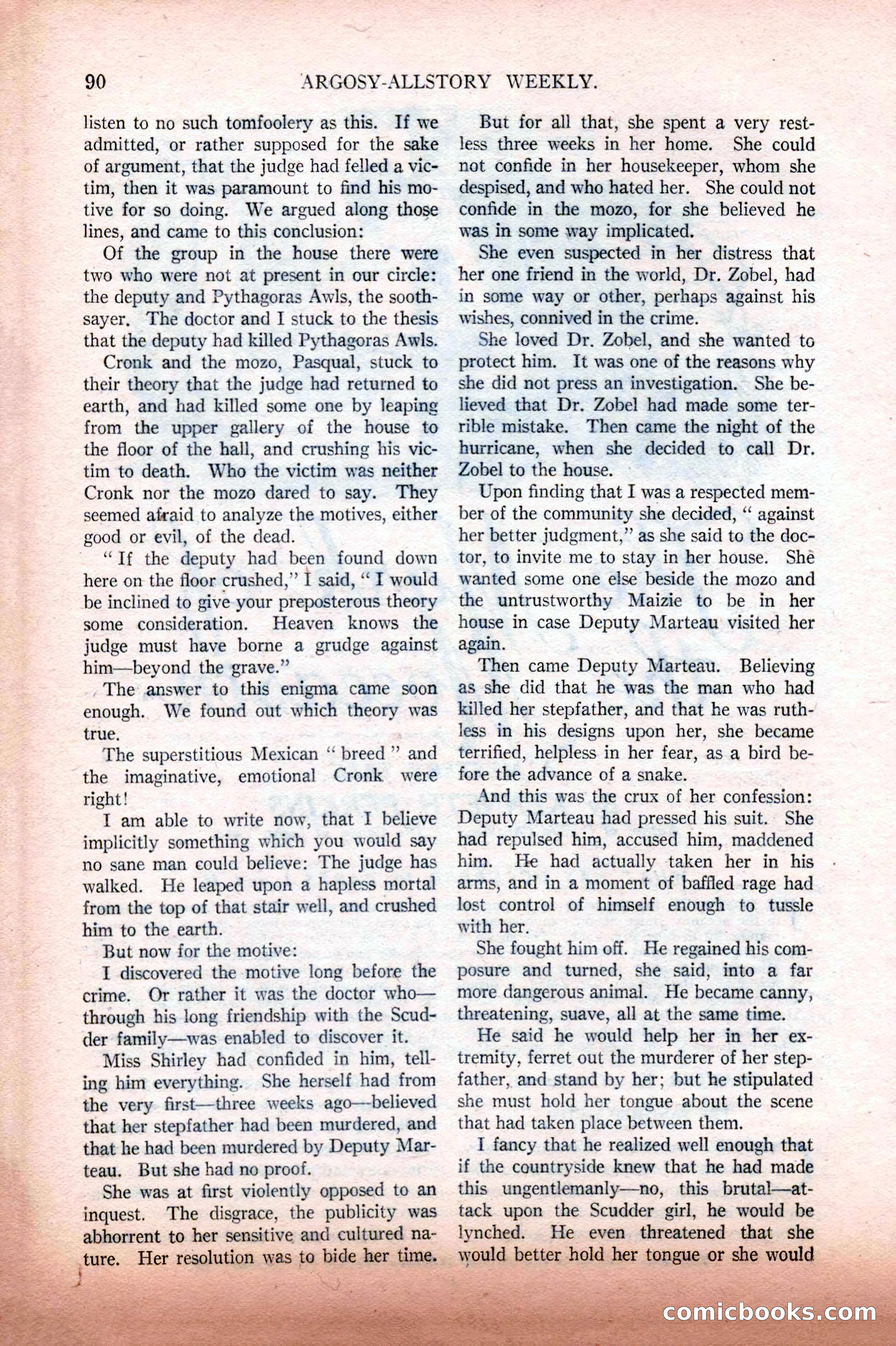
A restored page from Pulp Fiction, 1927. Page through the whole issue in the reader above.
📄 Transcribed text from this page (OCR, searchable)
Machine-transcribed from the original scan — historical spelling and the odd misread are preserved.
a | ip, ve, avs ey ER Ee af us Rts) a F 90 listen to no such tomfoolery as this. If we admitted, or rather supposed for the sake of argument, that the judge had felled a vic- tim, then it was paramount to find his mo- tive for so doing. We argued along those lines, and came to this conclusion: Of the group in the house there were two who were not at present in our circle: the deputy and Pythagoras Awls, the sooth- sayer, The doctor and I stuck to the thesis that the deputy had killed Pythagoras Awls. Cronk and the mozo, Pasqual, stuck to their theory that the judge had returned to earth, and had killed some one by leaping from the upper gallery of the house to the floor of the hall, and crushing his vic- tim to death. Who the victim was neither Cronk nor the mozo dared to say. They seemed afraid to analyze the motives, either good or evil, of the dead. “oA the deputy had been found down here on the floor crushed,” I said, “I would be inclined to give your preposterous theory some consideration. Heaven knows the judge must have borne a grudge against him—hbeyond the grave.” The answer to this enigma came soon enough. We found out which theory was true. The superstitious Mexican ‘“‘ breed ” and the imaginative, emotional Cronk were right! I am able to write now, that I believe implicitly something which you would say no sane man could believe: The judge has walked. He leaped upon a hapless mortal from the top of that stair well, and crushed him to the earth. - But now for the motive: I discovered the motive long before the crime. Or rather it was the doctor who— through his long friendship with the Scud- der family—was enabled to discover it. Miss Shirley had confided in him, tell- ing him everything. She herself had from the very first—three weeks ago—-believed that her stepfather had been murdered, and that he had been murdered by Deputy Mar- teau. But she had no proof. She was at first violently opposed to an inquest. The disgrace, the publicity was abhorrent to her sensitive and saline na- id ‘ti me. 3 “ 4 , 4 7 1 Ae o~ te} U u 0 f rE O at * = yo een, ee ae : SE a a a ee Se ss - ARGOSY-ALLSTORY WEEKLY. But for all that, she spent a very rest- less three weeks in her home. She could net confide in her housekeeper, whom she despised, and who hated her. She could not confide in the mozo, for she believed he was in some way implicated. She even suspected in her distress that her one friend in the world, Dr. Zobel, had in some way or other, perhaps against his wishes, connived in the crime. She loved Dr. Zobel, and she wanted to protect him. It was one of the reasons why she did not press an investigation. She be- lieved that Dr. Zobel had made some ter- rible mistake. Then came the night of the hurricane, when she decided to call Dr. Zobel to the house. Upon finding that I was a respected mem- ber of the community she decided, “‘ against her better judgment,” as she said to the doc- tor, to invite me to stay in her house. She wanted some one else beside the mozo and the untrustworthy Maizie to be in her house in case Deputy Marteau visited her again. Then came Deputy Marteau. Believing as she did that he was the man who had killed her stepfather, and that he was ruth- less in his designs upon her, she became terrified, helpless in her fear, as a bird be- fore the advance of a snake. And this was the crux of her confession: Deputy Marteau had pressed his suit. She had repulsed him, accused him, maddened him. He had actually taken her in his arms, and in a moment of baffled rage had lost control of himself enough to tussle with her. She fought him off. He regained his com- posure and turned, she said, into a far more dangerous animal. He became canny, threatening, suave, all at the same time. He said he would help her in her ex- tremity, ferret out the murderer of her step- father, and stand by her; but he stipulated she must hold her tongue about the scene that had taken place between them. I fancy that he realized well enough that if the countryside knew that he had made this ungentlemanly—no, this brutal—at- tack upon the Scudder girl, he would be lynched. ae .' — . oe a ould bet cher. tongue ors ne Vv J} is eae alt ats toll - ~~ - WU 1 bs a —_- ae Soe p Sf3G cate Ses ge RS —— Sas = > = aig SS a. ~~ —— even: threatened that = oe a Ae aie er ee == - na -- Set ae CROOKe COM