
Pulp Fiction, 1927 · page 17 of 180
Argosy All-Story Weekly, Vol. 189, No. 4 — page 17: what you’re looking at
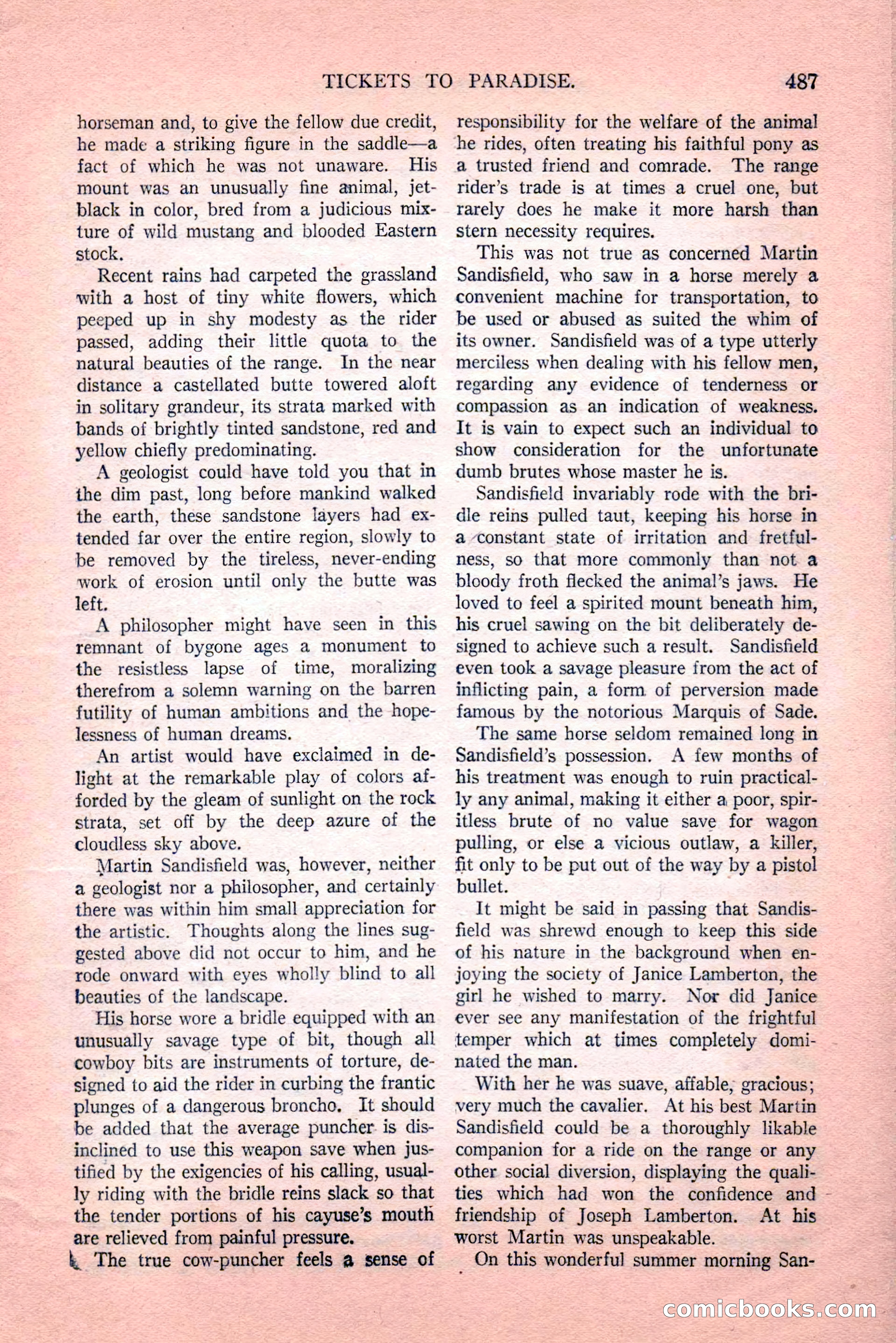
A restored page from Pulp Fiction, 1927. Page through the whole issue in the reader above.
📄 Transcribed text from this page (OCR, searchable)
Machine-transcribed from the original scan — historical spelling and the odd misread are preserved.
TICKETS TO PARADISE. horseman and, to give the fellow due credit, he made a striking figure in the saddle—a fact of which he was not unaware. His mount was an unusually fine animal, jJet- black in color, bred from a judicious mix- ture of wild mustang and blooded Eastern stock. Recent rains had carpeted the grassland with a host of tiny white flowers, which peeped up in shy modesty as the rider passed, adding their little quota to the natural beauties of the range. In the near distance a castellated butte towered aloft in solitary grandeur, its strata marked with bands of brightly tinted sandstone, red and yellow chiefly predominating. A geologist could have told you that in the dim past, long before mankind walked the earth, these sandstone layers had ex- tended far over the entire region, slowly to be removed by the tireless, never-ending work of erosion until only the butte was left. A philosopher might have seen in this remnant of bygone ages a monument to the resistless lapse of time, moralizing therefrom a solemn warning on the barren futility of human ambitions and the hope- lessness of human dreams. An artist would have exclaimed in de- light at the remarkable play of colors af- forded by the gleam of sunlight on the rock strata, set off by the deep azure of the cloudless sky above. Martin Sandisfield was, however, neither a geologist nor a philosopher, and certainly there was within him small appreciation for the artistic. Thoughts along the lines sug- gested above did not occur to him, and he rode onward with eyes wholly blind to all beauties of the landscape. His horse wore a bridle equipped with an unusually savage type of bit, though all cowboy bits are instruments of torture, de- signed to aid the rider in curbing the frantic plunges of a dangerous broncho, It should be added that the average puncher. is dis- inclined to use this weapon save when jus- tified by the exigencies of his calling, usual- ly riding with the bridle reins slack so that the tender portions of his cayuse’s mouth are relieved from painful pressure. k The true cow-puncher feels a sense of 487 responsibility for the welfare of the animal he rides, often treating his faithful pony as a trusted friend and comrade. The range rider’s trade is at times a cruel one, but rarely does he make it more harsh than stern necessity requires. This was not true as concerned Martin Sandisfield, who saw in a horse merely a convenient machine for transportation, to be used or abused as suited the whim of its owner. Sandisfield was of a type utterly merciless when dealing with his fellow men, regarding any evidence of tenderness or compassion as an indication of weakness. It is vain to expect such an individual to show consideration for the unfortunate dumb brutes whose master he is. Sandisfield invariably rode with the bri- dle reins pulled taut, keeping his horse in a constant state of irritation and fretful- ness, so that more commonly than not a bloody froth flecked the animal’s jaws. He loved to feel a spirited mount beneath him, his cruel sawing on the bit deliberately de- signed to achieve such a result. Sandisfield even took a savage pleasure from the act of inflicting pain, a form of perversion made famous by the notorious Marquis of Sade. The same horse seldom remained long in Sandisfield’s possession. A few months of his treatment was enough to ruin practical- ly any animal, making it either a poor, spir- itless brute of no value save for wagon pulling, or else a vicious outlaw, a killer, fit only to be put out of the way by a pistol bullet. It might be said in passing that Sandis- field was shrewd enough to keep this side of his nature in the background when en- joying the society of Janice Lamberton, the girl he wished to marry. Nor did Janice ever see any manifestation of the frightful temper which at times completely domi- nated the man. With her he was suave, affable; gracious; very much the cavalier. At his best Martin Sandisfield could be a thoroughly likable companion for a ride on the range or any other social diversion, displaying the quali- ties which had won the confidence and friendship of Joseph Lamberton. At his worst Martin was unspeakable. _ On this wonderful summer morning San- DOOKS - (E(0) AAI (E)