
Pulp Fiction, 1927 · page 53 of 180
Argosy All-Story Weekly, Vol. 189, No. 4 — page 53: what you’re looking at
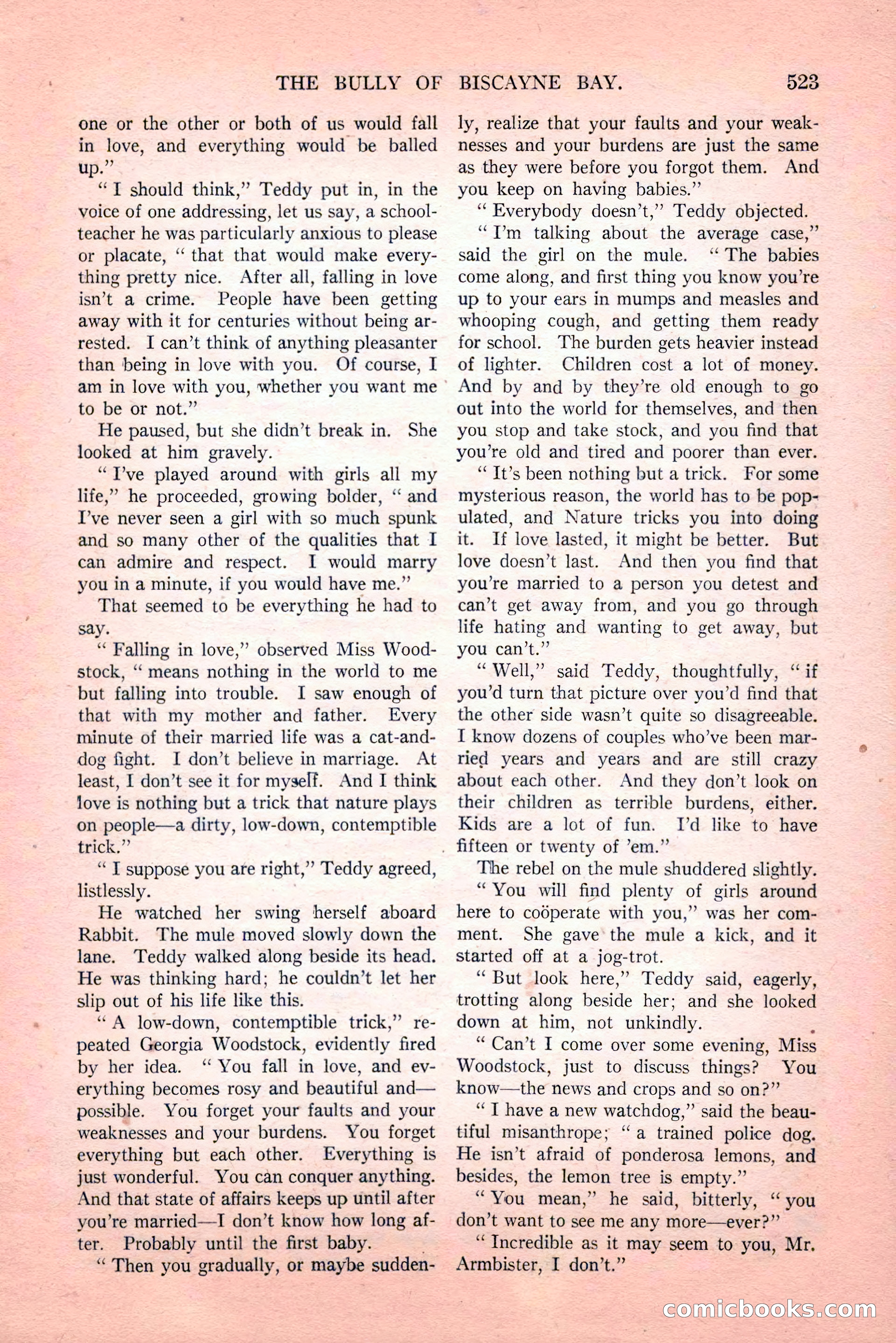
A restored page from Pulp Fiction, 1927. Page through the whole issue in the reader above.
📄 Transcribed text from this page (OCR, searchable)
Machine-transcribed from the original scan — historical spelling and the odd misread are preserved.
THE BULLY OF one or the other or both of us would fall in love, and everything would be balled up.” “T should think,” Teddy put in, in the voice of one addressing, let us say, a school- teacher he was particularly anxious to please or placate, ‘“ that that would make every- thing pretty nice. After all, falling in love isn’t a crime. People have been getting away with it for centuries without being ar- rested. I can’t think of anything pleasanter than being in love with you. Of course, I am in love with you, whether you want me to be or not.” He paused, but she didn’t break in. looked at him gravely. “T’ve played around with girls all my life,” he proceeded, growing bolder, ‘“‘ and I’ve never seen a girl with so much spunk and so many other of the qualities that I can admire and respect. I would marry you in a minute, if you would have me.”’ That seemed to be everything he had to say. “ Falling in love,” observed Miss Wood- stock, ‘“‘ means nothing in the world to me but falling into trouble. I saw enough of that with my mother and father. Every minute of their married life was a cat-and- dog fight. I don’t believe in marriage. At least, I don’t see it for myself. And I think love is nothing but a trick that nature plays on people—a dirty, low-down, contemptible trick.”’ ‘“T suppose you are right,’ Teddy agreed, listlessly. He watched her swing herself aboard Rabbit. The mule moved slowly down the lane. Teddy walked along beside its head. He was thinking hard; he couldn’t let her slip out of his life like this. “A low-down, contemptible trick,” re- peated Georgia Woodstock, evidently fired by her idea. ‘ You fall in love, and ev- erything becomes rosy and beautiful and— possible. You forget your faults and your weaknesses and your burdens. You forget everything but each other. Everything is just wonderful. You can conquer anything. And that state of affairs keeps up until after you’re married—I don’t know how long af- ter. Probably until the first baby. “Then you gradually, or maybe sudden- She BISCAYNE BAY. 523 ly, realize that your faults and your weak- nesses and your burdens are just the same as they were before you forgot them. And you keep on having babies.”’ “Everybody doesn’t,’ Teddy objected. “Tm talking about the average case,” said the girl on the mule. ‘“ The babies come along, and first thing you know you’re up to your ears in mumps and measles and whooping cough, and getting them ready for school. The burden gets heavier instead of lighter. Children cost a lot of money. And by and by they’re old enough to go out into the world for themselves, and then you stop and take stock, and you find that you’re old and tired and poorer than ever. ‘““Tt’s been nothing but a trick. For some mysterious reason, the world has to be pop- ulated, and Nature tricks you into doing it. If love lasted, it might be better. But love doesn’t last. And then you find that you're married to a person you detest and can’t get away from, and you go through life hating and wanting to get away, but you can’t.” “Well,” said Teddy, thoughtfully, “ if you’d turn that picture over you’d find that the other side wasn’t quite so disagreeable. I know dozens of couples who’ve been mar- ried years and years and are still crazy about each other. And they don’t look on their children as terrible burdens, either. Kids are a lot of fun. Id like to have . fifteen or twenty of ’em.” The rebel on the mule shuddered slightly. “You will find plenty of girls around here to codperate with you,” was her com- ment. She gave’ the mule a kick, and it started off at a jog-trot. “But look here,” Teddy said, eagerly, trotting along beside her; and she looked down at him, not unkindly. “Can’t I come over some evening, Miss Woodstock, just to discuss things? You know—the news and crops and so on?” ‘“T have a new watchdog,” said the beau- tiful misanthrope; “a trained police dog. He isn’t afraid of ponderosa lemons, and besides, the lemon tree is empty.” “You mean,” he said, bitterly, “ you don’t want to see me any more—ever?”’ “Incredible as it may seem to you, Mr. Armbister, I don’t.” com vDOOK (E@)