
Pulp Fiction, 1927 · page 71 of 180
Argosy All-Story Weekly, Vol. 189, No. 4 — page 71: what you’re looking at
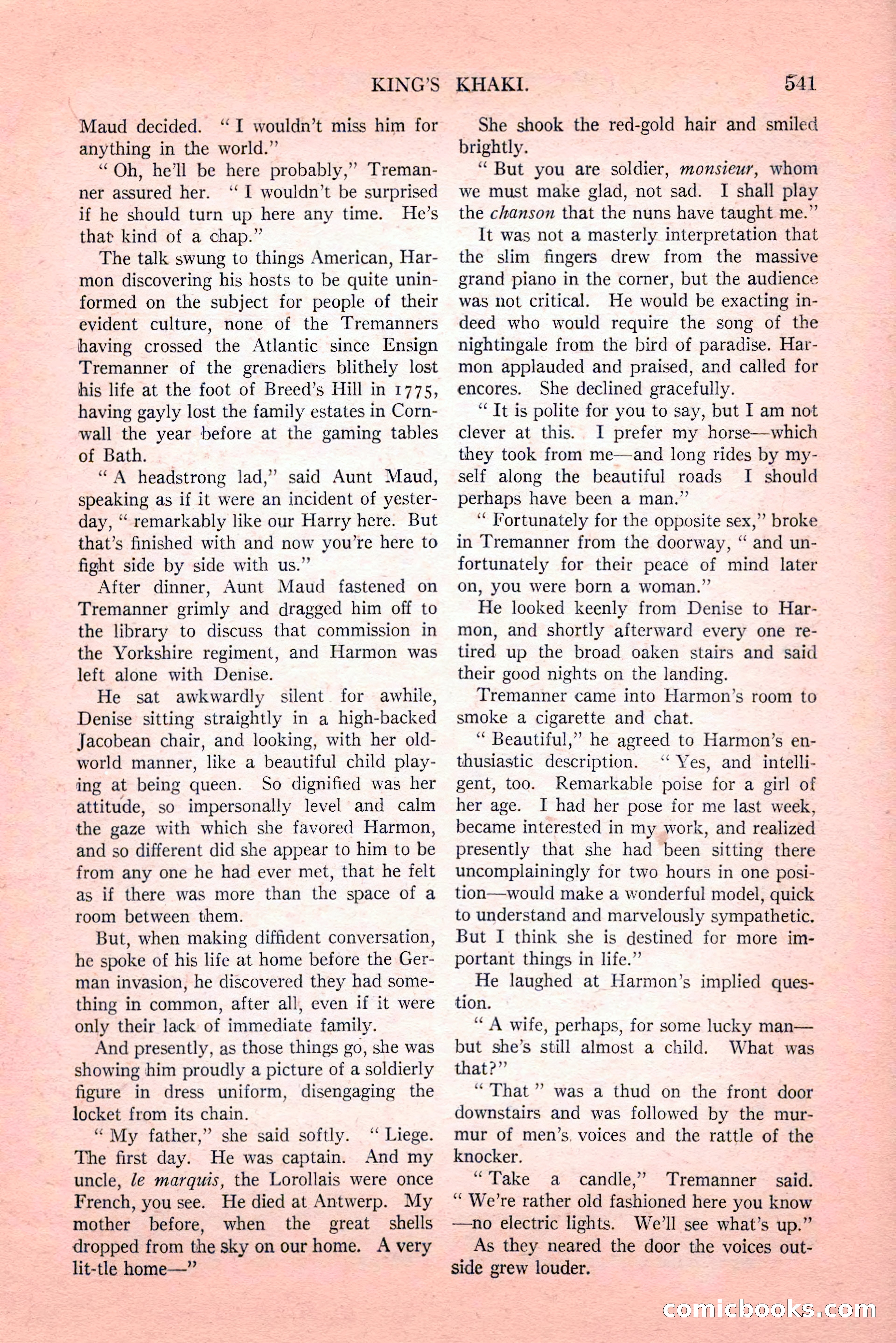
A restored page from Pulp Fiction, 1927. Page through the whole issue in the reader above.
📄 Transcribed text from this page (OCR, searchable)
Machine-transcribed from the original scan — historical spelling and the odd misread are preserved.
KING’S Maud decided. ‘I wouldn’t miss him for anything in the world.” “Oh, he’ll be here probably,” Treman- ner assured her. ‘‘ I wouldn’t be surprised if he should turn up here any time. He’s that kind of a chap.” The talk swung to things American, Har- mon discovering his hosts to be quite unin- formed on the subject for people of their evident culture, none of the Tremanners having crossed the Atlantic since Ensign Tremanner of the grenadiers blithely lost his life at the foot of Breed’s Hill in 1775, having gayly lost the family estates in Corn- wall the year before at the gaming tables of Bath. “A headstrong lad,’ said Aunt Maud, speaking as if it were an incident of yester- day, “ remarkably like our Harry here. But that’s finished with and now your're here to fight side by side with us.” After dinner, Aunt Maud fastened on Tremanner grimly and dragged him off to the library to discuss that commission in the Yorkshire regiment, and Harmon was left alone with Denise. He sat awkwardly silent for awhile, Denise sitting straightly in a high-backed Jacobean chair, and looking, with her old- world manner, like a beautiful child play- ing at being queen. So dignified was her attitude, so impersonally level and calm the gaze with which she favored Harmon, and so different did she appear to him to be from any one he had ever met, that he felt as if there was more than the space of a room between them. But, when making diffident conversation, he spoke of his life at home before the Ger- man invasion, he discovered they had some- thing in common, after all, even if it were only their lack of immediate family. And presently, as those things go, she was showing him proudly a picture of a soldierly figure in dress uniform, disengaging the locket from its chain. “My father,” she said softly. “ Liege. The first day. He was captain. And my uncle, le marquis, the Lorollais were once French, you see. He died at Antwerp. My mother before, when the great shells dropped from the sky on our home. A very lit-tle home—” KHAKI, 541 She shook the red-gold hair and smiled brightly. “But you are soldier, monsieur, whom we must make glad, not sad. I shall play the chanson that the nuns have taught me.” It was not a masterly interpretation that the slim fingers drew from the massive grand piano in the corner, but the audience was not critical. He would be exacting in- deed who would require the song of the nightingale from the bird of paradise. Har- mon applauded and praised, and called for encores. She declined gracefully. “Tt is polite for you to say, but I am not clever at this. I prefer my horse—which they took from me—and long rides by my- self along the beautiful roads I should perhaps have been a man.” ‘“ Fortunately for the opposite sex,” broke in Tremanner from the doorway, “ and un- fortunately for their peace of mind later on, you were born a woman.” He looked keenly from Denise to Har- mon, and shortly afterward every one re- tired up the broad oaken stairs and said their good nights on the landing. Tremanner came into Harmon’s room to smoke a cigarette and chat. Beautiful,” he agreed to Harmon’s en- thusiastic description. ‘‘ Yes, and intelli- gent, too. Remarkable poise for a girl of her age. I had her pose for me last week, became interested in my work, and realized presently that she had been sitting there uncomplainingly for two hours in one posi- tion—would make a wonderful model, quick to understand and marvelously sympathetic. But I think she is destined for more im- portant things in life.” He laughed at Harmon’s implied ques- tion. ‘A wife, perhaps, for some lucky man— but she’s still almost a child. What was that?” “That ” was a thud on the front door downstairs and was followed by the mur- mur of men’s. voices and the rattle of the knocker. “Take a candle,’ Tremanner said. ‘“ We’re rather old fashioned here you know —no electric lights. We'll see what’s up.” As they neared the door the voices out- side grew louder. Gomichbooks (E(0)