
Pulp Fiction, 1927 · page 81 of 180
Argosy All-Story Weekly, Vol. 189, No. 4 — page 81: what you’re looking at
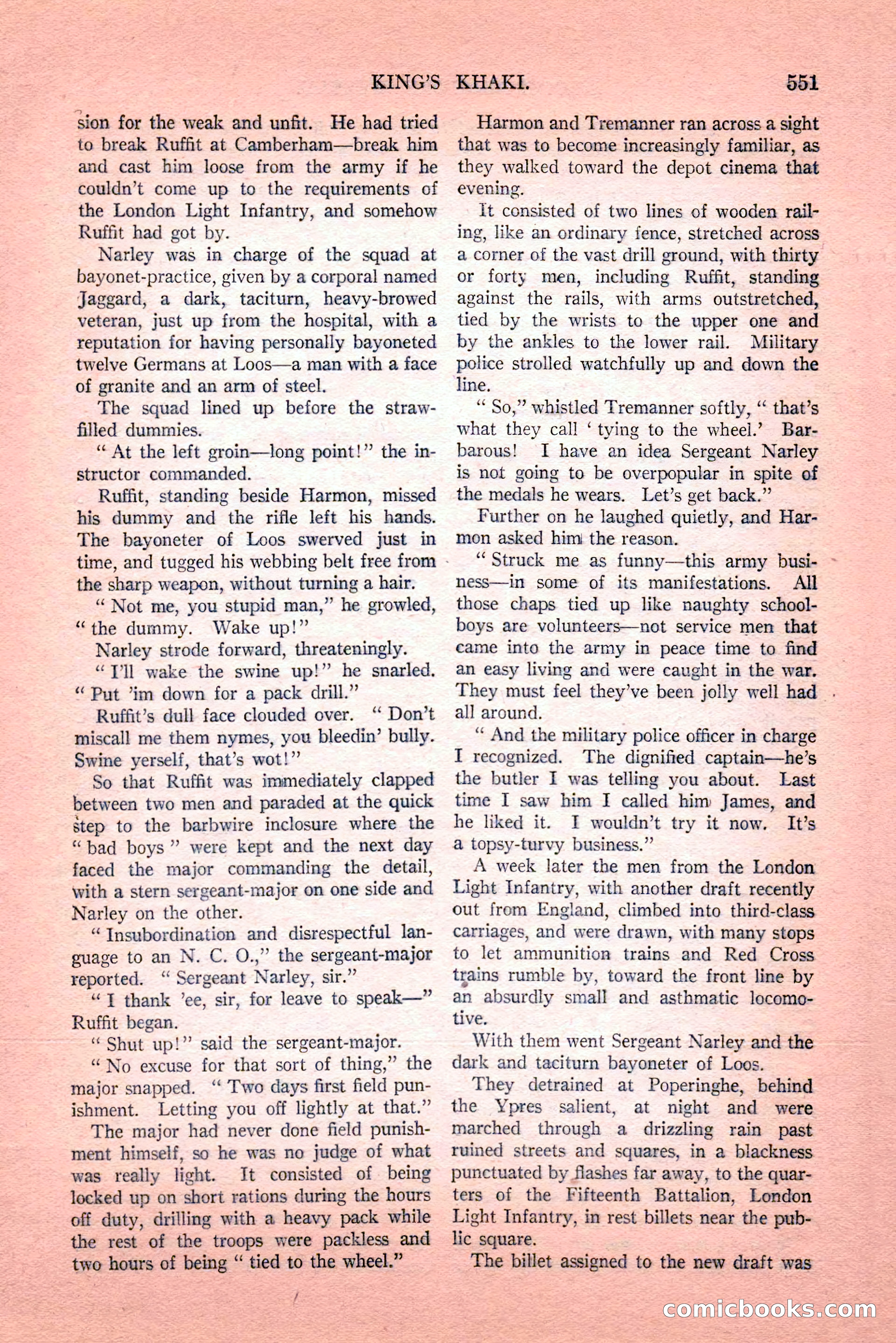
A restored page from Pulp Fiction, 1927. Page through the whole issue in the reader above.
📄 Transcribed text from this page (OCR, searchable)
Machine-transcribed from the original scan — historical spelling and the odd misread are preserved.
KING’S sion for the weak and unfit. He had tried to break Ruffit at Camberham—break him and cast him loose from the army if he couldn’t come up to the requirements of the London Light Infantry, and somehow Ruffit had got by. Narley was in charge of the squad at bayonet-practice, given by a corporal named jJaggard, a dark, taciturn, heavy-browed veteran, just up from the hospital, with a reputation for having personally bayoneted twelve Germans at Loos—a man with a face of granite and an arm of steel. The squad lined up before the straw- filled dummies. ‘“¢ At the left groin—long point!” the in- structor commanded. Ruffit, standing beside Harmon, missed his dummy and the rifle left his hands. The bayoneter of Loos swerved just in time, and tugged his webbing belt free from - the sharp weapon, without turning a hair. “ Not me, you stupid man,” he growled, “the dummy. Wake up!” Narley strode forward, threateningly. “T’ll wake the swine up!” he snarled. “ Put ’im down for a pack drill.” Ruffit’s dull face clouded over. “ Don’t miscall me them nymes, you bleedin’ bully. Swine yerself, that’s wot!”’ So that Ruffit was immediately clapped between two men and paraded at the quick step to the barbwire inclosure where the “bad boys ” were kept and the next day faced the major commanding the detail, with a stern sergeant-major on one side and Narley on the other. “Tnsubordination and disrespectful lan- guage to an N. C. O.,” the sergeant-major reported. “ Sergeant Narley, sir.” “T thank ’ee, sir, for leave to speak—” Ruffit began. “ Shut up!” said the sergeant-major. “No excuse for that sort of thing,” the major snapped. ‘ Two days first field pun- ishment. Letting you off lightly at that.” The major had never done field punish- ment himself, so he was no judge of what was really light. It consisted of being locked up on short rations during the hours off duty, drilling with a heavy pack while the rest of the troops were packless and two hours of being “ tied to the wheel.” / KHAKI. ool Harmon and Tremanner ran across a sight that was to become increasingly familiar, as they walked toward the depot cinema that evening. it consisted of two lines of wooden rail- ing, like an ordinary fence, stretched across a corner of the vast drill ground, with thirty or forty men, including Ruffit, standing against the rails, with arms outstretched, tied by the wrists to the upper one and by the ankles to the lower rail. Military police strolled watchfully up and down the line. “So,” whistled Tremanner softly, “ that’s what they call ‘ tying to the wheel.’ Bar- barous! I have an idea Sergeant Narley is not going to be overpopular in spite of the medals he wears. Let’s get back.” Further on he laughed quietly, and Har- mon asked himi the reason. ‘Struck me as funny—this army busi- ness—in some of its manifestations. All those chaps tied up like naughty school- boys are volunteers—not service men that came into the army in peace time to find an easy living and were caught in the war. They must feel they’ve been jolly well had . all around. ‘* And the military police officer in charge I recognized. The dignified captain—he’s the butler I was telling you about. Last time I saw him I called him James, and he liked it. I wouldn’t try it now. It’s a topsy-turvy business.” A week later the men from the London Light Infantry, with another draft recently out from England, climbed into third-class carriages, and were drawn, with many stops to let ammunition trains and Red Cross. trains rumble by, toward the front line by an absurdly small and asthmatic locomo- tive. With them went Sergeant Narley and the dark and taciturn bayoneter of Loos. They detrained at Poperinghe, behind the Ypres salient, at night and were marched through a drizzling rain past ruined streets and squares, in a blackness punctuated by flashes far away, to the quar- ters of the Fifteenth Battalion, London Light Infantry, in rest billets near the pub- lic square. The billet assigned to the new draft was ~ Comic VOOKS com