
Pulp Fiction, 1927 · page 104 of 168
Argosy All-Story Weekly, November 12, 1927 — page 104: what you’re looking at
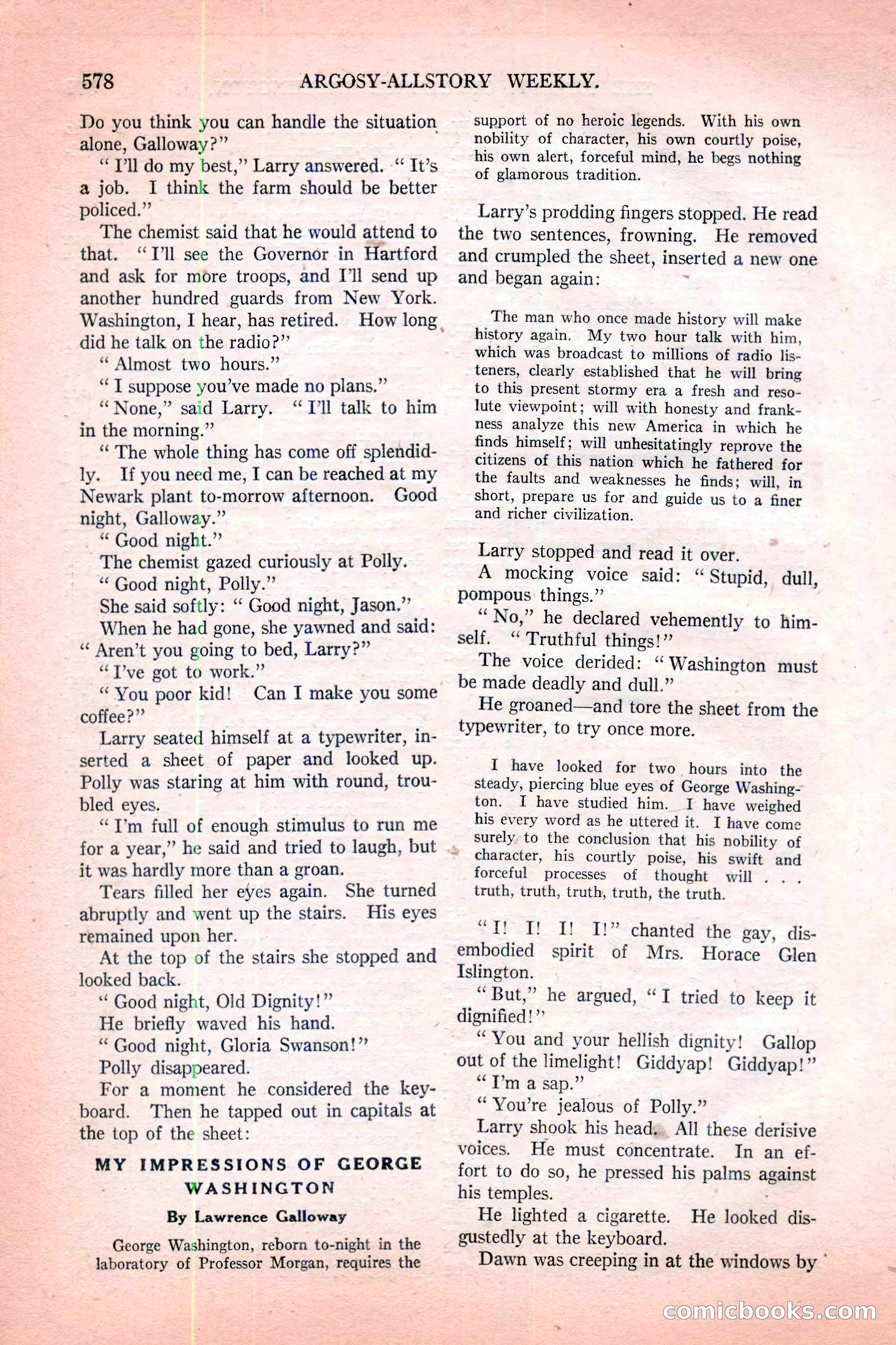
A restored page from Pulp Fiction, 1927. Page through the whole issue in the reader above.
📄 Transcribed text from this page (OCR, searchable)
Machine-transcribed from the original scan — historical spelling and the odd misread are preserved.
578 Do you think you can handle the situation alone, Galloway?” “Tl do my best,” Larry answered. ‘“‘ It’s a job. I think the farm should be better policed.” The chemist said that he would attend to that. ‘I'll see the Governor in Hartford and ask for more troops, and I'll send up another hundred guards from New York. Washington, I hear, has retired. How long. did he talk on the radio?” ‘““ Almost two hours.” ‘“‘T suppose you’ve made no plans,”’ “None,” said Larry. “Dll talk to him in the morning.” “The whole thing has come off splendid- If you need me, I can be reached at my Good ly. Newark plant to-morrow afternoon. night, Galloway.” “ Good night.” The chemist gazed curiously at Polly. “‘ Good night, Polly.” She said softly: “ Good night, Jason.” When he had gone, she yawned and said: “ Aren’t you going to bed, Larry?” “T’ve got to work.” “You poor kid! Can I make you some coffee?” Larry seated himself at a typewriter, in- serted a sheet of paper and looked up. Polly was staring at him with round, trou- bled eyes. “Tm full of enough stimulus to run me for a year,” he said and tried to laugh, but it was hardly more than a groan. Tears filled her eyes again. abruptly and went up the stairs. remained upon her. At the top of the stairs she stopped and looked back. “ Good night, Old Dignity!” He briefly waved his hand. “ Good night, Gloria Swanson!” Polly disappeared. For a moment he considered the key- board. Then he tapped out in capitals at the top of the sheet: MY IMPRESSIONS OF GEORGE WASHINGTON By Lawrence Galloway She turned His eyes George Washington, reborn to-night in the laboratory of Professor Morgan, requires the ARGOSY-ALLSTORY WEEKLY. support of no heroic legends. With his own nobility of character, his own courtly poise, his own alert, forceful mind, he begs nothing of glamorous tradition. Larry’s prodding fingers stopped. He read the two sentences, frowning. He removed and crumpled the sheet, inserted a new one and began again: The man who once made history will make history again. My two hour talk with him, which was broadcast to millions of radio lis- teners, clearly established that he will bring to this present stormy era a fresh and reso- lute viewpoint; will with honesty and frank- ness analyze this new America in which he finds himself; will unhesitatingly reprove the citizens of this nation which he fathered for the faults and weaknesses he finds; will, in short, prepare us for and guide us to a finer and richer civilization. Larry stopped and read it over. A mocking voice said: “ Stupid, dull, pompous things.” “ No,” he declared vehemently to him- self. “ Truthful things!” The voice derided: “ Washington must be made deadly and dull.” He groaned—and tore the sheet from the typewriter, to try once more. I have looked for two hours into the steady, piercing blue eyes of George Washing- ton. I have studied him. I have weighed his every word as he uttered it. I have come surely to the conclusion that his nobility of character, his courtly poise, his swift and forceful processes of thought will . . . truth, truth, truth, truth, the truth. “TI! I! I! I!” chanted the gay, dis- embodied spirit of Mrs. Horace Glen Islington. “But,” he argued, “I tried to keep it dignified!” “You and your hellish dignity! Gallop out of the limelight! Giddyap! Giddyap!” ‘““T’m a sap.” “You’re jealous of Polly.” Larry shook his head. All these derisive voices. He must concentrate. In an ef- fort to do so, he pressed his palms against his temples. He lighted a cigarette. gustedly at the keyboard. He looked dis- Dawn was creeping in at the windows by ° (e(0) DOOKS ANIC (E)