
Pulp Fiction, 1927 · page 111 of 168
Argosy All-Story Weekly, November 12, 1927 — page 111: what you’re looking at
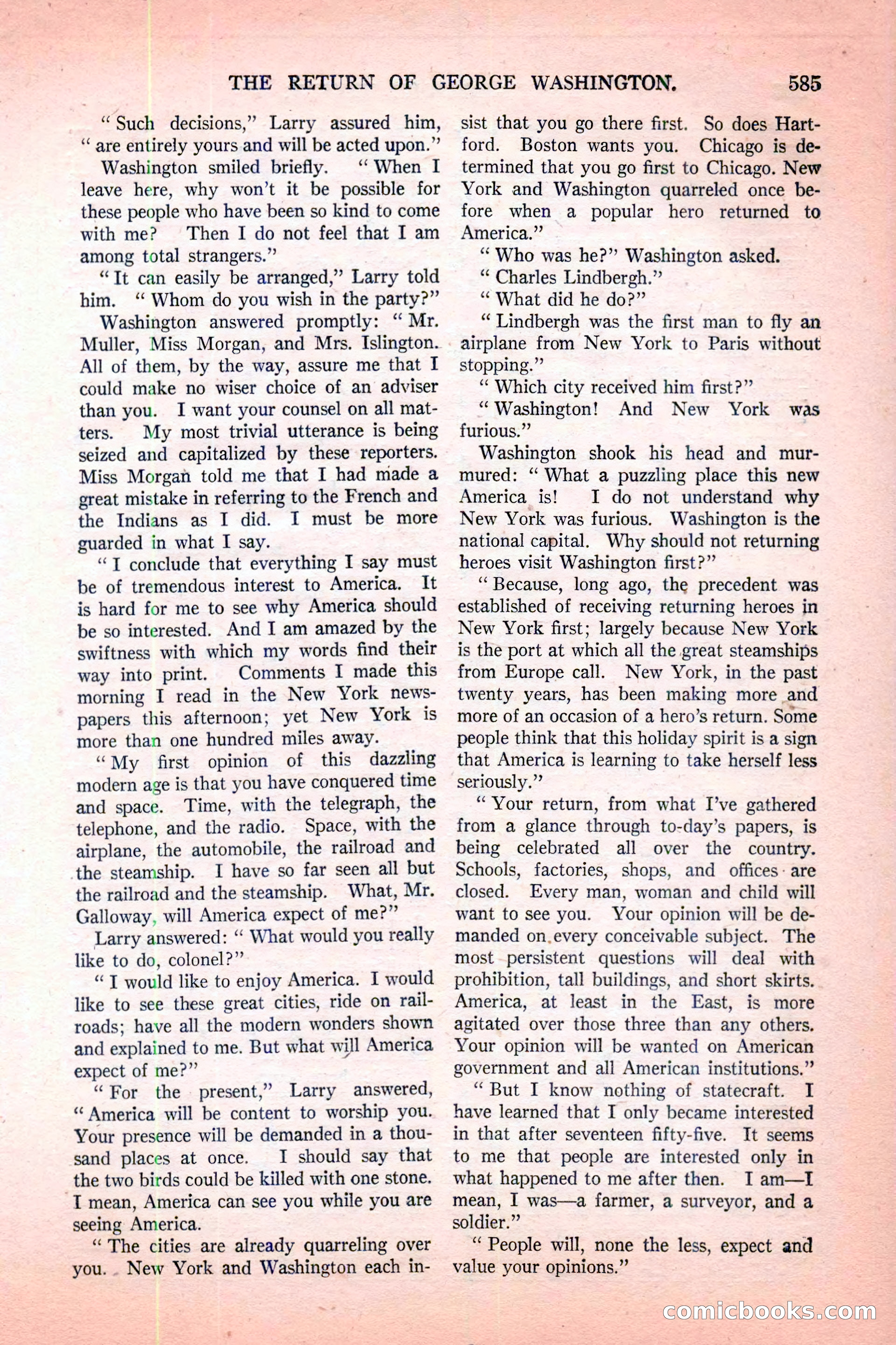
A restored page from Pulp Fiction, 1927. Page through the whole issue in the reader above.
📄 Transcribed text from this page (OCR, searchable)
Machine-transcribed from the original scan — historical spelling and the odd misread are preserved.
THE RETURN OF GEORGE WASHINGTON. “Such decisions,” Larry assured him, ‘are entirely yours and will be acted upon.” Washington smiled briefly. ‘‘ When I leave here, why won’t it be possible for these people who have been so kind to come with me? Then I do not feel that I am among total strangers.” “Tt can easily be arranged,” Larry told him. ‘ Whom do you wish in the party?” Washington answered promptly: “ Mr. Muller, Miss Morgan, and Mrs. Islington. All of them, by the way, assure me that I could make no wiser choice of an adviser than you. I want your counsel on all mat- ters. My most trivial utterance is being seized and capitalized by these reporters. Miss Morgan told me that I had made a great mistake in referring to the French and the Indians as I did. I must be more guarded in what I say. “T conclude that everything I say must be of tremendous interest to America. It is hard for me to see why America should be so interested. And I am amazed by the swiftness with which my words find their way into print. Comments I made this morning I read in the New York news- papers this afternoon; yet New York is more than one hundred miles away. “My first opinion of this dazzling modern age is that you have conquered time and space. Time, with the telegraph, the telephone, and the radio. Space, with the airplane, the automobile, the railroad and the steamship. I have so far seen all but the railroad and the steamship. What, Mr. Galloway, will America expect of me?” Larry answered: “ What would you really like to do, colonel?” “ T would like to enjoy America. I would like to see these great cities, ride on rail- roads; have all the modern wonders shown and explained to me. But what will America expect of me?”’ “For the present,” Larry answered, “ America will be content to worship you. Your presence will be demanded in a thou- sand places at once. I should say that the two birds could be killed with one stone. IT mean, America can see you while you are seeing America. “ The cities are already quarreling over you. . New York and Washington each in- 585 sist that you go there first. So does Hart- ford. Boston wants you. Chicago is de- termined that you go first to Chicago. New York and Washington quarreled once be- fore when a popular hero returned to America.” “Who was he?” Washington asked. “* Charles Lindbergh.” “What did he do?” “Lindbergh was the first man to fly an airplane from New York to Paris without stopping.” Which city received him first?” “Washington! And New York was furious.” Washington shook his head and mur- mured: ‘‘ What a puzzling place this new America is! I do not understand why New York was furious. Washington is the national capital. Why should not returning heroes visit Washington first?” ‘““ Because, long ago, the precedent was established of receiving returning heroes in New York first; largely because New York is the port at which all the great steamships from Europe call. New York, in the past twenty years, has been making more and more of an occasion of a hero’s return. Some people think that this holiday spirit is a sign that America is learning to take herself less seriously.” “Your return, from what I’ve gathered from a glance through to-day’s papers, is being celebrated all over the country. Schools, factories, shops, and offices: are closed. Every man, woman and child will want to see you. Your opinion will be de- manded on.every conceivable subject. The most persistent questions will deal with prohibition, tall buildings, and short skirts. America, at least in the East, is more agitated over those three than any others. Your opinion will be wanted on American government and all American institutions.” “ But I know nothing of statecraft. I have learned that I only became interested in that after seventeen fifty-five. It seems to me that people are interested only in what happened to me after then. I am—tI mean, I was—a farmer, a surveyor, and a soldier.” ‘People will, none the less, expect and value your opinions.” COPMIG LOOKS (E@)