
Pulp Fiction, 1927 · page 12 of 168
Argosy All-Story Weekly, November 12, 1927 — page 12: what you’re looking at
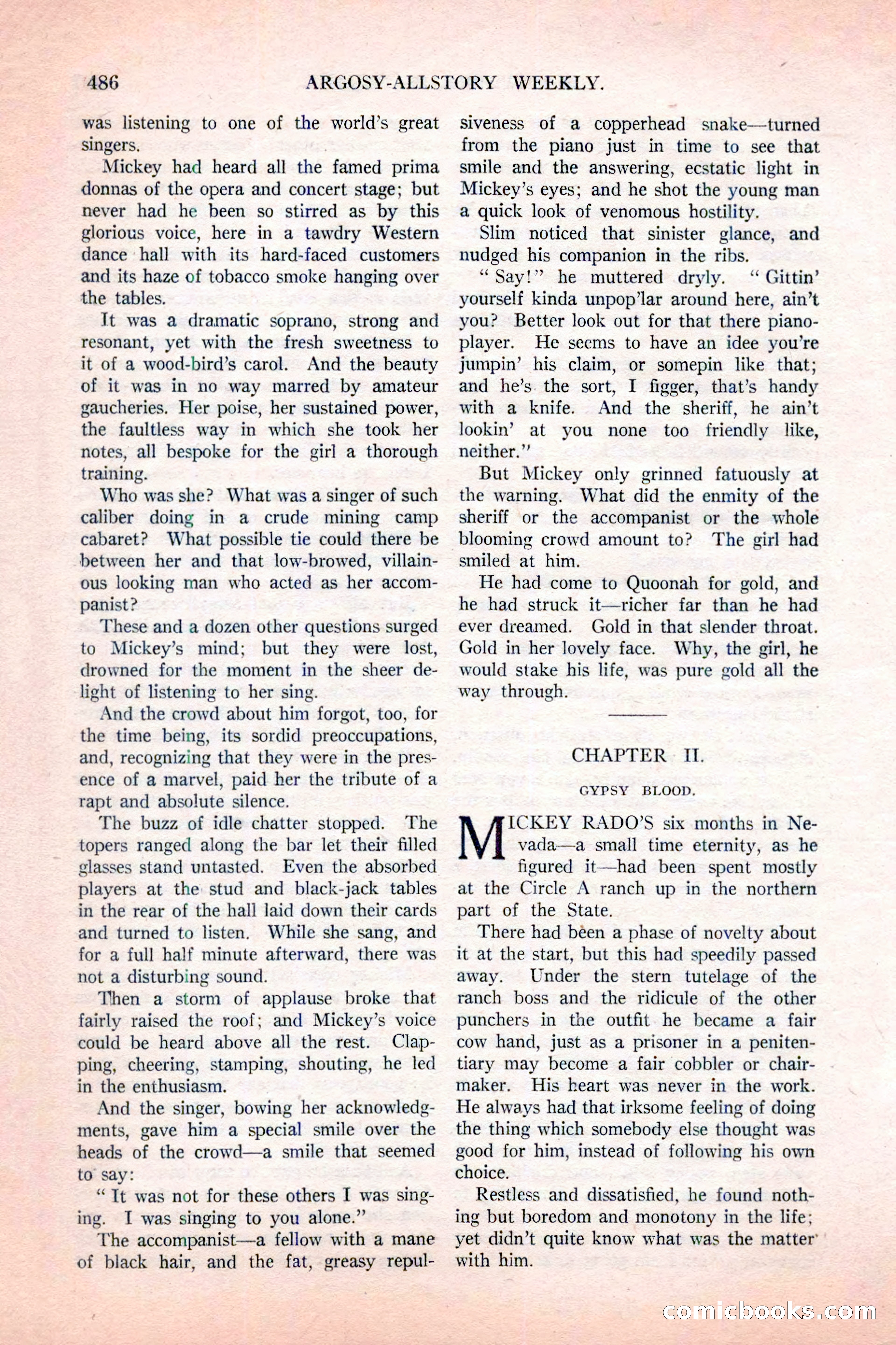
A restored page from Pulp Fiction, 1927. Page through the whole issue in the reader above.
📄 Transcribed text from this page (OCR, searchable)
Machine-transcribed from the original scan — historical spelling and the odd misread are preserved.
A86 was listening to one of the world’s great singers, | Mickey had heard all the famed prima donnas of the opera and concert stage; but never had he been so stirred as by this glorious voice, here in a tawdry Western dance hall with its hard-faced customers and its haze of tobacco smoke hanging over the tables. It was a dramatic soprano, strong and resonant, yet with the fresh sweetness to it of a wood-bird’s carol. And the beauty of it was in no way marred by amateur gaucheries. Her poise, her sustained power, the faultless way in which she took her notes, all bespoke for the girl a thorough training. Who was she? What was a singer of such caliber doing in a crude mining camp cabaret? What possible tie could there be between her and that low-browed, villain- ous looking man who acted as her accom- panist ? These and a dozen other questions surged to Mickey’s mind; but they were lost, drowned for the moment in the sheer de- light of listening to her sing. And the crowd about him forgot, too, for the time being, its sordid preoccupations, and, recognizing that they were in the pres- ence of a marvel, paid her the tribute of a rapt and absolute silence. The buzz of idle chatter stopped. The topers ranged along the bar let their filled classes stand untasted. Even the absorbed players at the stud and black-jack tables in the rear of the hall laid down their cards and turned to listen. While she sang, and for a full half minute afterward, there was not a disturbing sound. Then a storm of applause broke that fairly raised the roof; and Mickey’s voice could be heard above all the rest. Clap- ping, cheering, stamping, shouting, he led in the enthusiasm. And the singer, bowing her acknowledg- ments, gave him a special smile over the heads of the crowd—a smile that seemed to say: “Tt was not for these others I was sing- ing. TI was singing to you alone.” The accompanist—a fellow with a mane of black hair, and the fat, greasy repul- ARGOSY-ALLSTORY WEEKLY. siveness of a copperhead snake—turned from the piano just in time to see that smile and the answering, ecstatic light in Mickey’s eyes; and he shot the young man a quick look of venomous hostility. Slim noticed that sinister glance, and nudged his companion in the ribs. “Say!” he muttered dryly. ‘“ Gittin’ yourself kinda unpop’lar around here, ain’t you? Better look out for that there piano- player. He seems to have an idee you’re jumpin’ his claim, or somepin like that; and he’s. the sort, I figger, that’s handy with a knife. And the sheriff, he ain’t lookin’ at you none too friendly like, neither.” But Mickey only grinned fatuously at the warning. What did the enmity of the sheriff or the accompanist or the whole blooming crowd amount to? The girl had smiled at him. He had come to Quoonah for gold, and he had struck it—richer far than he had ever dreamed. Gold in that slender throat. Gold in her lovely face. Why, the girl, he would stake his life, was pure gold all the way through. _—_—— CHAPTER | II. GYPSY ICKEY RADO’S six months in Ne- vada—a small time eternity, as he figured it—had been spent mostly at the Circle A ranch up in the northern part of the State. There had béen a phase of novelty about it at the start, but this had speedily passed away. Under the stern tutelage of the ranch boss and the ridicule of the other punchers in the outfit he became a fair cow hand, just as a prisoner in a peniten- tiary may become a fair cobbler or chair- maker. His heart was never in the work. He always had that irksome feeling of doing the thing which somebody else thought was good for him, instead of following his own choice. Restless and dissatisfied, he found noth- ing but boredom and monotony in the life; BLOOD. yet didn’t quite know what was the matter’ with him. COPMICLOOOKS (C@)