
Pulp Fiction, 1927 · page 120 of 168
Argosy All-Story Weekly, November 12, 1927 — page 120: what you’re looking at
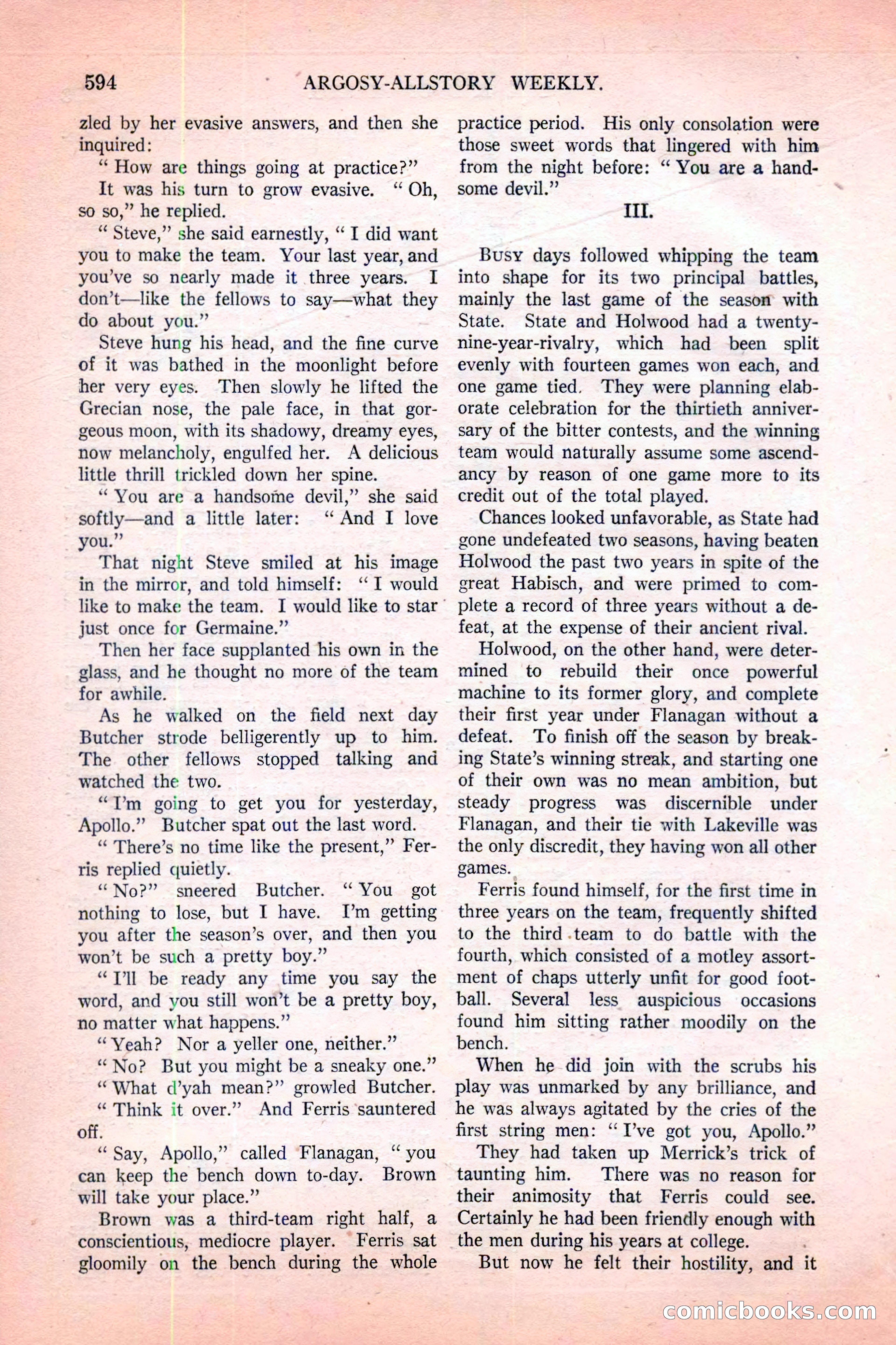
A restored page from Pulp Fiction, 1927. Page through the whole issue in the reader above.
📄 Transcribed text from this page (OCR, searchable)
Machine-transcribed from the original scan — historical spelling and the odd misread are preserved.
594 zled by her evasive answers, and then she inquired: “How are things going at practice?” It was his turn to grow evasive. ‘ Oh, so so,” he replied. “Steve,” she said earnestly, “ I did want you to make the team. Your last year, and you’ve so nearly made it three years. I don’t—like the fellows to say—what they do about you.” Steve hung his head, and the fine curve of it was bathed in the moonlight before her very eyes. Then slowly he lifted the Grecian nose, the pale face, in that gor- geous moon, with its shadowy, dreamy eyes, now melancholy, engulfed her. A delicious little thrill trickled down her spine. “You are a handsome devil,” she said softly—and a little later: ‘And I love you.” That night Steve smiled at his image in the mirror, and told himself: ‘‘ I would like to make the team. I would like to star just once for Germaine.” Then her face supplanted his own in the glass, and he thought no more of the team for awhile. As he walked on the field next day Butcher strode belligerently up to him. The other fellows stopped talking and watched the two. “Tm going to get you for yesterday, Apollo.” Butcher spat out the last word. ‘“‘ There’s no time like the present,” Fer- ris replied quietly. “No?” sneered Butcher. “‘ You got nothing to lose, but I have. I’m getting you after the season’s over, and then you won’t be such a pretty boy.” “Tl be ready any time you say the word, and you still won’t be a pretty boy, no matter what happens.” “Veah? Nor a yeller one, neither.” “No? But you might be a sneaky one.” “What d’yah mean?” growled Butcher. “ Think it over.” And Ferris sauntered off. “Say, Apollo,” called Flanagan, “ you can keep the bench down to-day. Brown will take your place.” Brown was a third-team right half, a conscientious, mediocre player. Ferris sat ~ gloomily on the bench during the whole -ARGOSY-ALLSTORY WEEKLY. practice period. His only consolation were those sweet words that lingered with him from the night before: “ You are a hand- some devil.” IIT. Busy days followed whipping the team into shape for its two principal battles, mainly the last game of the season with State. State and Holwood had a twenty- nine-year-rivalry, which had been split evenly with fourteen games won each, and one game tied. They were planning elab- orate celebration for the thirtieth anniver- sary of the bitter contests, and the winning team would naturally assume some ascend- ancy by reason of one game more to its credit out of the total played. Chances looked unfavorable, as State had gone undefeated two seasons, having beaten Holwood the past two years in spite of the great Habisch, and were primed to com- plete a record of three years without a de- feat, at the expense of their ancient rival. Holwood, on the other hand, were deter- mined to rebuild their once powerful machine to its former glory, and complete their first year under Flanagan without a defeat. To finish off the season by break- ing State’s winning streak, and starting one of their own was no mean ambition, but steady progress was discernible under Flanagan, and their tie with Lakeville was the only discredit, they having won all other games. Ferris found himself, for the first time in three years on the team, frequently shifted to the third.team to do battle with the fourth, which consisted of a motley assort- ment of chaps utterly unfit for good foot- ball. Several less auspicious occasions found him sitting rather moodily on the bench. When he did join with the scrubs his play was unmarked by any brilliance, and he was always agitated by the cries of the first string men: “I’ve got you, Apollo.” They had taken up Merrick’s trick of taunting him. There was no reason for their animosity that Ferris could see. Certainly he had been friendly enough with the men during his years at college. But now he felt their hostility, and it "col JOOKS AMI (E@)