
Pulp Fiction, 1927 · page 130 of 168
Argosy All-Story Weekly, November 12, 1927 — page 130: what you’re looking at
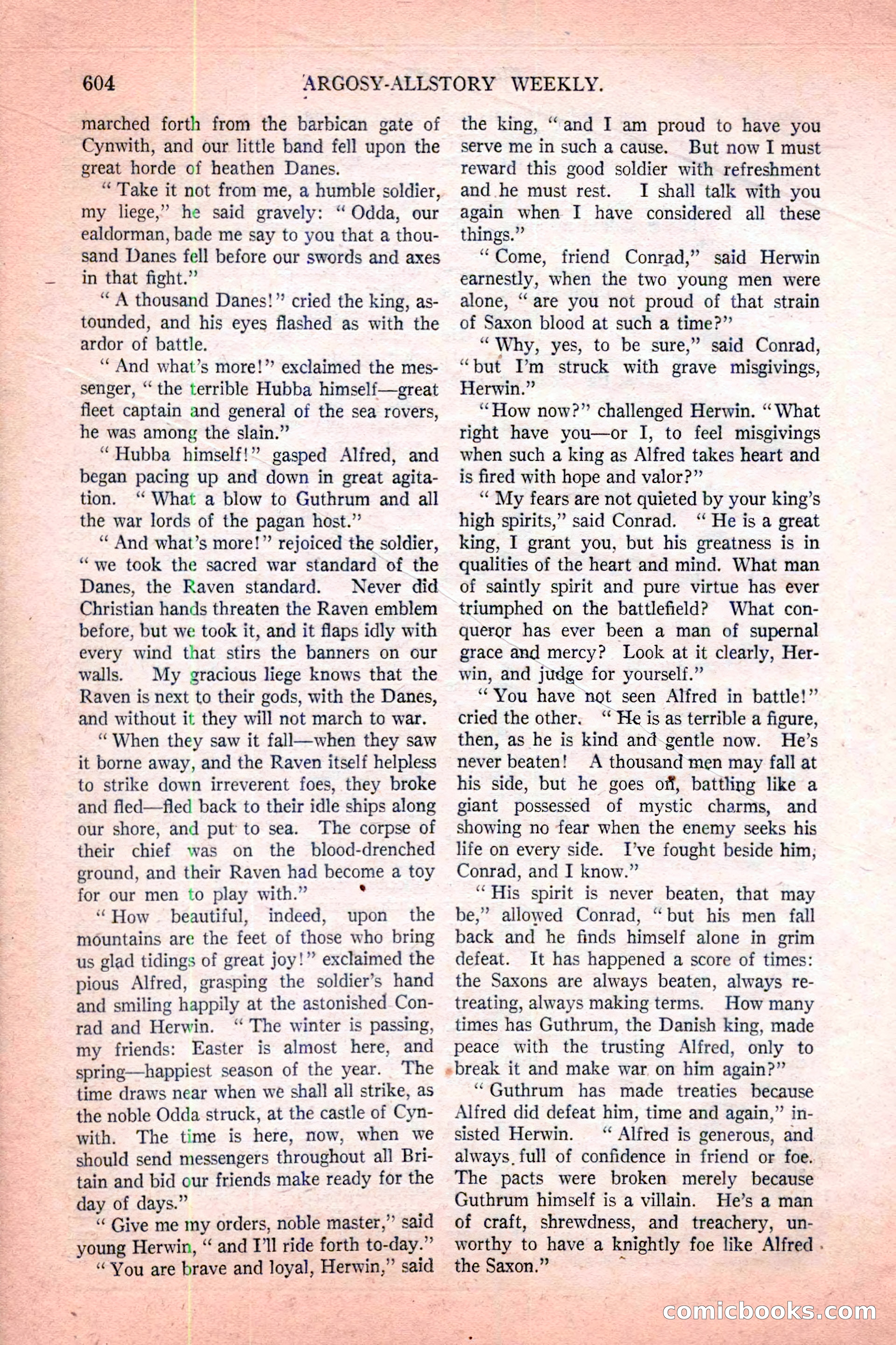
A restored page from Pulp Fiction, 1927. Page through the whole issue in the reader above.
📄 Transcribed text from this page (OCR, searchable)
Machine-transcribed from the original scan — historical spelling and the odd misread are preserved.
604 marched forth from the barbican gate of Cynwith, and our little band fell upon the great horde of heathen Danes. “Take it not from me, a humble soldier, my liege,” he said gravely: “ Odda, our ealdorman, bade me say to you that a thou- sand Danes fell before our swords and axes in that fight.” “A thousand Danes!” cried the king, as- tounded, and his eyes flashed as with the ardor of battle. ‘““ And what’s more!” exclaimed the mes- senger, “the terrible Hubba himself—great fleet captain and general of the sea rovers, he was among the slain.” “Hubba himself!” gasped Alfred, and began pacing up and down in great agita- tion. ‘“ What a blow to Guthrum and all the war lords of the pagan host.” “And what’s more!” rejoiced the soldier, “we took the sacred war standard of the Danes, the Raven standard. Never did Christian hands threaten the Raven emblem before, but we took it, and it flaps idly with every wind that stirs the banners on our walls. My gracious liege knows that the Raven is next to their gods, with the Danes, and without it they will not march to war. “When they saw it fall—when they saw it borne away, and the Raven itself helpless to strike down irreverent foes, they broke and fled—filed back to their idle ships along our shore, and put to sea. The corpse of their chief was on the blood-drenched ground, and their Raven had become a toy for our men to play with.” : “How beautiful, indeed, upon the mountains are the feet of those who bring us glad tidings of great joy!” exclaimed the pious Alfred, grasping the soldier’s hand and smiling happily at the astonished Con- rad and Herwin. ‘“ The winter is passing, my friends: Easter is almost here, and spring—happiest season of the year. The time draws near when we shall all strike, as the noble Odda struck, at the castle of Cyn- with. The time is here, now, when we should send messengers throughout all Bri- tain and bid our friends make ready for the day of days.” “Give me my orders, noble master,” said young Herwin, “ and I'll ride forth to-day.” “You are brave and loyal, Herwin,” said AE ARGOSY-ALLSTORY WEEKLY. the king, “and I am proud to have you serve me in such a cause. But now I must reward this good soldier with refreshment and he must rest. I shall talk with you again when I have considered all these things.” “Come, friend Conrad,” said Herwin earnestly, when the two young men were alone, “are you not proud of that strain of Saxon blood at such a time?” “Why, yes, to be sure,” said Conrad, “but I’m struck with grave misgivings, Herwin.” “How now?” challenged Herwin. “What right have you—or I, to feel misgivings when such a king as Alfred takes heart and is fired with hope and valor?” ‘My fears are not quieted by your king’s high spirits,” said Conrad. “ He is a great king, I grant you, but his greatness is in qualities of the heart and mind. What man of saintly spirit and pure virtue has ever triumphed on the battlefield? What con- queror has ever been a man of supernal grace and mercy? Look at it clearly, Her- win, and judge for yourself.” “You have not seen Alfred in battle!” cried the other. “‘ He is as terrible a figure, then, as he is kind and-gentle now. He’s never beaten! <A thousand men may fall at his side, but he goes off, battling like a giant possessed of mystic charms, and showing no fear when the enemy seeks his life on every side. I’ve fought beside him; Conrad, and I know.” “His spirit is never beaten, that may be,” allowed Conrad, “but his men fall back and he finds himself alone in grim defeat. It has happened a score of times: the Saxons are always beaten, always re- treating, always making terms. How many times has Guthrum, the Danish king, made peace with the trusting Alfred, only to «break it and make war on him again?” ‘“Guthrum has made treaties because Alfred did defeat him, time and again,” in- sisted Herwin. “Alfred is generous, and always, full of confidence in friend or foe. The pacts were broken merely because Guthrum himself is a villain. He’s a man of craft, shrewdness, and treachery, un- worthy to have a knightly foe like Alfred . the Saxon.” Gomichbooks com