
Pulp Fiction, 1927 · page 133 of 168
Argosy All-Story Weekly, November 12, 1927 — page 133: what you’re looking at
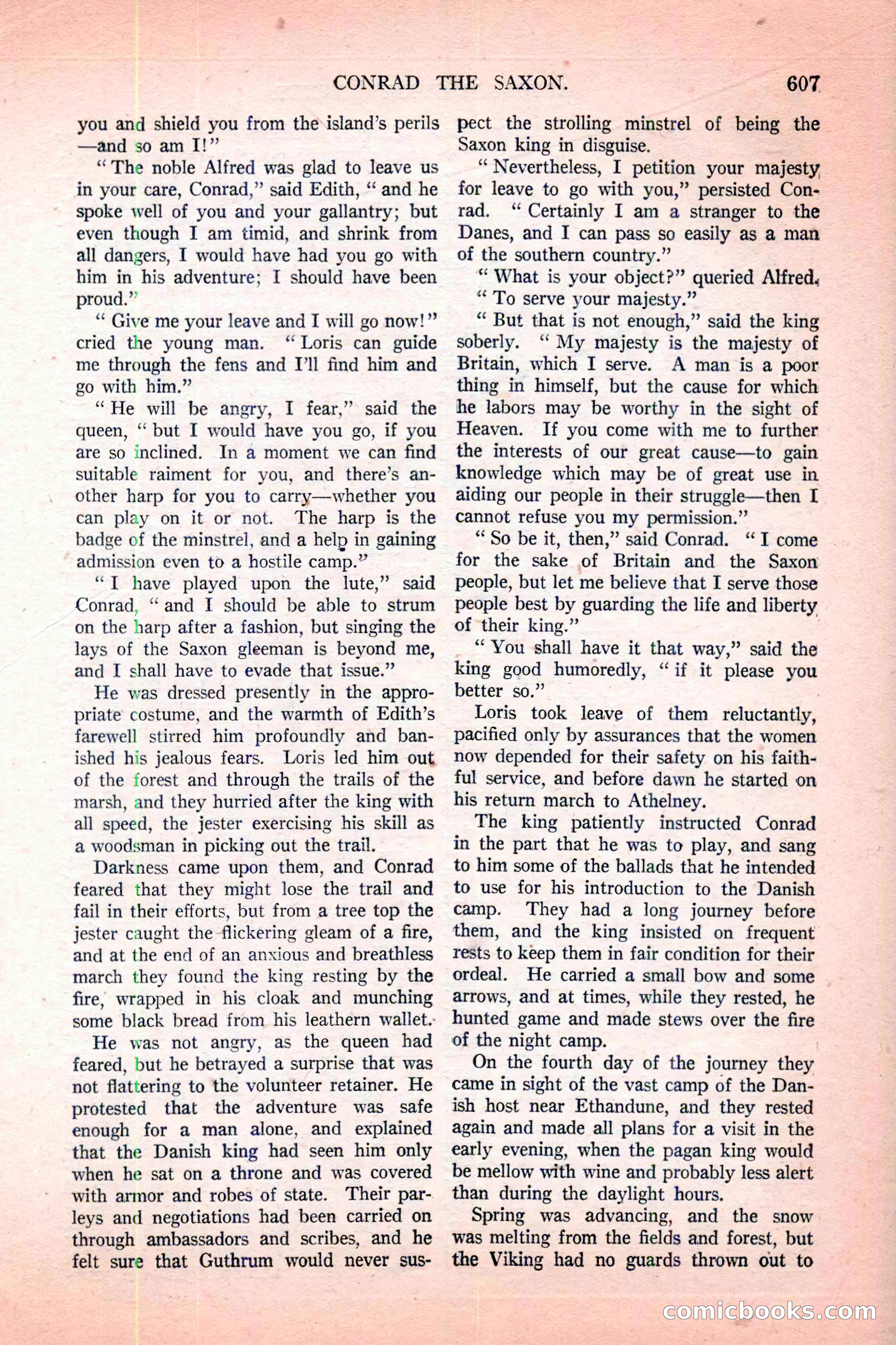
A restored page from Pulp Fiction, 1927. Page through the whole issue in the reader above.
📄 Transcribed text from this page (OCR, searchable)
Machine-transcribed from the original scan — historical spelling and the odd misread are preserved.
CONRAD THE SAXON. you and shield you from the island’s perils —and so am [!” “The noble Alfred was glad to leave us in your care, Conrad,” said Edith, ‘‘ and he spoke well of you and your gallantry; but even though I am timid, and shrink from all dangers, I would have had you go with him in his adventure; I should have been proud.”’ ‘“* Give me your leave and I will go now!” cried the young man. “ Loris can guide me through the fens and Ill find him and go with him.” “He will be angry, I fear,” said the queen, ‘‘ but I would have you go, if you are so inclined. In a moment we can find suitable raiment for you, and there’s an- other harp for you to carry—whether you can play on it or not. The harp is the badge of the minstrel, and a help in gaining admission even to a hostile camp.” ‘““T have played upon the lute,” said Conrad, “ and I should be able to strum on the harp after a fashion, but singing the lays of the Saxon gleeman is beyond me, and I shall have to evade that issue.” He was dressed presently in the appro- priate costume, and the warmth of Edith’s farewell stirred him profoundly and ban- ished his jealous fears. Loris led him out of the forest and through the trails of the marsh, and they hurried after the king with all speed, the jester exercising his skill as a woodsman in picking out the trail. Darkness came upon them, and Conrad feared that they might lose the trail and fail in their efforts, but from a tree top the jester caught the flickering gleam of a fire, and at the end of an anxious and breathless march they found the king resting by the fire, wrapped in his cloak and munching some black bread from his leathern wallet. He was not angry, as the queen had feared, but he betrayed a surprise that was not flattering to the volunteer retainer. He protested that the adventure was safe enough for a man alone, and explained that the Danish king had seen him only when he sat on a throne and was covered with armor and robes of state. Their par- leys and negotiations had been carried on through ambassadors and scribes, and he felt sure that Guthrum would never sus- 607 pect the strolling minstrel of being the Saxon king in disguise. ‘“ Nevertheless, I petition your majesty for leave to go with you,” persisted Con- rad, “ Certainly I am a stranger to the Danes, and I can pass so easily as a man of the southern country.” “ What is your object?” queried Alfred, ‘To serve your majesty.” “ But that is not enough,” said the king soberly. “‘ My majesty is the majesty of Britain, which I serve. A man is a poor thing in himself, but the cause for which he labors may be worthy in the sight of Heaven. If you come with me to further the interests of our great cause—to gain knowledge which may be of great use in aiding our people in their struggle—then I cannot refuse you my permission.” “So be it, then,” said Conrad. “I come for the sake of Britain and the Saxon people, but let me believe that I serve those people best by guarding the life and liberty of their king.” “You shall have it that way,” said the king good humoredly, “if it please you better so.” Loris took leave of them reluctantly, pacified only by assurances that the women now depended for their safety on his faith- ful service, and before dawn he started on his return march to Athelney. The king patiently instructed Conrad in the part that he was to play, and sang to him some of the ballads that he intended to use for his introduction to the Danish camp. They had a long journey before them, and the king insisted on frequent rests to keep them in fair condition for their ordeal. He carried a small bow and some arrows, and at times, while they rested, he hunted game and made stews over the fire of the night camp. On the fourth day of the journey they came in sight of the vast camp of the Dan- ish host near Ethandune, and they rested again and made all plans for a visit in the early evening, when the pagan king would be mellow with wine and probably less alert than during the daylight hours. Spring was advancing, and the snow was melting from the fields and forest, but the Viking had no guards thrown out to CONNIE OOS (CE)