
Pulp Fiction, 1927 · page 140 of 168
Argosy All-Story Weekly, November 12, 1927 — page 140: what you’re looking at
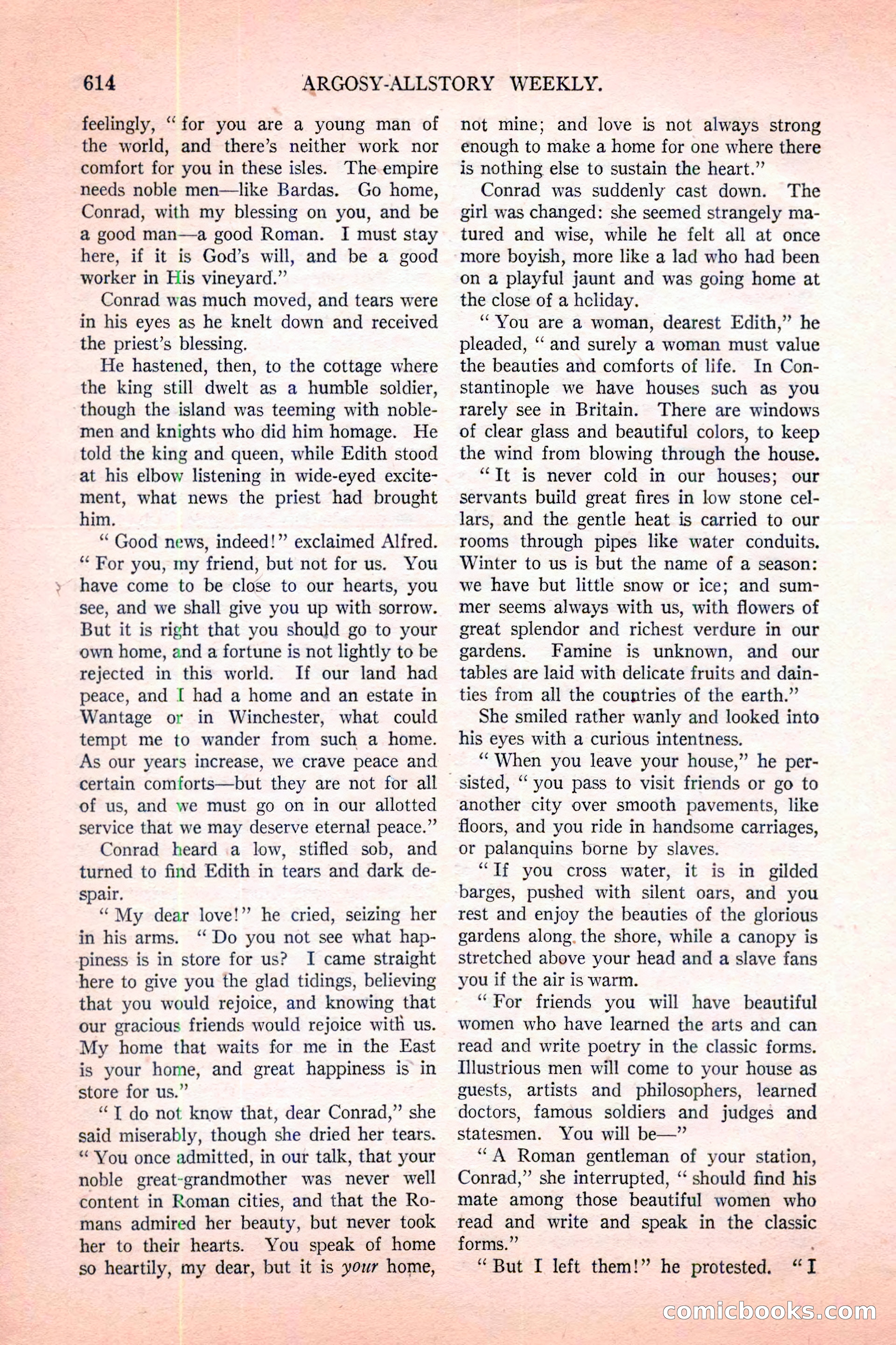
A restored page from Pulp Fiction, 1927. Page through the whole issue in the reader above.
📄 Transcribed text from this page (OCR, searchable)
Machine-transcribed from the original scan — historical spelling and the odd misread are preserved.
614 feelingly, “for you are a young man of the world, and there’s neither work nor comfort for you in these isles. The empire needs noble men—like Bardas. Go home, Conrad, with my blessing on you, and be a good man—a good Roman. I must stay here, if it is God’s will, and be a good worker in His vineyard.” Conrad was much moved, and tears were in his eyes as he knelt down and received the priest’s blessing. He hastened, then, to the cottage where the king still dwelt as a humble soldier, though the island was teeming with noble- men and knights who did him homage. He told the king and queen, while Edith stood at his elbow listening in wide-eyed excite- ment, what news the priest had brought him. “ Good news, indeed!” exclaimed Alfred. * For you, my friend, but not for us. You have come to be close to our hearts, you see, and we shall give you up with sorrow. But it is right that you should go to your own home, and a fortune is not lightly to be rejected in this world. If our land had peace, and [ had a home and an estate in Wantage or in Winchester, what could tempt me to wander from such a home. As our years increase, we crave peace and certain comforts—but they are not for all of us, and we must go on in our allotted service that we may deserve eternal peace.” Conrad heard a low, stifled sob, and turned to find Edith in tears and dark de- spair, “My dear love!” he cried, seizing her in his arms. ‘‘ Do you not see what hap- piness is in store for us? I came straight here to give you the glad tidings, believing that you would rejoice, and knowing that our gracious friends would rejoice with us. My home that waits for me in the East is your home, and great happiness is in store for us.” “T do not know that, dear Conrad,” she said miserably, though she dried her tears. “You once admitted, in our talk, that your noble great-grandmother was never well content in Roman cities, and that the Ro- mans admired her beauty, but never took her to their hearts. You speak of home so heartily, my dear, but it is your home, ARGOSY-ALLSTORY WEEKLY. not mine; and love is not always strong enough to make a home for one where there is nothing else to sustain the heart.” Conrad was suddenly cast down. The girl was changed: she seemed strangely ma- tured and wise, while he felt all at once more boyish, more like a lad who had been on a playful jaunt and was going home at the close of a hcliday. “You are a woman, dearest Edith,” he pleaded, ‘‘ and surely a woman must value the beauties and comforts of life. In Con- stantinople we have houses such as you rarely see in Britain. There are windows of clear glass and beautiful colors, to keep the wind from blowing through the house. “It is never cold in our houses; our servants build great fires in low stone cel- lars, and the gentle heat is carried to our rooms through pipes like water conduits. Winter to us is but the name of a season: we have but little snow or ice; and sum- mer seems always with us, with flowers of great splendor and richest verdure in our gardens. Famine is unknown, and our tables are laid with delicate fruits and dain- ties from all the countries of the earth.” She smiled rather wanly and looked into his eyes with a curious intentness. “When you leave your house,” he per- sisted, “you pass to visit friends or go to another city over smooth pavements, like floors, and you ride in handsome carriages, or palanquins borne by slaves. “If you cross water, it is in gilded barges, pushed with silent oars, and you rest and enjoy the beauties of the glorious gardens along, the shore, while a canopy is stretched above your head and a slave fans you if the air is warm. “For friends you will have beautiful women who have learned the arts and can read and write poetry in the classic forms. Illustrious men will come to your house as guests, artists and philosophers, learned doctors, famous soldiers and judges and statesmen. You will be—” “A Roman gentleman of your station, Conrad,” she interrupted, “ should find his mate among those beautiful women who read and write and speak in the classic forms.” “But I left them!” he protested. “I CEOPMICL OO KS (E@)