
Pulp Fiction, 1927 · page 157 of 168
Argosy All-Story Weekly, November 12, 1927 — page 157: what you’re looking at
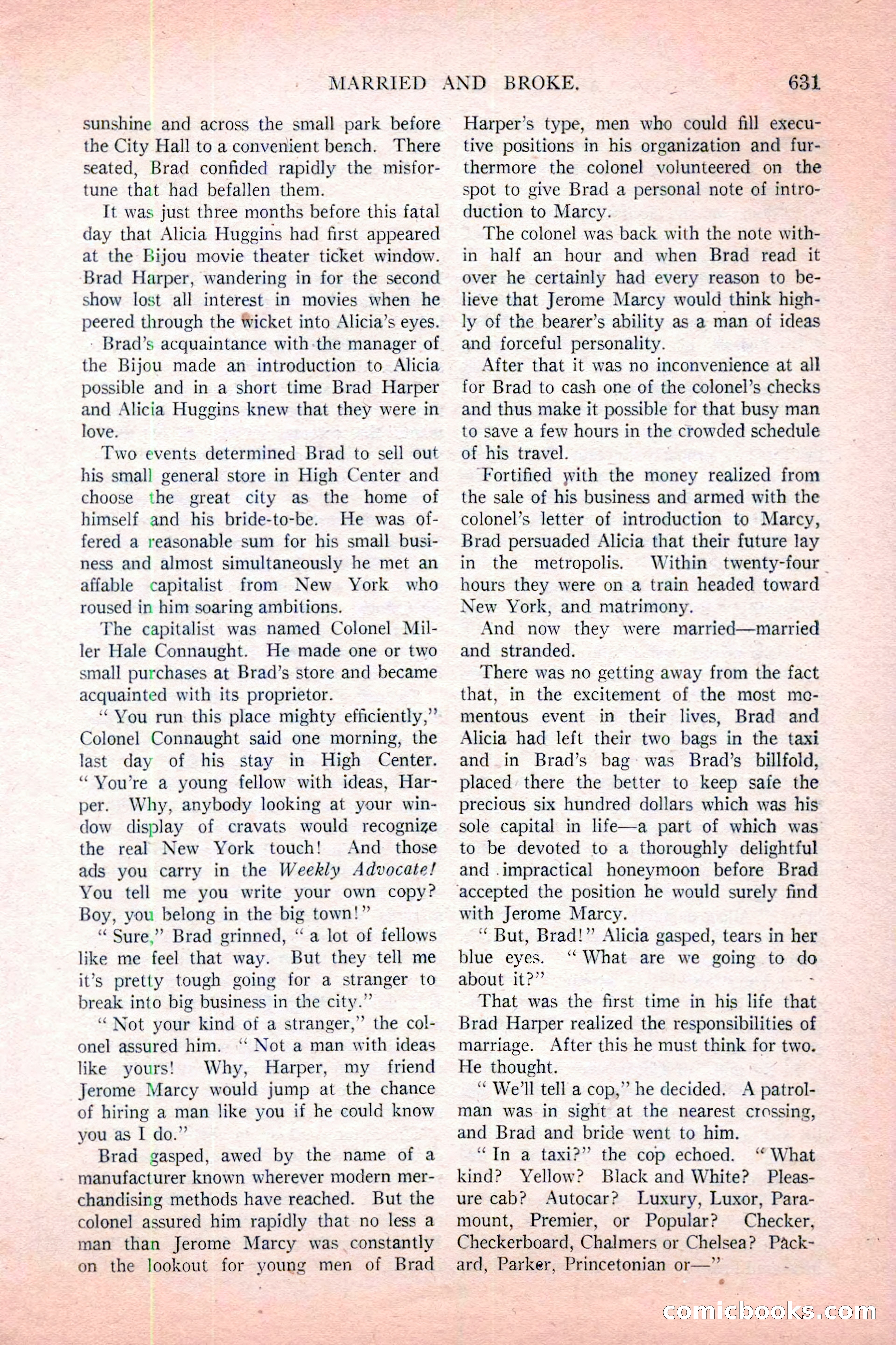
A restored page from Pulp Fiction, 1927. Page through the whole issue in the reader above.
📄 Transcribed text from this page (OCR, searchable)
Machine-transcribed from the original scan — historical spelling and the odd misread are preserved.
MARRIED AND BROKE, sunshine and across the small park before the City Hall to a convenient bench. There seated, Brad confided rapidly the misfor- tune that had befallen them. It was just three months before this fatal day that Alicia Huggins had first appeared at the Bijou movie theater ticket window. Brad Harper, wandering in for the second show lost all interest in movies when he peered through the Wicket into Alicia’s eyes. - Brad’s acquaintance with the manager of the Bijou made an introduction to Alicia possible and in a short time Brad Harper and Alicia Huggins knew that they were in love. Two events determined Brad to sell out his small general store in High Center and choose the great city as the home of himself and his bride-to-be. He was of- fered a reasonable sum for his small busi- ness and almost simultaneously he met an affable capitalist from New York who roused in him soaring ambitions. The capitalist was named Colonel Mil- ler Hale Connaught. He made one or two small purchases at Brad’s store and became acquainted with its proprietor. ‘You run this place mighty efficiently,” Colonel Connaught said one morning, the last day of his stay in High Center. “‘You’re a young fellow with ideas, Har- per. Why, anybody looking at your win- dow display of cravats would recognize the real New York touch! And_ those ads you carry in the Weekly Advocate! You tell me you write your own copy? Boy, you belong in the big town!” “ Sure,” Brad grinned, “a lot of fellows like me feel that way. But they tell me it’s pretty tough going for a stranger to break into big business in the city.” ‘Not your kind of a stranger,” the col- onel assured him. ‘“‘ Not a man with ideas like yours! Why, Harper, my friend Jerome Marcy would jump at the chance of hiring a man like you if he could know you as I do.” Brad gasped, awed by the name of a manufacturer known wherever modern mer- chandising methods have reached. But the colonel assured him rapidly that no less a man than Jerome Marcy was _ constantly on the lookout for young men of Brad 631 Harper’s type, men who could fill execu- tive positions in his organization and fur- thermore the colonel volunteered on the spot to give Brad a personal note of intro- duction to Marcy. The colonel was back with the note with- in half an hour and when Brad read it over he certainly had every reason to be- lieve that Jerome Marcy would think high- ly of the bearer’s ability as a man of ideas and forceful personality. After that it was no inconvenience at all for Brad to cash one of the colonel’s checks and thus make it possible for that busy man to save a few hours in the crowded schedule of his travel. ‘Fortified with the money realized from the sale of his business and armed with the colonel’s letter of introduction to Marcy, Brad persuaded Alicia that their future lay in the metropolis. hours they were on a train headed toward New York, and matrimony. And now they were married—married and stranded. There was no getting away from the fact that, in the excitement of the most meo- mentous event in their lives, Brad and Alicia had left their two bags in the taxi and in Brad’s bag- was Brad’s_ billfold, placed there the better to keep safe the precious six hundred dollars which was his sole capital in life—a part of which was to be devoted to a thoroughly delightful and .impractical honeymoon before Brad accepted the position he would surely find with Jerome Marcy. ‘“ But, Brad!” Alicia gasped, tears in her blue eyes. ‘“‘ What are we going to do about it?” d That was the first time in his life that Brad Harper realized the responsibilities of marriage. After this he must think for two. He thought. ‘“ We'll tell a cop,” he decided. A patrol- man was in sight at the nearest crossing, and Brad and bride went to him. “In a taxi?” the cop echoed. ‘“ What kind? Yellow? Black and White? Pleas- ure cab? Autocar? Luxury, Luxor, Para- mount, Premier, or Popular? Checker, Checkerboard, Chalmers or Chelsea? Pack- ard, Parker, Princetonian or—”’ CEOPMIC LOOKS Within twenty-four (F@)