
Pulp Fiction, 1927 · page 166 of 168
Argosy All-Story Weekly, November 12, 1927 — page 166: what you’re looking at
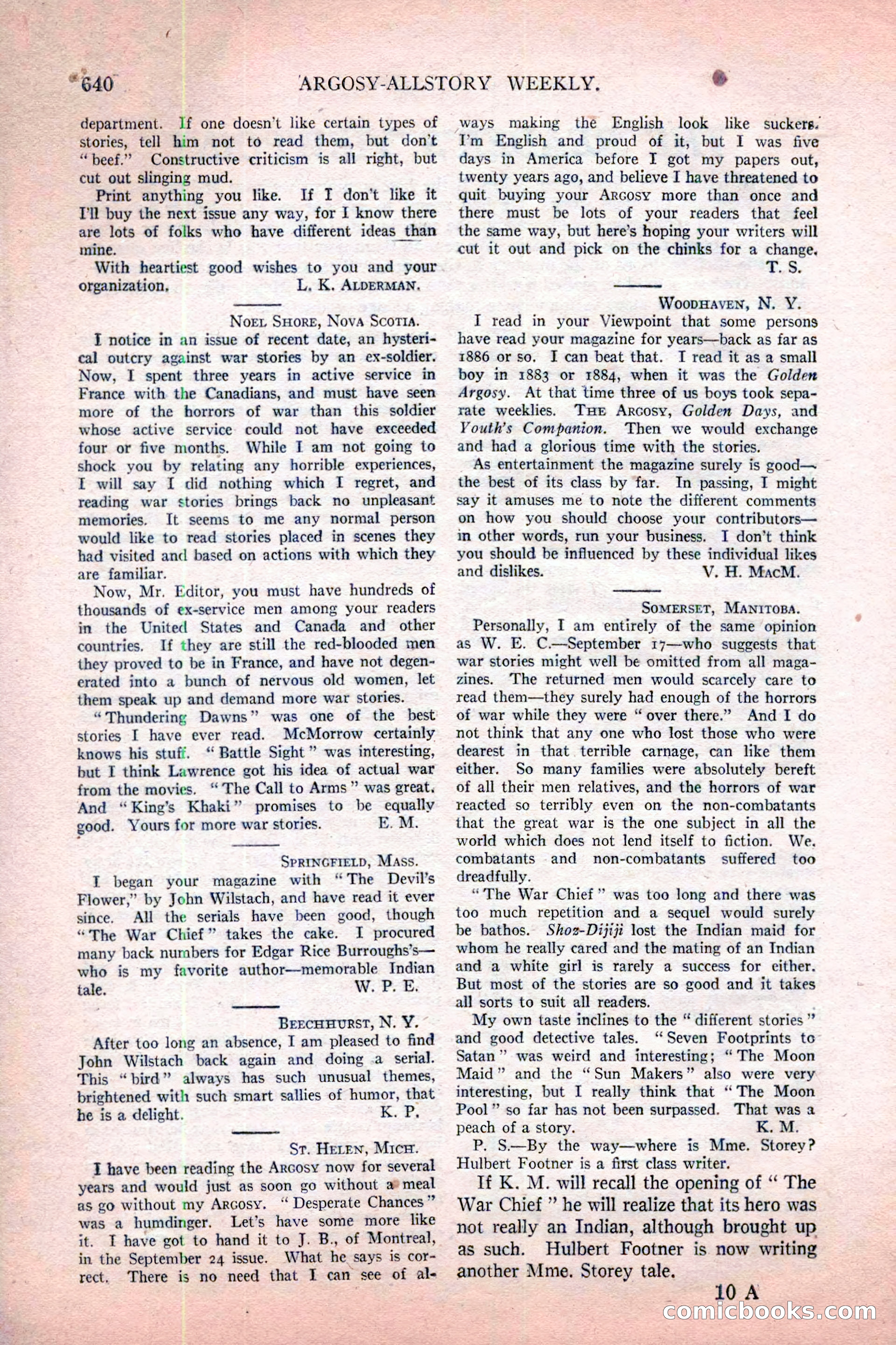
A restored page from Pulp Fiction, 1927. Page through the whole issue in the reader above.
📄 Transcribed text from this page (OCR, searchable)
Machine-transcribed from the original scan — historical spelling and the odd misread are preserved.
*640 department. Jf one doesn’t like certain types of stories, tell him not to read them, but don't “beef.” Constructive criticism is all right, but cut out slinging mud. Print anything you like. If I don't like it T'll buy the next issue any way, for L know there are lots of folks who have different ideas than mine. With heartiest good wishes to you and your organization, L, K. ALDERMAN. Noer SHORE, Nova SCOTIA. I notice in an issue of recent date, an hysteri- cal outcry against war stories by an ex-soldier. Now, I spent three years in active service in France with the Canadians, and must have seen more of the horrors of war than this soldier whose active service could not have exceeded four or five months. While I am not going to shock you by relating any horrible experiences, I will say I did nothing which I regret, and reading war stories brings back no unpleasant memories. It seems to me any normal person would like to read stories placed in scenes they had visited and based on actions with which they are familiar. Now, Mr. Editor, you must have hundreds of thousands of ex-service men among your readers in the United States and Canada and other countries. If they are still the red-blooded men they proved to be in France, and have not degen- erated into a bunch of nervous old women, let them speak up and demand more war stories. “Thundering Dawns” was one of the best stories I have ever read. McMorrow certainly knows his stuff. “ Battle Sight ’ was interesting, but I think Lawrence got his idea of actual war from the movies. “The Call to Arms” was great, And “King’s Khaki” promises to be equally good. Yours for more war stories. E. M. SPRINGFIELD, Mass. I began your magazine with “The Devil’s Flower,” by John Wilstach, and have read it ever since. All the serials have been good, though “The War Chief” takes the cake. I procured many back numbers for Edgar Rice Burroughs’s— who is my favorite author—memorable Indian tale. W. P. E. Beecuuurst, N. Y. After too long an absence, I am pleased to find John Wilstach back again and doing .a serial. This “bird” always has such unusual themes, brightened with such smart sallies of humor, that he is a delight. Rice St. Heten, Mice. T have been reading the Arcosy now for several years and would just as soon go without a meal as go without my Arcosy. ‘“ Desperate Chances ” was a humdinger. Let’s have some more like it. I have got to hand it to J. B., of Montreal, in the September 24 issue. What he says is cor- rect. There is no need that I can see of al- ARGOSY-ALLSTORY WEEKLY. e ways making thé English look like suckers. I’m English and proud of it, but I was five days in America before I got my papers out, twenty years ago, and believe I have threatened to quit buying your Arcosy more than once and there must be lots of your readers that feel the same way, but here’s hoping your writers will cut it out and pick on the chinks for a change, a Be WoopHaven, N, Y. I read in your Viewpoint that some persons have read your magazine for years—back as far as 1886 or so. I can beat that. I read it as a small boy in 1883 or 1884, when it was the Golden Argosy. At that time three of us boys took sepa- rate weeklies. THe Arcosy, Golden Days, and Youth’s Companion. Then we would exchange and had a glorious time with the stories. As entertainment the magazine surely is gzood—~ the best of its class by far. In passing, I might say it amuses me to note the different comments on how you should choose your contributors— in other words, run your business. I don’t think you should be influenced by these individual likes and dislikes. V. H. MacM. SOMERSET, MANITOBA. Personally, I am entirely of the same opinion as W. E. C.—September 17—who suggests that war stories might well be omitted from all maga- zines. The returned men would scarcely care to read them—they surely had enough of the horrors of war while they were “over there.” And I do not think that any one who lost those who were dearest in that terrible carnage, can like them either. So many families were absolutely bereft of all their men relatives, and the horrors of war reacted so terribly even on the non-combatants that the great war is the one subject in all the world which does not lend itself to fiction. We. combatants and non-combatants suffered too dreadfully. “The War Chief” was too long and there was too much repetition and a sequel would surely be bathos. Shoz-Dijiji whom he really cared and the mating of an Indian and a white girl is rarely a success for either. But most of the stories are so good and it takes all sorts to suit all readers. ; My own taste inclines to the “ different stories ”’ and good detective tales. ‘Seven Footprints to Satan’ was weird and interesting; “ The Moon Maid” and the “Sun Makers” also were very interesting, but I really think that “The Moon Pool” so far has not been surpassed. That was a peach of a story. K. M. P. S—By the way—where is Mme. Storey? Hulbert Footner is a first class writer. If K. M. will recall the opening of ‘‘ The War Chief ” he will realize that its hero was not really an Indian, although brought up as such. Hulbert Footner is now writing another Mme. Storey tale. 10 A Eomichbooks Gon