
Pulp Fiction, 1927 · page 31 of 168
Argosy All-Story Weekly, November 12, 1927 — page 31: what you’re looking at
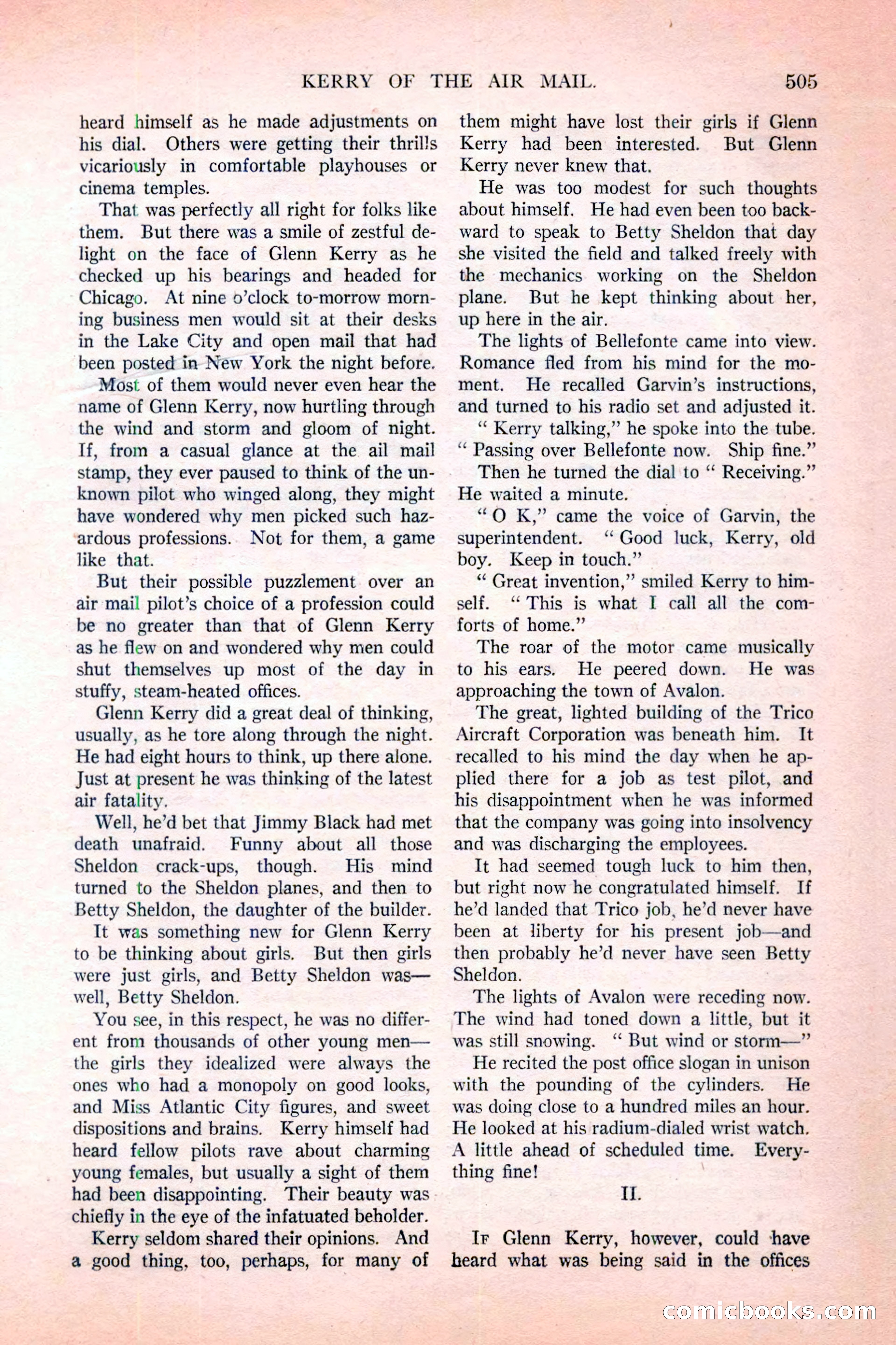
A restored page from Pulp Fiction, 1927. Page through the whole issue in the reader above.
📄 Transcribed text from this page (OCR, searchable)
Machine-transcribed from the original scan — historical spelling and the odd misread are preserved.
KERRY OF THE heard himself as he made adjustments on his dial. Others were getting their thrills vicariously in comfortable playhouses or cinema temples. That was perfectly all right for folks like them. But there was a smile of zestful de- light on the face of Glenn Kerry as he checked up his bearings and headed for Chicago. At nine o’clock to-morrow morn- ing business men would sit at their desks in the Lake City and open mail that had been posted in New York the night before. Most of them would never even hear the name of Glenn Kerry, now hurtling through the wind and storm and gloom of night. If, from a casual glance at the ail mail stamp, they ever paused to think of the un- known pilot who winged along, they might have wondered why men picked such haz- ardous professions. Not for them, a game like that. But their possible puzzlement over an air mail pilot’s choice of a profession could be no greater than that of Glenn Kerry as he flew on and wondered why men could shut themselves up most of the day in stuffy, steam-heated offices. Glenn Kerry did a great deal of thinking, usually, as he tore along through the night. He had eight hours to think, up there alone. Just at present he was thinking of the latest air fatality. Well, he’d bet that Jimmy Black had met death unafraid. Funny about all those Sheldon crack-ups, though. His mind turned to the Sheldon planes, and then to Betty Sheldon, the daughter of the builder. It was something new for Glenn Kerry to be thinking about girls. But then girls were just girls, and Betty Sheldon was— well, Betty Sheldon. You see, in this respect, he was no differ- ent from thousands of other young men— the girls they idealized were always the ones who had a monopoly on good looks, and Miss Atlantic City figures, and sweet dispositions and brains. Kerry himself had heard fellow pilots rave about charming young females, but usually a sight of them had been disappointing. Their beauty was chiefly in the eye of the infatuated beholder. Kerry seldom shared their opinions. And a good thing, too, perhaps, for many of AIR MAIL. 505 them might have lost their girls if Glenn Kerry had been interested. But Glenn Kerry never knew that. He was too modest for such thoughts about himself. He had even been too back- ward to speak to Betty Sheldon that day she visited the field and talked freely with the mechanics working on the Sheldon plane. But he kept thinking about her, up here in the air. The lights of Bellefonte came into view. Romance fled from his mind for the mo- ment. He recalled Garvin’s instructions, and turned to his radio set and adjusted it. “ Kerry talking,” he spoke into the tube. ‘“ Passing over Bellefonte now. Ship fine.” Then he turned the dial to “ Receiving.” He waited a minute. “O K,” came the voice of Garvin, the superintendent. ‘ Good luck, Kerry, old boy. Keep in touch.” “‘ Great invention,” smiled Kerry to him- self. “‘ This is what I call all the com- forts of home.” The roar of the motor came musically to his ears. He peered down. He was approaching the town of Avalon. The great, lighted building of the Trico Aircraft Corporation was beneath him. It recalled to his mind the day when he ap- plied there for a job as test pilot, and his disappointment when he was informed that the company was going into insolvency and was discharging the employees. It had seemed tough luck to him then, but right now he congratulated himself. If he’d landed that Trico job, he’d never have been at liberty for his present job—and then probably he’d never have seen Betty Sheldon. : The lights of Avalon were receding now. The wind had toned down a little, but it was still snowing. ‘ But wind or storm—” He recited the post office slogan in unison with the pounding of the cylinders. He was doing close to a hundred miles an hour. He looked at his radium-dialed wrist watch. A little ahead of scheduled time. Every- thing fine! EH, Ir Glenn Kerry, however, could have heard what was being said in the offices COPNICLOOKS (E@