
Pulp Fiction, 1927 · page 34 of 168
Argosy All-Story Weekly, November 12, 1927 — page 34: what you’re looking at
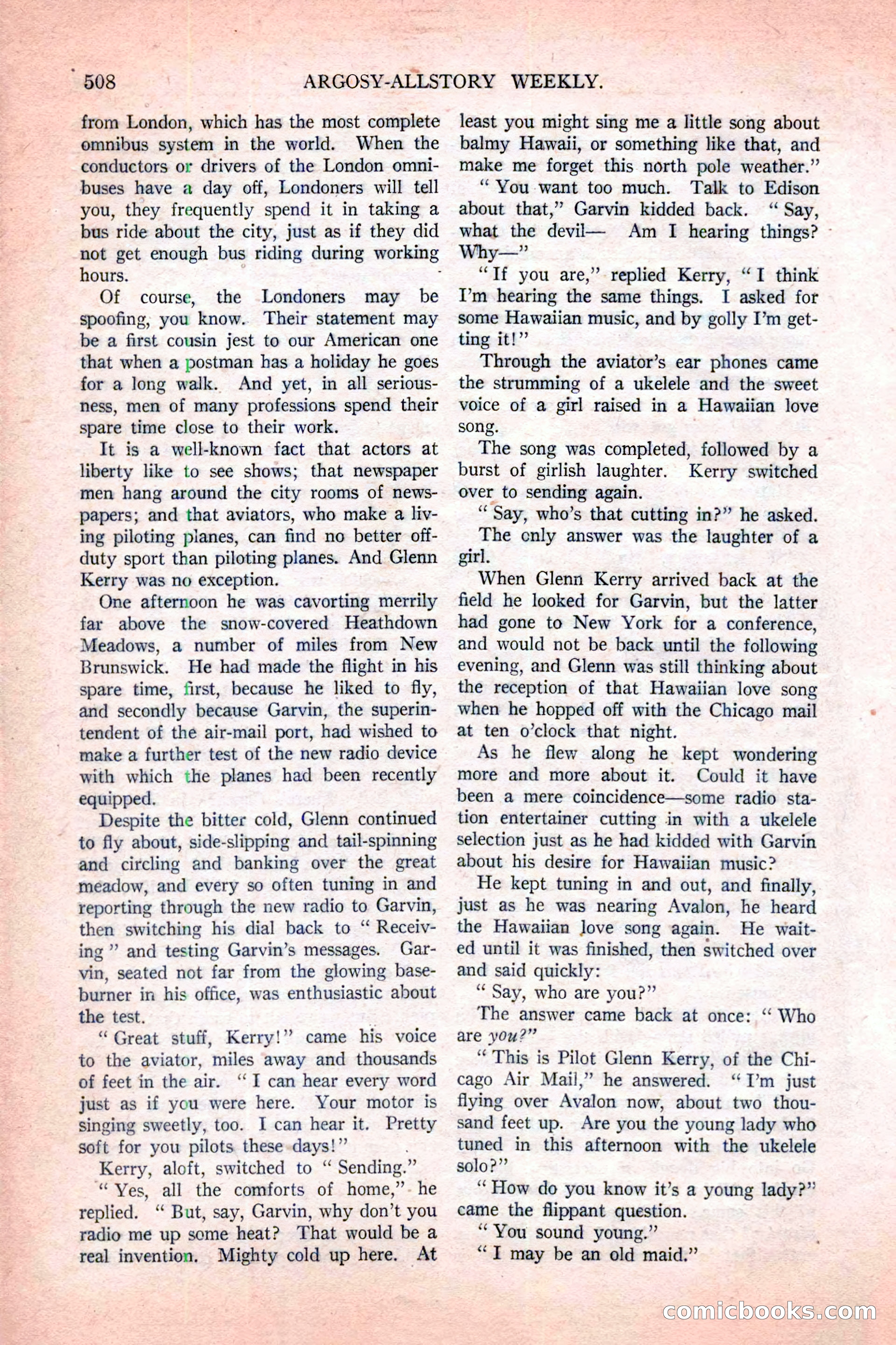
A restored page from Pulp Fiction, 1927. Page through the whole issue in the reader above.
📄 Transcribed text from this page (OCR, searchable)
Machine-transcribed from the original scan — historical spelling and the odd misread are preserved.
508 from London, which has the most complete omnibus system in the world. When the conductors or drivers of the London omni- buses have a day off, Londoners will tell you, they frequently spend it in taking a bus ride about the city, just as if they did not get enough bus riding during working hours. Of course, the Londoners may be spoofing, you know. Their statement may be a first cousin jest to our American one that when a postman has a holiday he goes for a long walk. And yet, in all serious- ness, men of many professions spend their spare time close to their work. It is a well-known fact that actors at liberty like to see shows; that newspaper men hang around the city rooms of news- papers; and that aviators, who make a liv- ing piloting planes, can find no better off- duty sport than piloting planes. And Glenn Kerry was no exception. One afternoon he was cavorting merrily far above the snow-covered Heathdown Meadows, a number of miles from New Brunswick. He had made the flight in his spare time, first, because he liked to fly, and secondly because Garvin, the superin- tendent of the air-mail port, had wished to make a further test of the new radio device with which the planes had been recently equipped. Despite the bitter cold, Glenn continued to fly about, side-slipping and tail-spinning and circling and banking over the great meadow, and every so often tuning in and reporting through the new radio to Garvin, then switching his dial back to “ Receiv- ing” and testing Garvin’s messages. Gar- vin, seated not far from the glowing base- burner in his office, was enthusiastic about the test. “Great stuff, Kerry!’’ came his voice to the aviator, miles away and thousands of feet in the air. ‘I can hear every word just as if you were here. Your motor is singing sweetly, too. I can hear it. Pretty soft for you pilots these days!” Kerry, aloft, switched to “ Sending. “Ves, all the comforts of home,’ he replied. “ But, say, Garvin, why don’t you radio me up some heat? That would be a real invention. Mighty cold up here. At ? ARGOSY-ALLSTORY WEEKLY. least you might sing me a little song about balmy Hawaii, or something like that, and make me forget this north pole weather.” “You want too much. Talk to Edison about that,” Garvin kidded back. “ Say, what the devil— Why—” “Tf you are,” replied Kerry, “I think I’m hearing the same things. I asked for some Hawaiian music, and by golly I’m get- ting it!”’ Through the aviator’s ear phones came the strumming of a ukelele and the sweet voice of a girl raised in a Hawaiian love song. The song was completed, followed by a burst of girlish laughter. Kerry switched over to sending again. ‘‘ Say, who’s that cutting in?” he asked. The only answer was the laughter of a girl. When Glenn Kerry arrived back at the field he looked for Garvin, but the latter had gone to New York for a conference, and would not be back until the following evening, and Glenn was still thinking about the reception of that Hawaiian love song when he hopped off with the Chicago mail at ten o’clock that night. As he flew along he kept wondering more and more about it. Could it have been a mere coincidence—some radio sta- tion entertainer cutting in with a ukelele selection just as he had kidded with Garvin about his desire for Hawaiian music? He kept tuning in and out, and finally, just as he was nearing Avalon, he heard the Hawaiian Jove song again. He wait- ed until it was finished, then switched over and said quickly: “* Say, who are your” The answer came back at once: are you?” “This is Pilot Glenn Kerry, of the Chi- cago Air Mail,” he answered. “I’m just flying over Avalon now, about two thou- sand feet up. Are you the young lady who tuned in this afternoon with the ukelele solo?” “How do you know it’s a young lady?” came the flippant question. ‘You sound young.” “I may be an old maid.” ** Who DOOKS (COMME Am I hearing things? — (E©)