
Pulp Fiction, 1927 · page 51 of 168
Argosy All-Story Weekly, November 12, 1927 — page 51: what you’re looking at
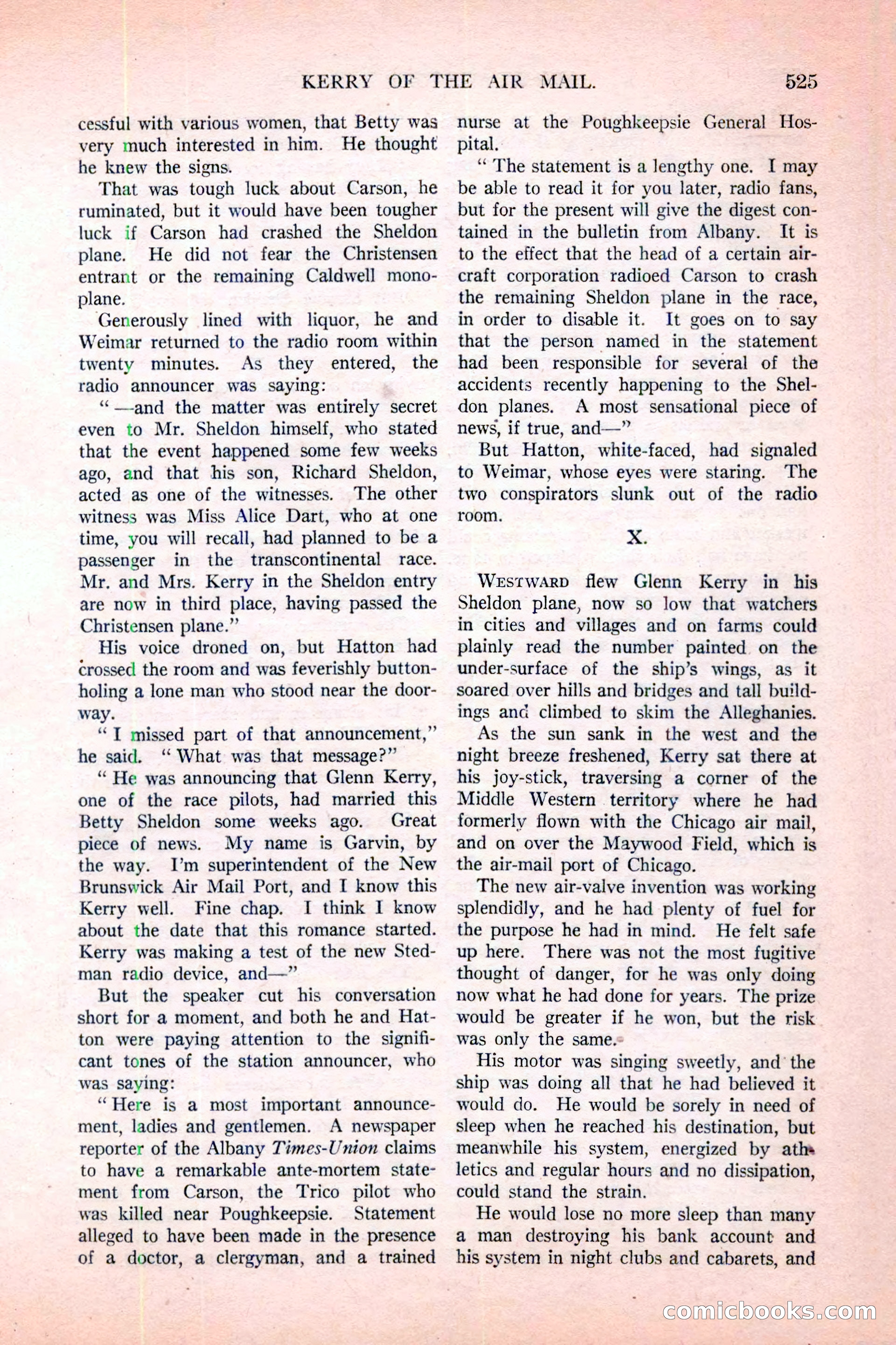
A restored page from Pulp Fiction, 1927. Page through the whole issue in the reader above.
📄 Transcribed text from this page (OCR, searchable)
Machine-transcribed from the original scan — historical spelling and the odd misread are preserved.
KERRY OF cessful with various women, that Betty was very much interested in him. He thought he knew the signs. That was tough luck about Carson, he ruminated, but it would have been tougher luck if Carson had crashed the Sheldon plane. He did not fear the Christensen entrant or the remaining Caldwell mono- plane. Generously lined with liquor, he and Weimar returned to the radio room within twenty minutes. As they entered, the radio announcer was saying: ‘“_and the matter was entirely secret even to Mr. Sheldon himself, who stated that the event happened some few weeks ago, and that his son, Richard Sheldon, acted as one of the witnesses. The other witness was Miss Alice Dart, who at one time, you will recall, had planned to be a passenger in the transcontinental race. Mr. and Mrs. Kerry in the Sheldon entry are now in third place, having passed the Christensen plane.”’ His voice droned on, but Hatton had crossed the room and was feverishly button- holing a lone man who stood near the door- way. “T missed part of that announcement,” he said. ‘ What was that message?” “ He was announcing that Glenn Kerry, one of the race pilots, had married this Betty Sheldon some weeks ago. Great piece of news. My name is Garvin, by the way. I’m superintendent of the New Brunswick Air Mail Port, and I know this Kerry well. Fine chap. I think I know about the date that this romance started. Kerry was making a test of the new Sted- man radio device, and—”’ But the speaker cut his conversation short for a moment, and both he and Hat- ton were paying attention to the signifi- cant tones of the station announcer, who was saying: “Here is a most important announce- ment, ladies and gentlemen. A newspaper reporter of the Albany Times-Union claims to have a remarkable ante-mortem state- ment from Carson, the Trico pilot who was killed near Poughkeepsie. Statement alleged to have been made in the presence of a doctor, a clergyman, and a trained THE AIR MAIL. 525 nurse at the Poughkeepsie General Hos- pital. “The statement is a lengthy one. I may be able to read it for you later, radio fans, but for the present will give the digest con- tained in the bulletin from Albany. It is to the effect that the head of a certain air- craft corporation radioed Carson to crash the remaining Sheldon plane in the race, in order to disable it. It goes on to say that the person named in the statement had been responsible for several of the accidents recently happening to the Shel- don planes. A most sensational piece of news, if true, and—” But Hatton, white-faced, had signaled to Weimar, whose eyes were staring. The two conspirators slunk out of the radio room. X. Westwarp flew Glenn Kerry in his Sheldon plane, now so low that watchers in cities and villages and on farms could plainly read the number painted on the under-surface of the ship’s wings, as it soared over hills and bridges and tall build- ings and climbed te skim the Alleghanies. As the sun sank in the west and the night breeze freshened, Kerry sat there at his joy-stick, traversing a corner of the Middle Western territory where he had formerly flown with the Chicago air mail, and on over the Maywood Field, which is the air-mail port of Chicago. The new air-valve invention was working splendidly, and he had plenty of fuel for the purpose he had in mind. He felt safe up here. There was not the most fugitive thought of danger, for he was only doing now what he had done for years. The prize would be greater if he won, but the risk was only the same.* His motor was singing sweetly, and’ the ship was doing all that he had believed it would do. He would be sorely in need of sleep when he reached his destination, but meanwhile his system, energized by athe letics and regular hours and no dissipation, could stand the strain. He would lose no more sleep than many a man destroying his bank account and his system in night clubs and cabarets, and COPMICLOOOKS (E@