
Pulp Fiction, 1927 · page 54 of 168
Argosy All-Story Weekly, November 12, 1927 — page 54: what you’re looking at
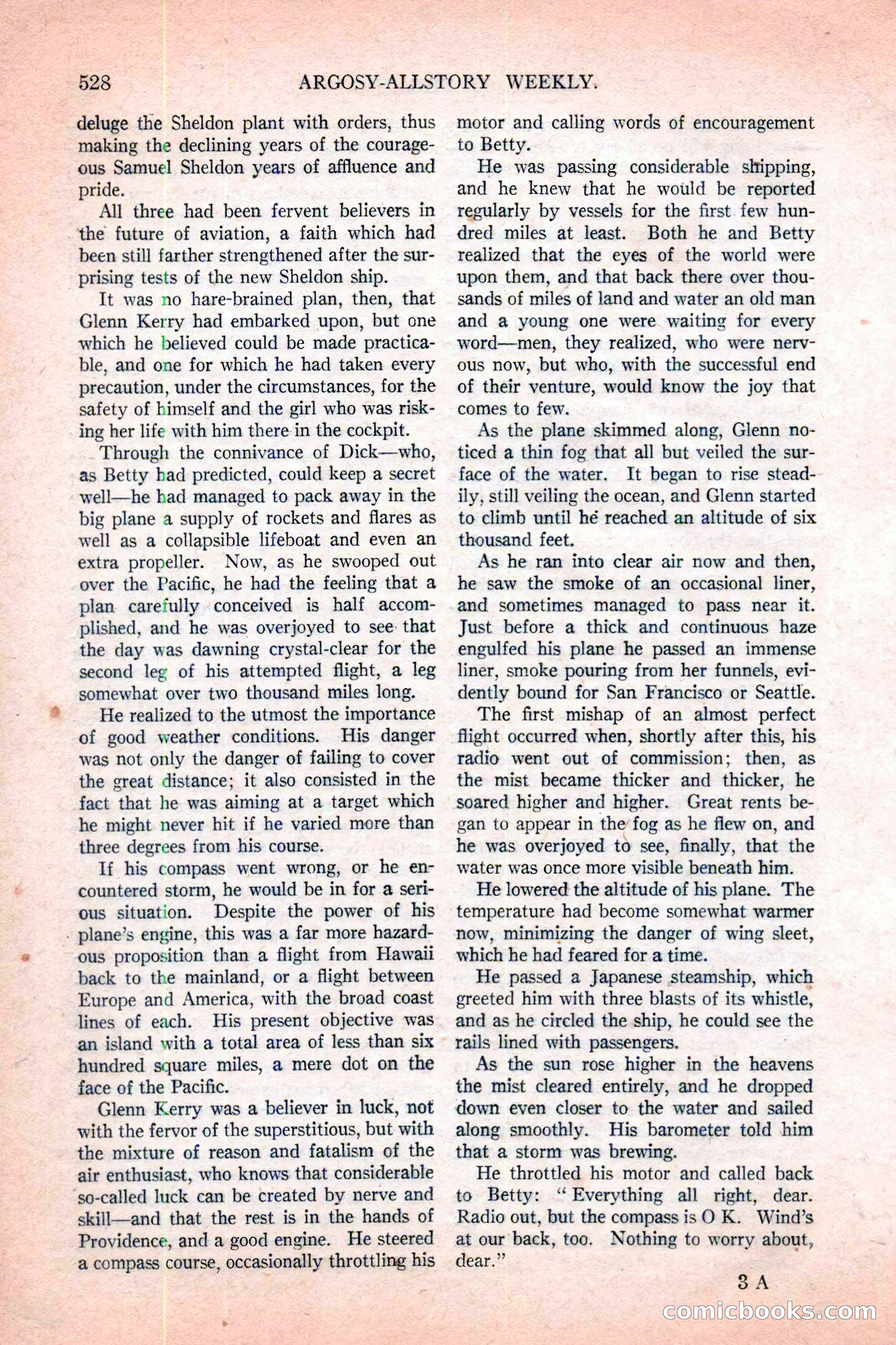
A restored page from Pulp Fiction, 1927. Page through the whole issue in the reader above.
📄 Transcribed text from this page (OCR, searchable)
Machine-transcribed from the original scan — historical spelling and the odd misread are preserved.
28 deluge the Sheldon plant with orders, thus making the declining years of the courage- ous Samuel Sheldon years of affluence and pride. All three had been fervent believers in the future of aviation, a faith which had been still farther strengthened after the sur- prising tests of the new Sheldon ship. It was no hare-brained plan, then, that Glenn Kerry had embarked upon, but one which he believed could be made practica- ble, and one for which he had taken every precaution, under the circumstances, for the safety of himself and the girl who was risk- ing her life with him there in the cockpit. Through the connivance of Dick—who, as Betty had predicted, could keep a secret well—he had managed to pack away in the big plane a supply of rockets and flares as well as a collapsible lifeboat and even an extra propeller. Now, as he swooped out over the Pacific, he had the feeling that a plan carefully conceived is half accom- plished, and he was overjoyed to see: that the day was dawning crystal-clear for the second leg of his attempted flight, a leg somewhat over two thousand miles long. He realized to the utmost the importance of good weather conditions. His danger was not only the danger of failing to cover the great distance; it also consisted in the fact that he was aiming at a target which he might never hit if he varied more than three degrees from his course. If his compass went wrong, or he en- countered storm, he would be in for a seri- ous situation. Despite the power of his . plane’s engine, this was a far more hazard- ous proposition than a flight from Hawaii back to the mainland, or a flight between Europe and America, with the broad coast lines of each. His present objective was an island with a total area of less than six hundred square miles, a mere dot on the face of the Pacific. Glenn Kerry was a believer in luck, not with the fervor of the superstitious, but with the mixture of reason and fatalism of the air enthusiast, who knows that considerable so-called luck can be created by nerve and skill—and that the rest is in the hands of Providence, and a good engine. He steered a compass course, occasionally throttling his ARGOSY-ALLSTORY WEEKLY. motor and calling words of encouragement to Betty. He was passing considerable shipping, and he knew that he would be reported regularly by vessels for the first few hun- dred miles at least. Both he and Betty realized that the eyes of the world were upon them, and that back there over thou- sands of miles of land and water an old man and a young one were waiting for every word—men, they realized, who were nerv- ous now, but who, with the successful end of their venture, would know the joy that comes to few. As the plane skimmed along, Glenn no- ticed a thin fog that all but veiled the sur- face of the water. It began to rise stead- ily, still veiling the ocean, and Glenn started to climb until hé reached an altitude of six thousand feet. As he ran into clear air now and then, he saw the smoke of an occasional liner, and sometimes managed to pass near it. Just before a thick and continuous haze engulfed his plane he passed an immense liner, smoke pouring from her funnels, evi- dently bound for San Francisco or Seattle. The first mishap of an almost perfect flight occurred when, shortly after this, his radio went out of commission; then, as the mist became thicker and thicker, he soared higher and higher. Great rents be- gan to appear in the fog as he flew on, and he was overjoyed to see, finally, that the water was once more visible beneath him. He lowered the altitude of his plane. The temperature had become somewhat warmer now, minimizing the danger of wing sleet, which he had feared for a time. He passed a Japanese steamship, which greeted him with three blasts of its whistle, and as he circled the ship, he could see the rails lined with passengers. As the sun rose higher in the heavens the mist cleared entirely, and he dropped down even closer to the water and sailed along smoothly. His barometer told him that a storm was brewing. He throttled his motor and called back to Betty: “Everything all right, dear. Radio out, but the compass is O K. Wind’s at our back, too. Nothing to worry about, dear.” 3A COPMNICLOOOKS (E©)