
Pulp Fiction, 1927 · page 67 of 168
Argosy All-Story Weekly, November 12, 1927 — page 67: what you’re looking at
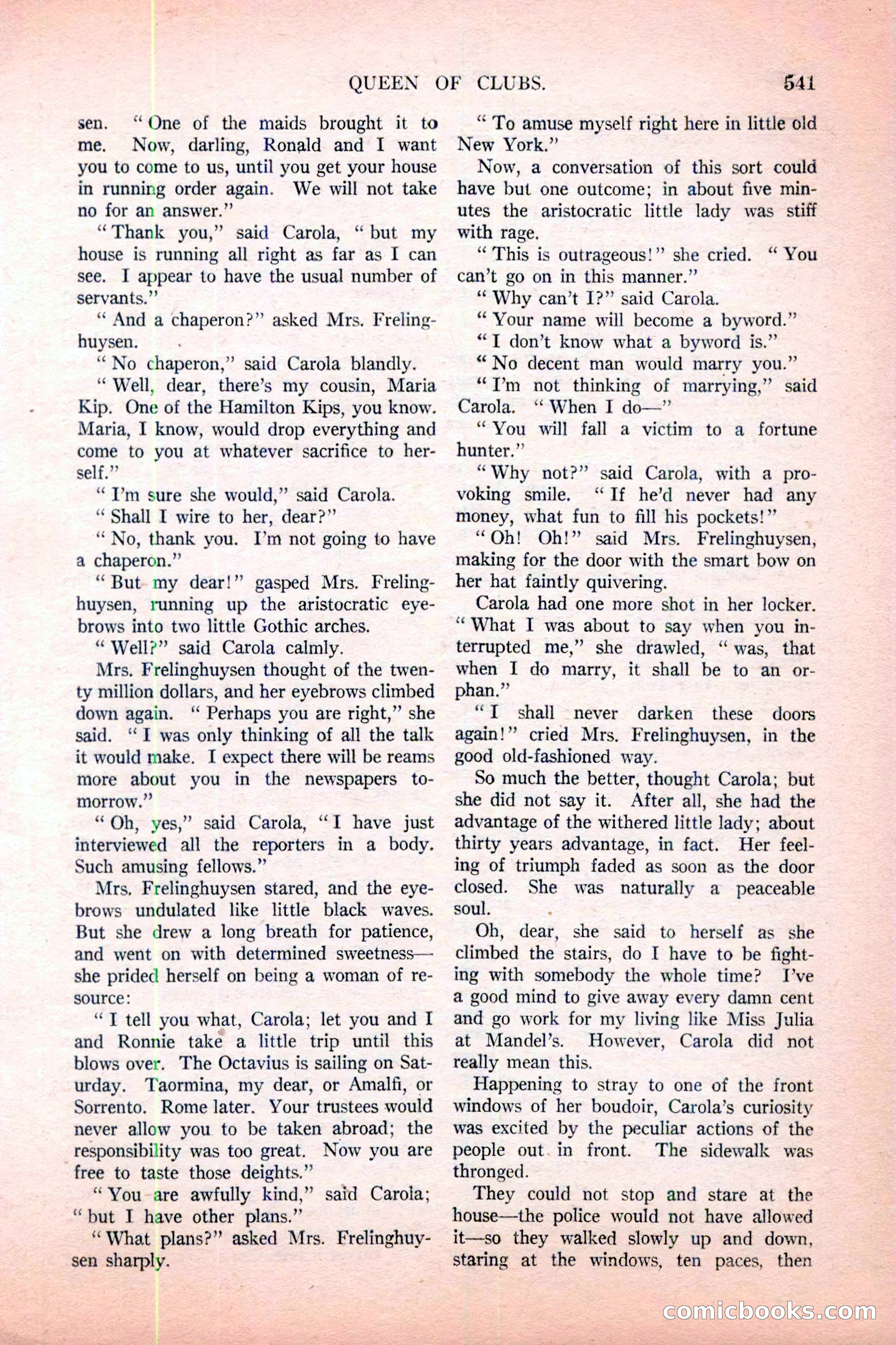
A restored page from Pulp Fiction, 1927. Page through the whole issue in the reader above.
📄 Transcribed text from this page (OCR, searchable)
Machine-transcribed from the original scan — historical spelling and the odd misread are preserved.
QUEEN OF CLUBS. sen. “One of the maids brought it to me. Now, darling, Ronald and I want you to come to us, until you get your house in running order again. We will not take no for an answer.” “Thank you,” said Carola, “ but my house is running all right as far as I can see. I appear to have the usual number of servants.”’ “And a chaperon?” asked Mrs. Freling- huysen. ‘No chaperon,” said Carola blandly. “Well, dear, there’s my cousin, Maria Kip. One of the Hamilton Kips, you know. Maria, I know, would drop everything and come to you at whatever sacrifice to her- self.” ‘“1’m sure she would,” said Carola. “ Shall I wire to her, dear?” “No, thank you. I’m not going to have a chaperon.” “But. my dear!” gasped Mrs. Freling- huysen, running up the aristocratic eye- brows into two little Gothic arches. “Well?” said Carola calmly. Mrs. Frelinghuysen thought of the twen- ty million dollars, and her eyebrows climbed down again. ‘‘ Perhaps you are right,” she said. ‘“ I was only thinking of all the talk it would make. I expect there will be reams more about you in the newspapers to- morrow.” “Oh, yes,” said Carola, “I have just interviewed all the reporters in a_ body. Such amusing fellows.” Mrs, Frelinghuysen stared, and the eye- brows undulated like little black waves. But she drew a long breath for patience, and went on with determined sweetness— she prided herself on being a woman of re- source: “T tell you what, Carola; let you and I and Ronnie take a little trip until this blows over. The Octavius is sailing on Sat- urday. Taormina, my dear, or Amalfi, or Sorrento. Rome later. Your trustees would never allow you to be taken abroad; the responsibility was too great. Now you are free to taste those deights.” “‘You-are awfully kind,” said Carola; “but I have other plans.” “What plans?” asked Mrs. Frelinghuy- sen sharply. 5AL “To amuse myself right here in little old New York.” Now, a conversation of this sort could have but one outcome; in about five min- utes the aristocratic little lady was stiff with rage, “This is outrageous!” she cried. “ You can’t go on in this manner.” Why can’t I?” said Carola. “Your name will become a byword.” “T don’t know what a byword is.” “No decent man would marry you.” “Tm not thinking of marrying,” said Carola. ‘‘ When I do—” “You will fall a victim to a fortune hunter.” “Why not?” said Carola, with a pro- voking smile. ‘If he’d never had any money, what fun to fill his pockets!” “Oh! Oh!” said Mrs. Frelinghuysen, making for the door with the smart bow on her hat faintly quivering. Carola had one more shot in her locker. ‘““What I was about to say when you in- terrupted me,” she drawled, “ was, that when I do marry, it shall be to an or- phan.” “T shall never darken these doors again!” cried Mrs. Frelinghuysen, in the good old-fashioned way. So much the better, thought Carola; but she did not say it. After all, she had the advantage of the withered little lady; about thirty years advantage, in fact. Her feel- ing of triumph faded as soon as the door closed. She was naturally a peaceable soul. Oh, dear, she said to herself as she climbed the stairs, do I have to be fight- ing with somebody the whole time? I’ve a good mind to give away every damn cent and go work for my living like Miss Julia at Mandel’s. However, Carola did not really mean this. Happening to stray to one of the front windows of her boudoir, Carola’s curiosity was excited by the peculiar actions of the people out. in front. The sidewalk was thronged. They could not stop and stare at the house—the police would not have allowed it—so they walked slowly up and down, staring at the windows, ten paces, then Gomichbooks (EO)