
Pulp Fiction, 1927 · page 77 of 168
Argosy All-Story Weekly, November 12, 1927 — page 77: what you’re looking at
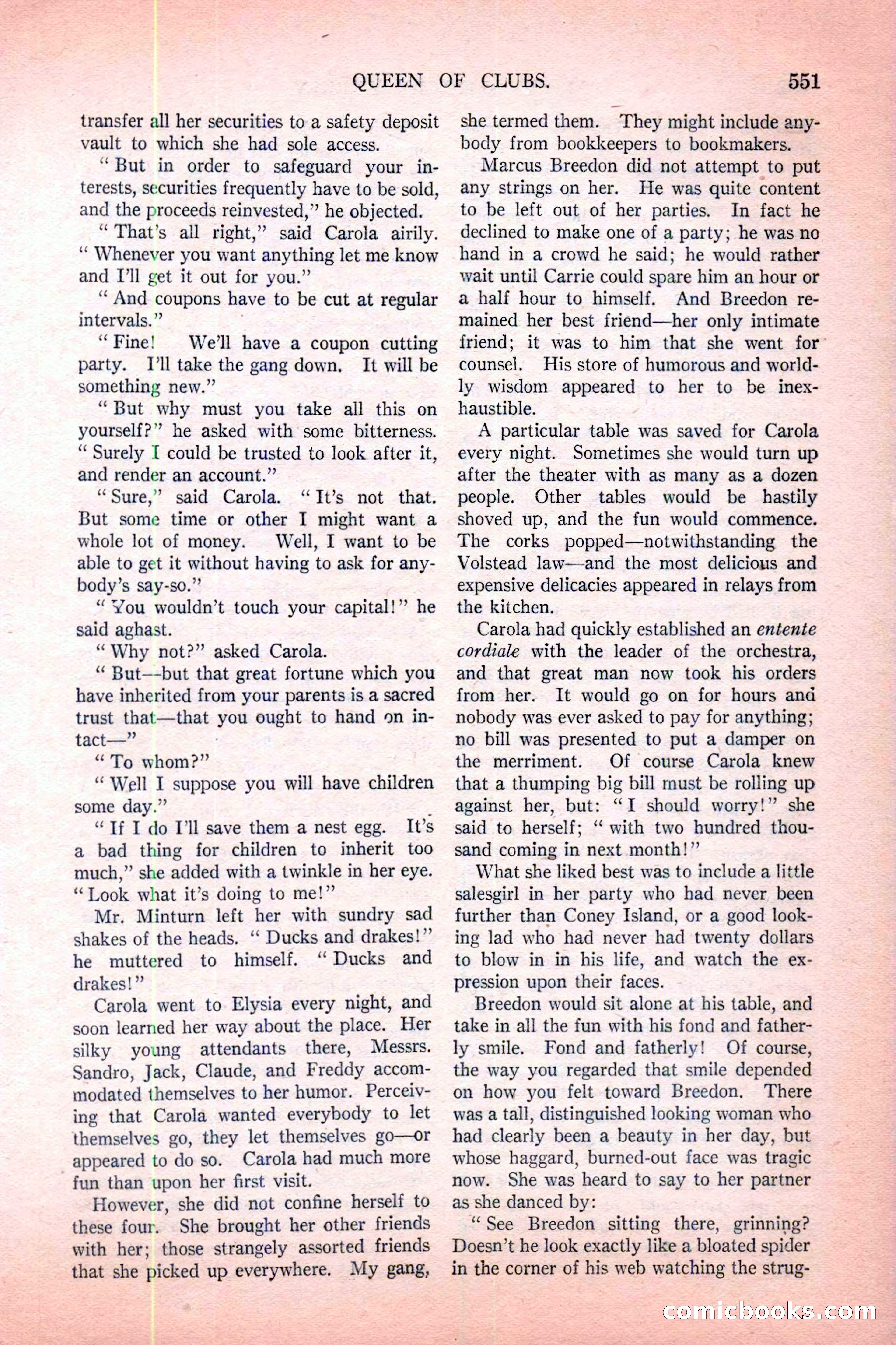
A restored page from Pulp Fiction, 1927. Page through the whole issue in the reader above.
📄 Transcribed text from this page (OCR, searchable)
Machine-transcribed from the original scan — historical spelling and the odd misread are preserved.
QUEEN OF CLUBS. transfer all her securities to a safety deposit vault to which she had sole access. ‘But in order to safeguard your in- terests, securities frequently have to be sold, and the proceeds reinvested,” he objected. “That’s all right,” said Carola airily. ‘‘ Whenever you want anything let me know and I’ll get it out for you.” ‘And coupons have to be cut at regular intervals.” 3 ‘* Fine! party. I'll take the gang down. something new.” “But why must you take all this on yourself?” he asked with some bitterness. ‘Surely [ could be trusted to look after it, and render an account.” “Sure,” said Carola. “It’s not that. But some time or other I might want a whole lot of money. Well, I want to be able to get it without having to ask for any- body’s say-so.”’ “You wouldn’t touch your capital!’ he said aghast. “Why not?” asked Carola. “ But—but that great fortune which you have inherited from your parents is a sacred trust that—that you ought to hand on in- tact—”’ : “To whom?” ‘Well I suppose you will have children some day.” : “Tf I do I'll save them a nest egg. It’s a bad thing for children to inherit too much,” she added with a twinkle in her eye. “Look what it’s doing to me!” Mr. Minturn left her with sundry sad shakes of the heads. ‘‘ Ducks and drakes!”’ he muttered to himself. ‘“ Ducks and drakes!” Carola went to Elysia every night, and soon learned her way about the place. Her silky young attendants there, Messrs. Sandro, Jack, Claude, and Freddy accom- modated themselves to her humor. Perceiv- ing that Carola wanted everybody to let themselves go, they let themselves go—or appeared to do so. Carola had much more fun than upon her first visit. However, she did not confine herself to these four. She brought her other friends with her; those strangely assorted friends that she picked up everywhere. My gang, We'll have a coupon cutting It will be 501 she termed them. They might include any- body from bookkeepers to bookmakers. Marcus Breedon did not attempt to put any strings on her. He was quite content to be left out of her parties. In fact he declined to make one of a party; he was no hand in a crowd he said; he would rather wait until Carrie could spare him an hour or a half hour to himself. And Breedon re- mained her best friend—her only intimate friend; it was to him that she went for counsel. His store of humorous and world- ly wisdom appeared to her to be inex- haustible. A particular table was saved for Carola every night. Sometimes she would turn up after the theater with as many as a dozen people. Other tables would be _ hastily shoved up, and the fun would commence. The corks popped—notwithstanding the Volstead law—and the most delicious and expensive delicacies appeared in relays from the kitchen. Carola had quickly established an entente cordiale with the leader of the orchestra, and that great man now took his orders from her. It would go on for hours and nobody was ever asked to pay for anything; no bill was presented to put a damper on the merriment. Of course Carola knew that a thumping big bill must be rolling up against her, but: “I should worry!” she said to herself; “‘ with two hundred thou- sand coming in next month!” What she liked best was to include a little salesgirl in her party who had never been further than Coney Island, or a good look- ing lad who had never had twenty dollars to blow in in his life, and watch the ex- pression upon their faces. Breedon would sit alone at his table, and take in all the fun with his fond and father- ly smile. Fond and fatherly! Of course, the way you regarded that smile depended on how you felt toward Breedon. There was a tall, distinguished looking woman who had clearly been a beauty in her day, but whose haggard, burned-out face was tragic now. She was heard to say to her partner as she danced by: “See Breedon sitting there, grinning? Doesn’t he look exactly like a bloated spider in the corner of his web watching the strug- Gomichbooks (E@)