
Pulp Fiction, 1927 · page 98 of 168
Argosy All-Story Weekly, November 12, 1927 — page 98: what you’re looking at
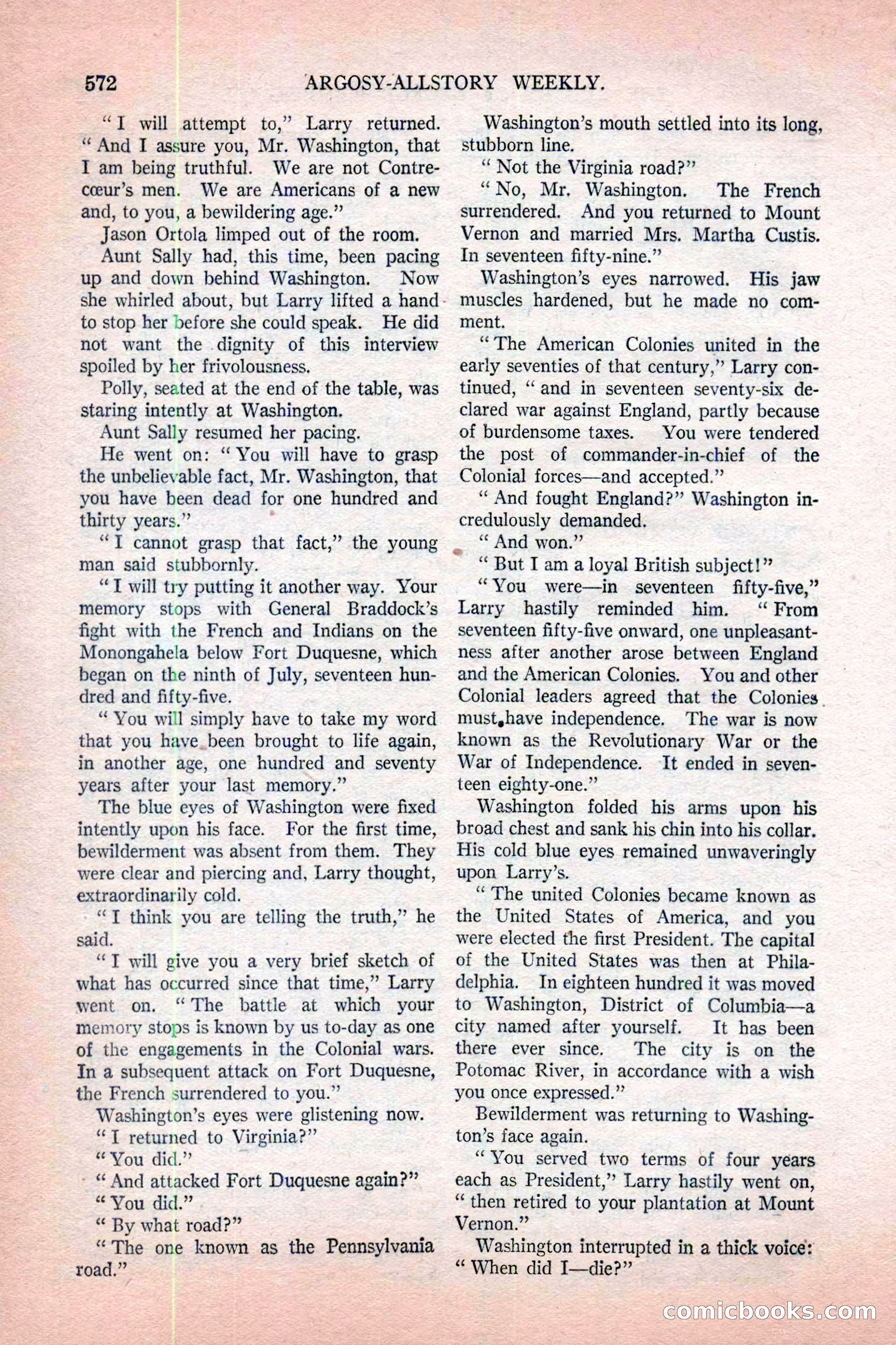
A restored page from Pulp Fiction, 1927. Page through the whole issue in the reader above.
📄 Transcribed text from this page (OCR, searchable)
Machine-transcribed from the original scan — historical spelling and the odd misread are preserved.
572 “J will attempt to,” Larry returned. ‘And I assure you, Mr. Washington, that IT am being truthful. We are not Contre- ceeur’s men. We are Americans of a new and, to you, a bewildering age.” Jason Ortola limped out of the room. Aunt Sally had, this time, been pacing up and down behind Washington. Now she whirled about, but Larry lifted a hand- to stop her before she could speak. He did not want the dignity of this interview spoiled by her frivolousness. Polly, seated at the end of the table, was staring intently at Washington. Aunt Sally resumed her pacing. He went on: “ You will have to grasp the unbelievable fact, Mr. Washington, that you have been dead for one hundred and thirty years.” “TI cannot grasp that fact,” the young _ man said stubbornly. “T will try putting it another way. Your memory stops with General Braddock’s fight with the French and Indians on the Monongahela below Fort Duquesne, which began on the ninth of July, seventeen hun- dred and fifty-five. “You will simply have to take my word that you have_been brought to life again, in another age, one hundred and seventy years after your last memory.” The blue eyes of Washington were fixed intently upon his face. For the first time, bewilderment was absent from them. They were clear and piercing and, Larry thought, extraordinarily cold. “T think you are telling the truth,” he said. “T will give you a very brief sketch of what has occurred since that time,” Larry went on. “The battle at which your memory stops is known by us to-day as one of the engagements in the Colonial wars. In a subsequent attack on Fort Duquesne, the French surrendered to you.” Washington’s eyes were glistening now. “T returned to Virginia?” You did.” - “ And attacked Fort Duquesne again?” “You did.” *¢ By what road?” “The one known as the Pennsylvania road.” ARGOSY-ALLSTORY WEEKLY. Washington’s mouth settled into its long, stubborn line. “ Not the Virginia road?” “No, Mr, Washington. The French surrendered. And you returned to Mount Vernon and married Mrs. Martha Custis. In seventeen fifty-nine.” Washington’s eyes narrowed. His jaw muscles hardened, but he made no com- ment. “The American Colonies united in the early seventies of that century,” Larry con- tinued, ‘and in seventeen seventy-six de- clared war against England, partly because of burdensome taxes. You were tendered the post of commander-in-chief of the Colonial forces—and accepted.” ‘And fought England?” Washington in- credulously demanded. ‘“‘ And won.” “ But I am a loyal British subject!” “You were—in seventeen fifty-five,” Larry hastily reminded him. ‘“ From seventeen fifty-five onward, one unpleasant- ness after another arose between England and the American Colonies. You and other Colonial leaders agreed that the Colonies. must,have independence. The war is now known as the Revolutionary War or the War of Independence. It ended in seven- teen eighty-one.” Washington folded his arms upon his broad chest and sank his chin into his collar. His cold blue eyes remained unwaveringly upon Larry’s. “The united Colonies became known as the United States of America, and you were elected the first President. The capital of the United States was then at Phila- delphia. In eighteen hundred it was moved to Washington, District of Columbia—a city named after yourself. It has been there ever since. The city is on the Potomac River, in accordance with a wish you once expressed.” Bewilderment was returning to Washing- ton’s face again. “You served two terms of four years each as President,” Larry hastily went on, “then retired to your plantation at Mount Vernon.” Washington interrupted in a thick voice: ‘When did I—die?” Gomichbooks (ECo)