
Pulp Fiction, 1928 · page 112 of 164
Argosy All-Story Weekly, February 18, 1928 — page 112: what you’re looking at
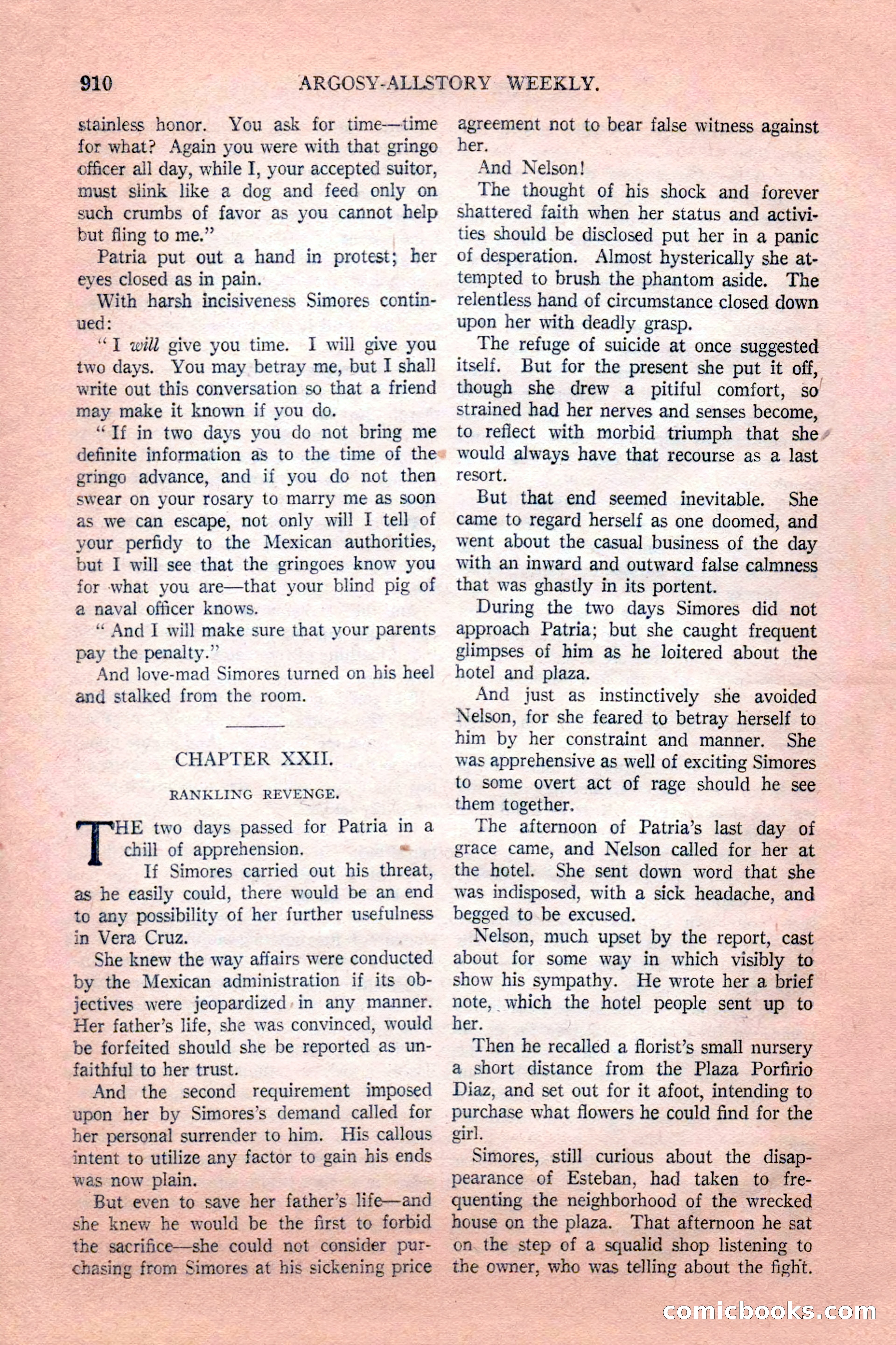
A restored page from Pulp Fiction, 1928. Page through the whole issue in the reader above.
📄 Transcribed text from this page (OCR, searchable)
Machine-transcribed from the original scan — historical spelling and the odd misread are preserved.
910 stainless honor. You ask for time—time for what? Again you were with that gringo officer all day, while I, your accepted suitor, must slink like a dog and feed only on such crumbs of favor as you cannot help but fling to me.” Patria put out a hand in protest; her eyes closed as in pain. With harsh incisiveness Simores contin- ued: “I will give you time. I will give you two days. You may betray me, but I shall write out this conversation so that a friend may make it known if you do. “Tf in two days you do not bring me definite information as to the time of the» gringo advance, and if you do not then swear on your rosary to marry me as soon as we can escape, not only will I tell of your perfidy to the Mexican authorities, but I will see that the gringoes know you for what you are—that your blind pig of a naval officer knows. “And I will make sure that your parents pay the penalty.” And love-mad Simores turned on his heel and stalked from the room. CHAPTER XXII. RANKLING REVENGE. HE two days passed for Patria in a chill of apprehension. . If Simores carried out his threat, as he easily could, there would be an end to any possibility of her further usefulness in Vera Cruz. She knew the way affairs were conducted by the Mexican administration if its ob- jectives were jeopardized:in any manner. Her father’s life, she was convinced, would be forfeited should she be reported as un- faithful to her trust. And the second requirement imposed upon her by Simores’s demand called for her personal surrender to him. His callous intent to utilize any factor to gain his ends was now plain. But even to save her father’s life—and she knew he would be the first to forbid the sacrifice—she could not consider pur- _ chasing from Simores at his sickening price ARGOSY-ALLSTORY WEEKLY. Seen not to bear false witness against er. And Nelson! The thought of his shock and forever shattered faith when her status and activi- ties should be disclosed put her in a panic of desperation. Almost hysterically she at- tempted to brush the phantom aside. The relentless hand of circumstance closed down upon her with deadly grasp. The refuge of suicide at once suggested itself. But for the present she put it off, though she drew a pitiful comfort, so strained had her nerves and senses become, to reflect with morbid triumph that she would always have that recourse as a last resort. But that end seemed inevitable. She came to regard herself as one doomed, and went about the casual business of the day with an inward and outward false calmness that was ghastly in its portent. During the two days Simores did not approach Patria; but she caught frequent glimpses of him as he loitered about the hotel and plaza. And just as instinctively she avoided Nelson, for she feared to betray herself to him by her constraint and manner. She was apprehensive as well of exciting Simores to some overt act of rage should he see them together. The afternoon of Patria’s last day of grace came, and Nelson called for her at the hotel. She sent down word that she was indisposed, with a sick headache, and begged to be excused. Nelson, much upset by the report, cast about for some way in which visibly to show his sympathy. He wrote her a brief note, which the hotel people sent up to her. ; Then he recalled a florist’s small nursery a short distance from the Plaza Porfirio Diaz, and set out for it afoot, intending to purchase what flowers he could find for the girl. Simores, still curious about the disap- pearance of Esteban, had taken to fre- quenting the neighborhood of the wrecked house on the plaza. That afternoon he sat on. the step of a squalid shop listening to the owner, who was telling about the fight. .OOKS EGOMEE (E(9)