
Pulp Fiction, 1928 · page 53 of 164
Argosy All-Story Weekly, February 18, 1928 — page 53: what you’re looking at
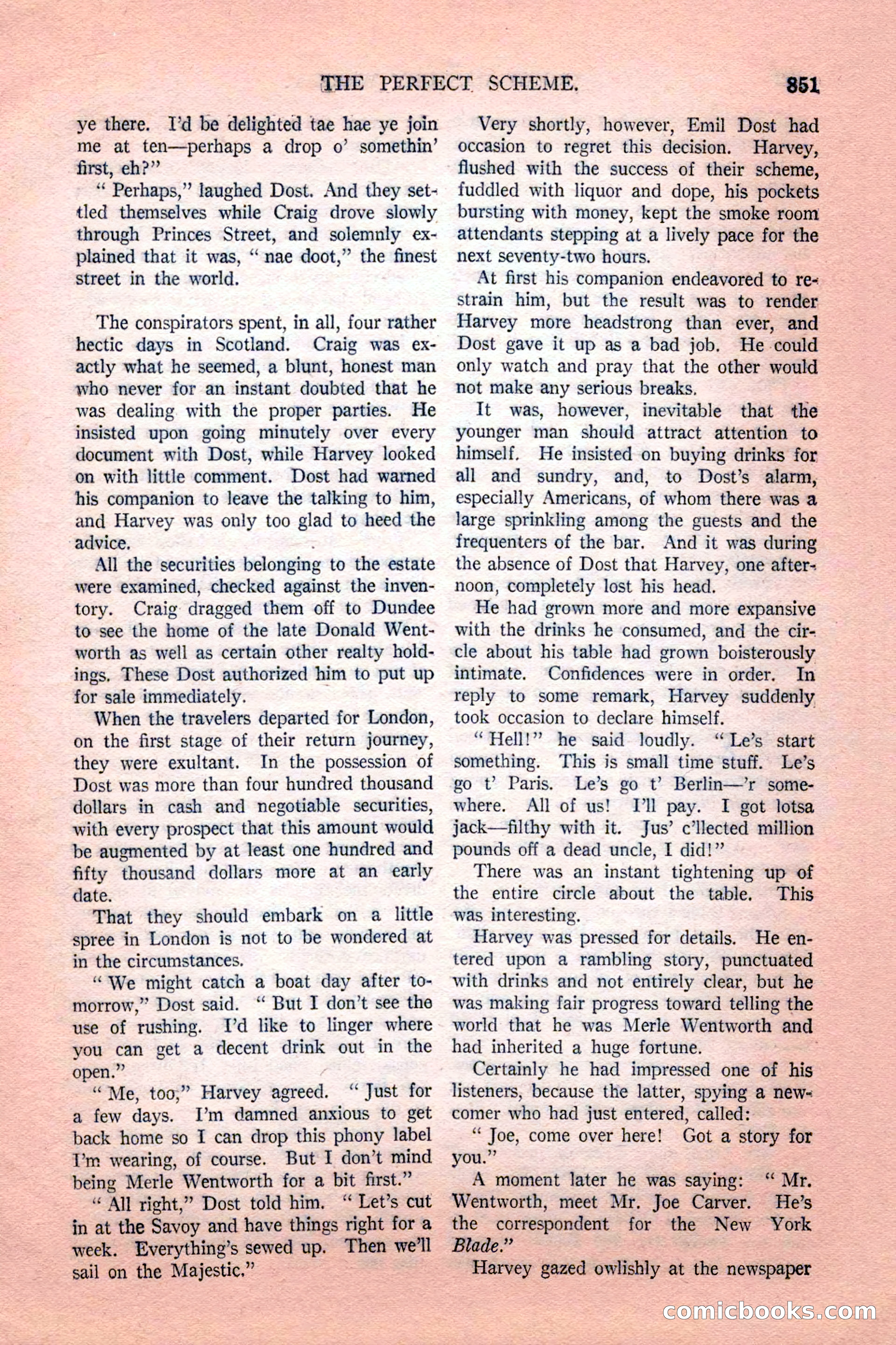
A restored page from Pulp Fiction, 1928. Page through the whole issue in the reader above.
📄 Transcribed text from this page (OCR, searchable)
Machine-transcribed from the original scan — historical spelling and the odd misread are preserved.
THE PERFECT SCHEME. ye there. I’d be delighted tae hae ye join me at ten—perhaps a drop o’ somethin’ first, eh?” ‘“ Perhaps,” laughed Dost. And they set- tled themselves while Craig drove slowly through Princes Street, and solemnly ex- plained that it was, “‘ nae doot,” the finest street in the world. The conspirators spent, in all, four rather hectic days in Scotland. Craig was ex- actly what he seemed, a blunt, honest man who never for an instant doubted that he was dealing with the proper parties. He insisted upon going minutely over every document with Dost, while Harvey looked on with little comment. Dost had warned his companion to leave the talking to him, and Harvey was only too glad to heed the advice. All the securities belonging to the estate were examined, checked against the inven- tory. Craig dragged them off to Dundee to see the home of the late Donald Went- worth as well as certain other realty hold- ings, These Dost authorized him to put up for sale immediately. When the travelers departed for London, on the first stage of their return journey, they were exultant. In the possession of Dost was more than four hundred thousand dollars in cash and negotiable securities, with every prospect that this amount would be augmented by at least one hundred and fifty thousand dollars more at an early date. That they should embark on a little spree in London is not to be wondered at in the circumstances. “We might catch a boat day after to- morrow,” Dost said. “ But I don’t see the use of rushing. I’d like to linger where you can get a decent drink out in the open.” “Me, too,” Harvey agreed. “ Just for a few days. I’m damned anxious to get back home so I can drop this phony label I’m wearing, of course. But I don’t mind being Merle Wentworth for a bit first.” “All right,” Dost told him. “ Let’s cut in at the Savoy and have things right for a week. Everything’s sewed up. ster we'll sail on the Majestic.” 351 Very shortly, however, Emil Dost had occasion to regret this decision. Harvey, flushed with the success of their scheme, fuddled with liquor and dope, his pockets bursting with money, kept the smoke room attendants stepping at a lively pace for the next seventy-two hours. At first his companion endeavored to re- strain him, but the result was to render Harvey more headstrong than ever, and Dost gave it up as a bad job. He could only watch and pray that the other would not make any serious breaks, It was, however, inevitable that the younger man should attract attention to himself, He insisted on buying drinks for all and sundry, and, to Dost’s alarm, especially Americans, of whom there was a large sprinkling among the guests and the frequenters of the bar. And it was during the absence of Dost that Harvey, one after- noon, completely lost his head. He had grown more and more expansive with the drinks he consumed, and the cir- cle about his table had grown boisterously intimate. Confidences were in order. In reply to some remark, Harvey suddenly took occasion to declare himself. “Hell!” he said loudly. “Le’s start something. This is small time stuff. Le’s go t’ Paris. Le’s go t’ Berlin—’r some- where. All of us! Ill pay. I got lotsa jack—filthy with it. Jus’ c’llected million pounds off a dead uncle, I did!” There was an instant tightening up of the entire circle about the table. This was interesting. Harvey was pressed for details. He en- tered upon a rambling story, punctuated with drinks and not entirely clear, but he was making fair progress toward telling the world that he was Merle Wentworth and had inherited a huge fortune. Certainly he had impressed one of his listeners, because the latter, spying a new- comer who had just entered, called: ““ Joe, come over here! Got a story for you.” A moment later he was saying: “ Mr, Wentworth, meet Mr. Joe Carver. He’s the correspondent for de New York Blade.” Harvey gazed owlishly at the newspaper Gomichbooks (E(O)