
Pulp Fiction, 1928 · page 62 of 164
Argosy All-Story Weekly, February 18, 1928 — page 62: what you’re looking at
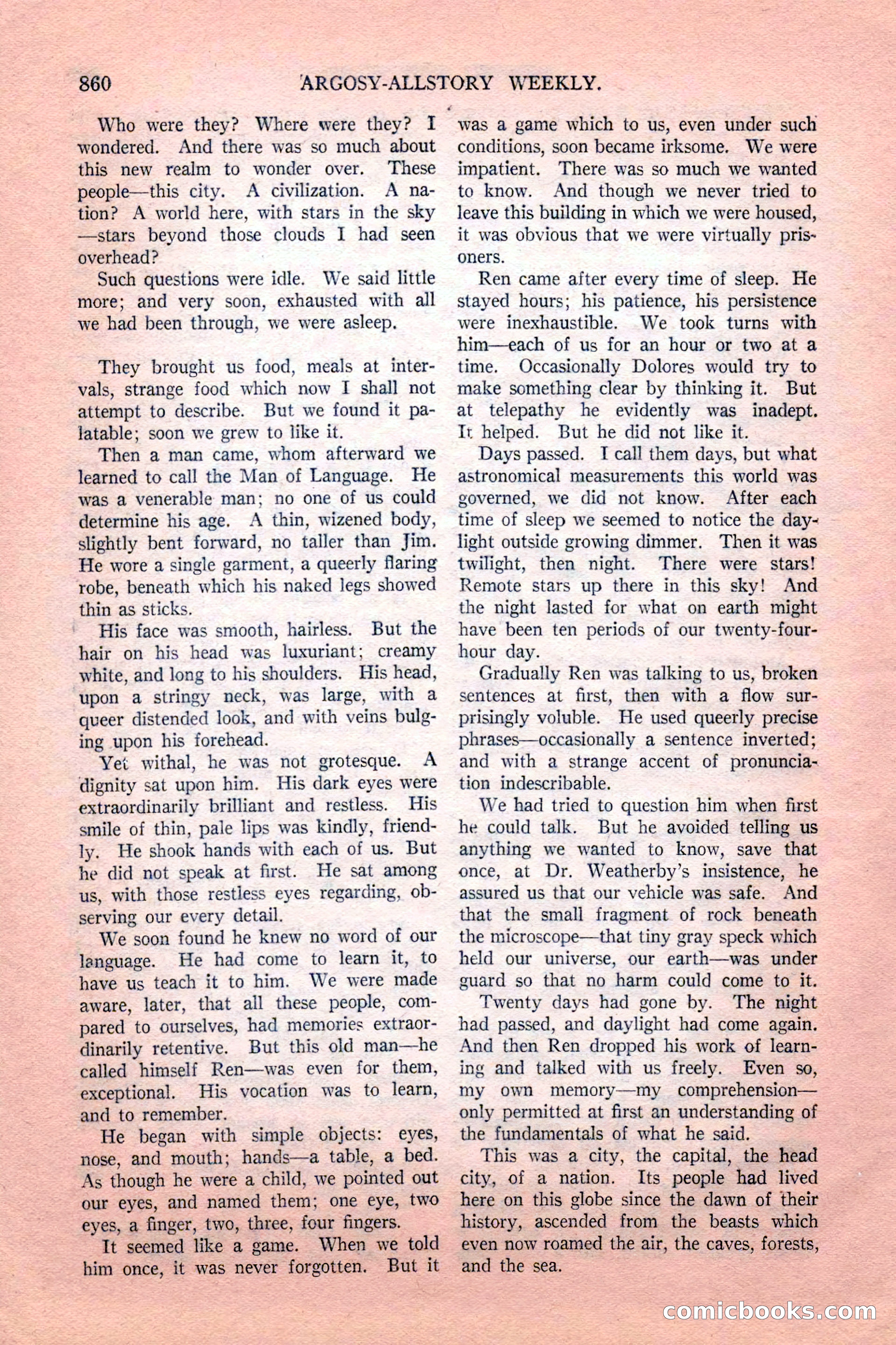
A restored page from Pulp Fiction, 1928. Page through the whole issue in the reader above.
📄 Transcribed text from this page (OCR, searchable)
Machine-transcribed from the original scan — historical spelling and the odd misread are preserved.
860 Who were they? Where were they? I wondered. And there was so much about this new realm to wonder over. ‘These people—this city. <A civilization. A na- tion? A world here, with stars in the sky —stars beyond those clouds I had seen overhead? Such questions were idle. We said little more; and very soon, exhausted with all we had been through, we were asleep. They brought us food, meals at inter- vals, strange food which now I shall not attempt to describe. But we found it pa- latable; soon we grew to like it. Then a man came, whom afterward we learned to call the Man of Language. He was a venerable man; no one of us could determine his age. A thin, wizened body, slightly bent forward, no taller than Jim. He wore a single garment, a queerly flaring robe, beneath which his naked legs showed thin as sticks. His face was smooth, hairless. But the hair on his head was luxuriant; creamy white, and long to his shoulders. His head, upon a stringy neck, was large, with a queer distended look, and with veins bulg- ing upon his forehead. Yet withal, he was not grotesque. A dignity sat upon him. His dark eyes were extraordinarily brilliant and restless. His smile of thin, pale lips was kindly, friend- ly. He shook hands with each of us. But he did not speak at first. He sat among us, with those restless eyes regarding, ob- serving our every detail. We soon found he knew no word of our language. He had come to learn it, to have us teach it to him. We were made aware, later, that all these people, com- pared to ourselves, had memories extraor- dinarily retentive. But this old man—he called himself Ren—was even for them, exceptional. His vocation was to learn, and to remember. He began with simple objects: eyes, nose, and mouth; hands—a table, a bed. As though he were a child, we pointed out our eyes, and named them; one eye, two eyes, a finger, two, three, four fingers. It seemed like a game. When we told him once, it was never forgotten. But it ARGOSY-ALLSTORY WEEKLY. was a game which to us, even under such conditions, soon became irksome. We were impatient. There was so much we wanted to know. And though we never tried to leave this building in which we were housed, it was obvious that we were virtually pris- oners. Ren came after every time of sleep. He stayed hours; his patience, his persistence were inexhaustible. We took turns with him—each of us for an hour or two at a time. Occasionally Dolores would try to make something clear by thinking it. But at telepathy he evidently was inadept. It helped. But he did not like it. Days passed. I call them days, but what astronomical measurements this world was governed, we did not know. After each time of sleep we seemed to notice the day- light outside growing dimmer. Then it was twilight, then night. There were stars! Remote stars up there in this sky! And the night lasted for what on earth might have been ten periods of our twenty-four- hour day. Gradually Ren was talking to us, broken sentences at first, then with a flow sur- prisingly voluble. He used queerly precise phrases—occasionally a sentence inverted; and with a strange accent of pronuncia- tion indescribable. We had tried to question him when first he could talk. But he avoided telling us anything we wanted to know, save that once, at Dr. Weatherby’s insistence, he assured us that our vehicle was safe. And that the small fragment of rock beneath the microscope—that tiny gray speck which held our universe, our earth—was under guard so that no harm could come to it. Twenty days had gone by. The night had passed, and daylight had come again. And then Ren dropped his work of learn- ing and talked with us freely. Even so, my own memory—my comprehension— only permitted at first an understanding of the fundamentals of what he said. This was a city, the capital, the head city, of a nation. Its people had lived here on this globe since the dawn of their history, ascended from the beasts which even now roamed the air, the caves, forests, and the sea. : <S (E) micboo Eon