
Pulp Fiction, 1928 · page 71 of 164
Argosy All-Story Weekly, February 18, 1928 — page 71: what you’re looking at
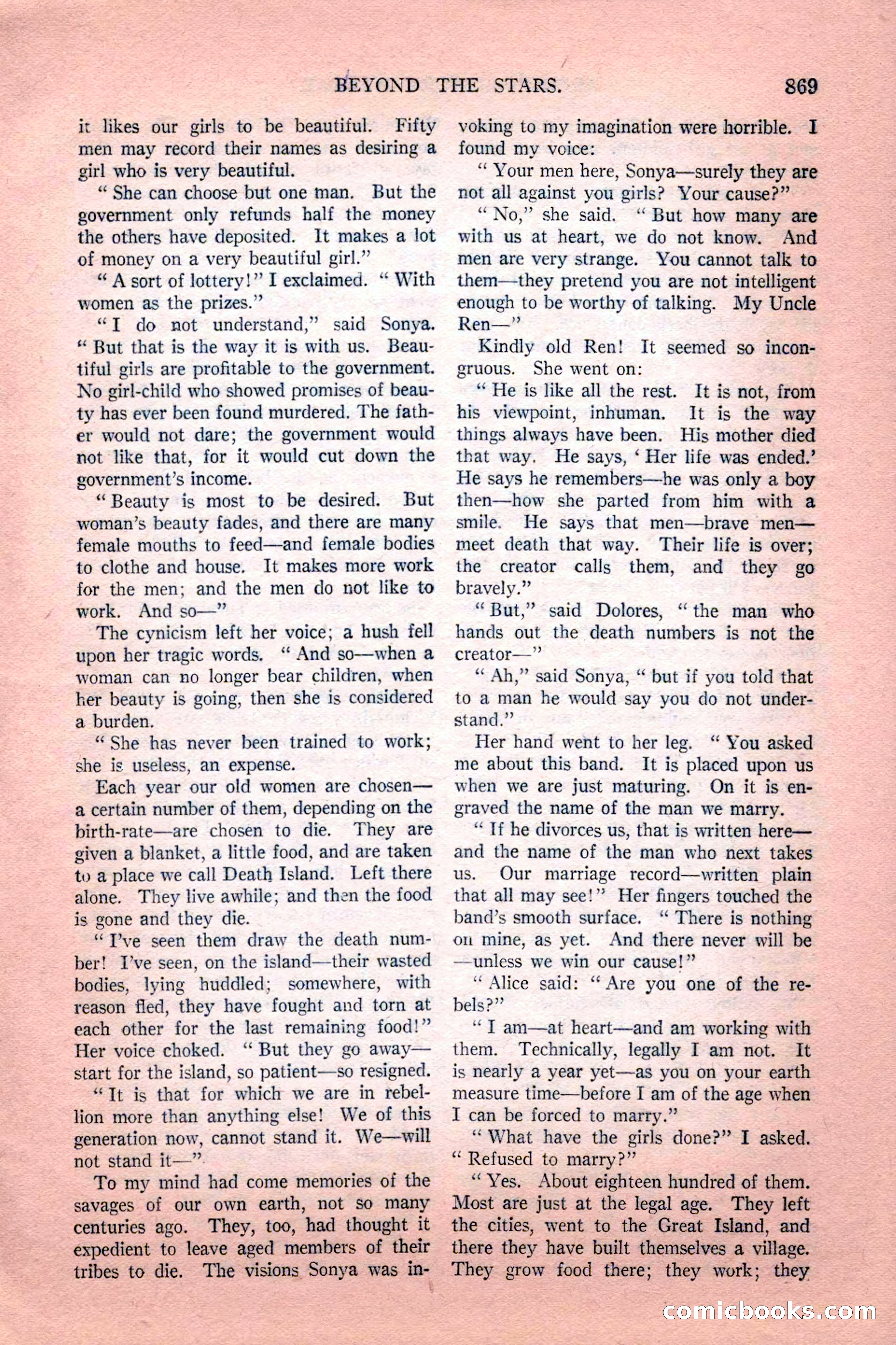
A restored page from Pulp Fiction, 1928. Page through the whole issue in the reader above.
📄 Transcribed text from this page (OCR, searchable)
Machine-transcribed from the original scan — historical spelling and the odd misread are preserved.
BEYOND THE STARS. it likes our girls to be beautiful. Fifty men may record their names as desiring a girl who is very beautiful. “ She can choose but one man. But the government only refunds half the money the others have deposited. It makes a lot of money on a very beautiful girl.” “ A sort of lottery!” I exclaimed. “ With women as the prizes.” “T do not understand,” said Sonya. “ But that is the way it is with us. Beau- tiful girls are profitable to the government. No girl-child who showed promises of beau- ty has ever been found murdered. The fath- er would not dare; the government would not like that, for it would cut down the government’s income. “Beauty is most to be desired. But woman’s beauty fades, and there are many female mouths to feed—and female bodies to clothe and house. It makes more work for the men; and the men do not like to work. And so—” The cynicism left her voice; a hush fell upon her tragic words. “ And so—when a woman can no longer bear children, when her beauty is going, then she is considered a burden. “She has never been trained to work; she is useless, an expense. Each year our old women are chosen— a certain number of them, depending on the birth-rate—are chosen to die. They are given a blanket, a little food, and are taken tv a place we call Death Island. Left there alone. They live awhile; and then the food is gone and they die. “Tve seen them draw the death num- ber! I’ve seen, on the island—their wasted bodies, lying huddled; somewhere, with reason fled, they have fought and torn at each other for the last remaining food!” Her voice choked. ‘“ But they go away— start for the island, so patient—so resigned. “Tt is that for which we are in rebel- lion more than anything else! We of this generation now, cannot stand it. We—will not stand it—”. To my mind had come memories of the savages of our own earth, not so many centuries ago. They, too, had thought it expedient to leave aged members of their tribes to die. The visions Sonya was = 869 voking to my imagination were horrible. I found my voice: “Your men here, Sonya—surely they are not all against you girls? Your cause?” “No,” she said. ‘“ But how many are with us at heart, we do not know. And men are very strange. You cannot talk to them—they pretend you are not intelligent enough to be worthy of talking. My Uncle Ren—” Kindly old Ren! It seemed so incon- gruous. She went on: “ He is like all the rest. his viewpoint, inhuman. It is the way things always have been. His mother died that way. He says, ‘ Her life was ended.’ He says he remembers—he was only a boy then—how she parted from him with a smile. He says that men—brave men— meet death that way. Their life is over; the creator calls them, and they go bravely.” “But,” said Dolores, “‘ the man who hands out the death numbers is not the creator—” *“‘ Ah,” said Sonya, “ but if you told that to a man he would say you do not under- stand.” Her hand went to her leg. ‘“ You asked me about this band. It is placed upon us when we are just maturing. On it is en- graved the name of the man we marry. “Tf he divorces us, that is written here— and the name of the man who next takes us. Our marriage record—written plain that all may see!” Her fingers touched the band’s smooth surface. “ There is nothing on mine, as yet. And there never will be —unless we win our cause!” ‘Alice said: ‘Are you one of the re- bels?”’ ‘“T am—at heart—and am working with them. Technically, legally I am not. It is nearly a year yet—as you on your earth measure time—before I am of the age when I can be forced to marry.” It is not, from “What have the girls done?” I asked. : “Refused to marry?” “Yes. About eighteen hundred of them. Most are just at the legal age. They left the cities, went to the Great Island, and there they have built themselves a village. They grow food there; they work; they Gomichooks (EC)