
Pulp Fiction, 1928 · page 101 of 160
Argosy All-Story Weekly, April 7, 1928 — page 101: what you’re looking at
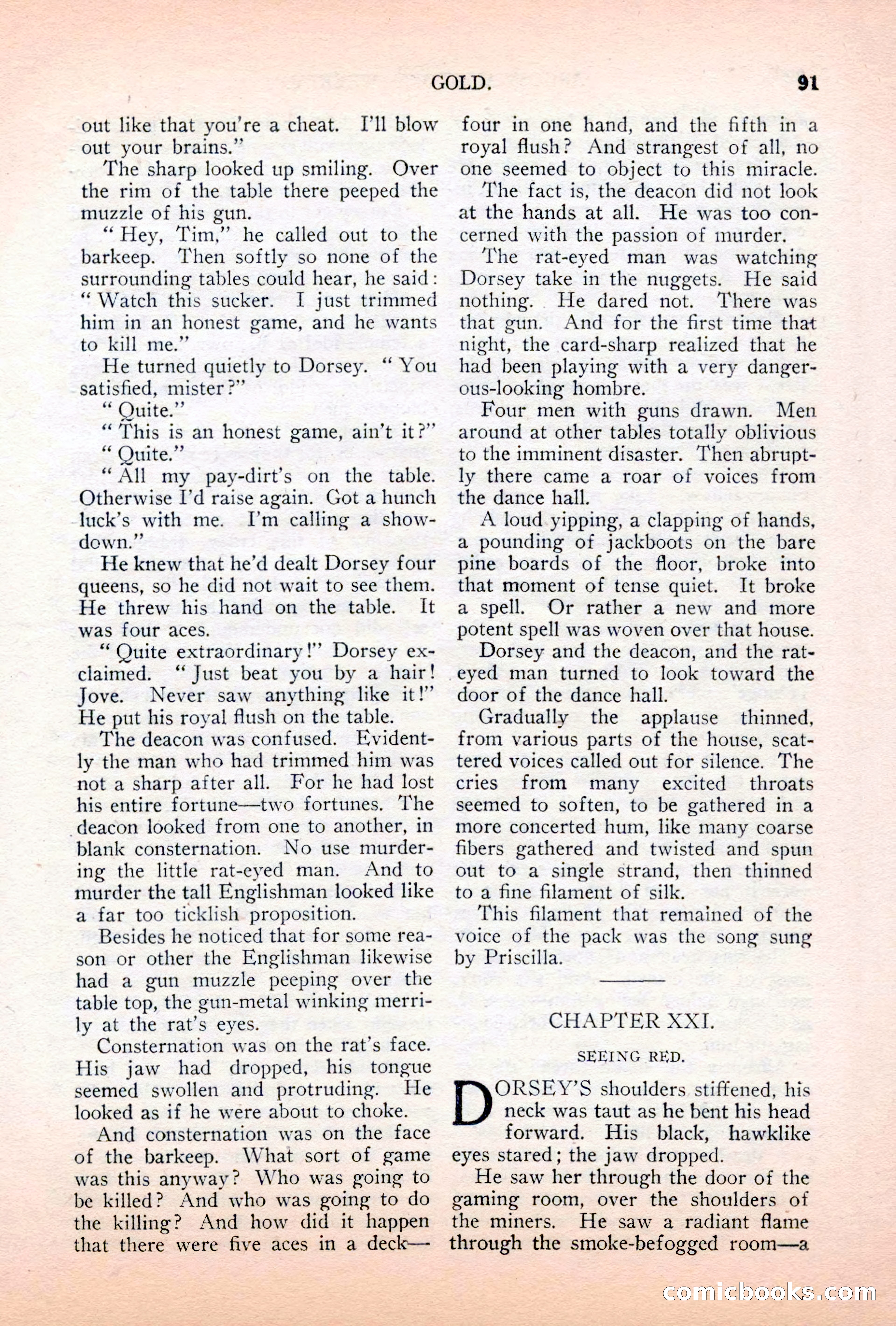
A restored page from Pulp Fiction, 1928. Page through the whole issue in the reader above.
📄 Transcribed text from this page (OCR, searchable)
Machine-transcribed from the original scan — historical spelling and the odd misread are preserved.
GOLD. out like that you’re a cheat. I'll blow out your brains.” The sharp looked up smiling. Over the rim of the table there peeped the muzzle of his gun. “Hey, Tim,” he called out to the barkeep. Then softly so none of the surrounding tables could hear, he said: “Watch this sucker. I just trimmed him in an honest game, and he wants to kill me.” He turned quietly to Dorsey. “ You satisfied, mister?” = Onite” “This is an honest game, ain’t it?” “ Ouite.”’ “All my pay-dirt’s on the table. Otherwise I'd raise again. Got a hunch luck’s with me. I’m calling a show- down.” He knew that he’d dealt Dorsey four queens, so he did not wait to see them. He threw his hand on the table. It was four aces. “ Quite extraordinary!’ Dorsey ex- claimed. “ Just beat you by a hair! Jove. Never saw anything like it!” He put his royal flush on the table. The deacon was confused. Evident- ly the man who had trimmed him was not a sharp after all. For he had lost his entire fortune—two fortunes. The deacon looked from one to another, in blank consternation. No use murder- ing the little rat-eyed man. And to murder the tall Englishman looked like a far too ticklish proposition. Besides he noticed that for some rea- son or other the Englishman likewise had a gun muzzle peeping over the table top, the gun-metal winking merri- ly at the rat’s eyes. Consternation was on the rat’s face. His jaw had dropped, his tongue seemed swollen and protruding. He looked as if he were about to choke. And consternation was on the face of the barkeep. What sort of game was this anyway? Who was going to be killed? And who was going to do the killing? And how did it happen that there were five aces in a deck— 91 four in one hand, and the fifth in a royal flush? And strangest of all, no one seemed to object to this miracle. The fact is, the deacon did not look at the hands at all. He was too con- cerned with the passion of murder. The rat-eyed man was watching Dorsey take in the nuggets. He said nothing. He dared not. There was that gun. And for the first time that night, the card-sharp realized that he had been playing with a very danger- ous-looking hombre. Four men with guns drawn. Men around at other tables totally oblivious to the imminent disaster. Then abrupt- ly there came a roar of voices from the dance hall. A loud yipping, a clapping of hands, a pounding of jackboots on the bare pine boards of the floor, broke into that moment of tense quiet. It broke a spell. Or rather a new and more potent spell was woven over that house. Dorsey and the deacon, and the rat- -eyed man turned to look toward the door of the dance hall. Gradually the applause thinned, from various parts of the house, scat- tered voices called out for silence. The cries from many excited throats seemed to soften, to be gathered in a more concerted hum, like many coarse fibers gathered and twisted and spun out to a single strand, then thinned to a fine filament of silk. This filament that remained of the voice of the pack was the song sung by Priscilla. —-——_ -- - —— CHAPTER XXI. SEEING RED. ORSEY’S shoulders stiffened, his neck was taut as he bent his head forward. His black, hawklike eyes stared; the jaw dropped. He saw her through the door of the gaming room, over the shoulders of the miners. He saw a radiant flame through the smoke-befogged room—a COPMIE MOO KS (E@)