
Pulp Fiction, 1928 · page 105 of 160
Argosy All-Story Weekly, April 7, 1928 — page 105: what you’re looking at
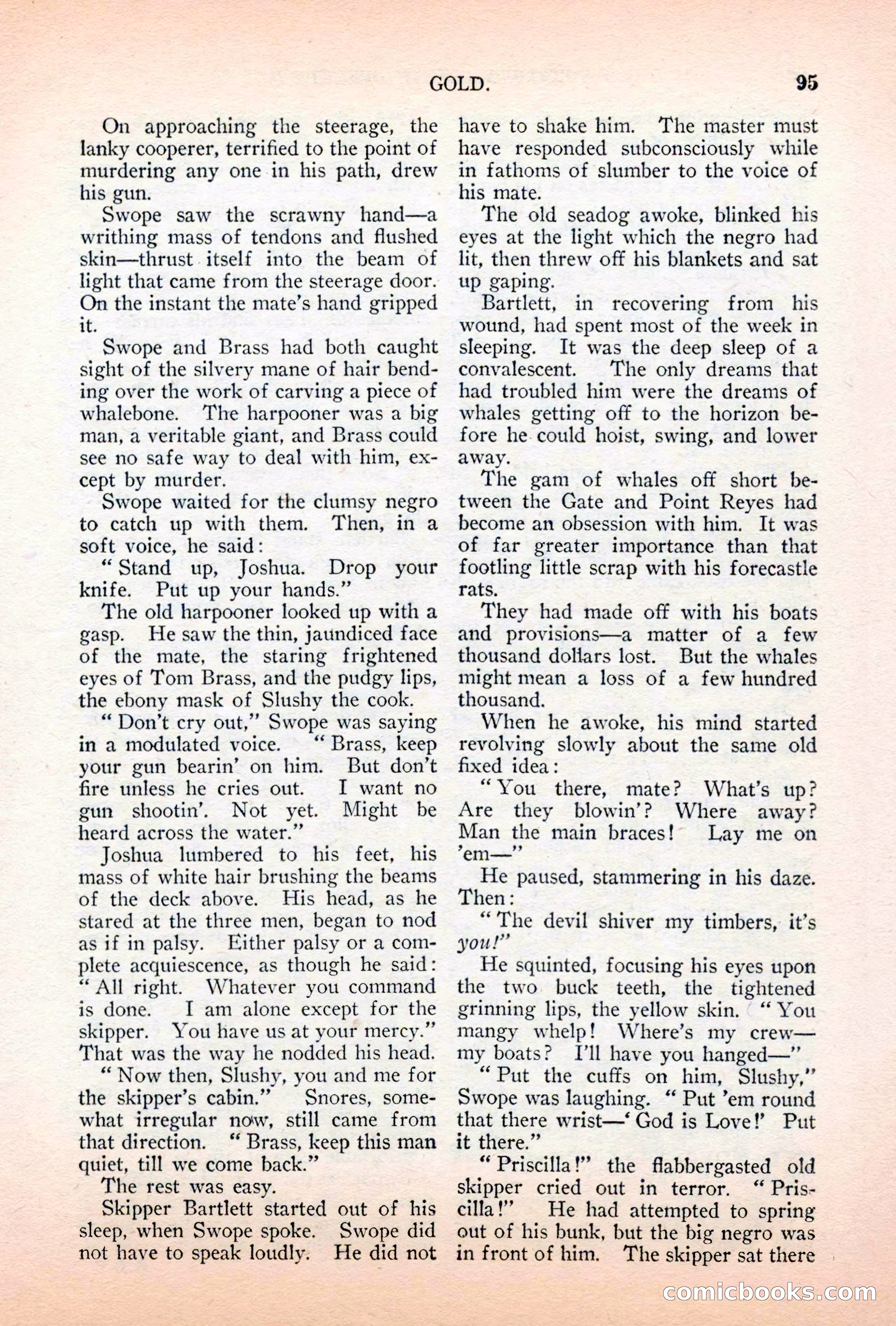
A restored page from Pulp Fiction, 1928. Page through the whole issue in the reader above.
📄 Transcribed text from this page (OCR, searchable)
Machine-transcribed from the original scan — historical spelling and the odd misread are preserved.
GOLD. On approaching the steerage, the lanky cooperer, terrified to the point of murdering any one in his path, drew his gun. Swope saw the scrawny hand—a writhing mass of tendons and flushed skin—thrust itself into the beam of light that came from the steerage door. On the instant the mate’s hand gripped it. Swope and Brass had both caught sight of the silvery mane of hair bend- ing over the work of carving a piece of whalebone. The harpooner was a big man, a veritable giant, and Brass could see no safe way to deal with him, ex- cept by murder. Swope waited for the clumsy negro to catch up with them. Then, in a soft voice, he said: “Stand up, Joshua. Drop your knife. Put up your hands.” The old harpooner looked up with a gasp. He saw the thin, jaundiced face of the mate, the staring frightened eyes of Tom Brass, and the pudgy lips, the ebony mask of Slushy the cook. “Don’t cry out,’”’ Swope was saying in a modulated voice. “ Brass, keep your gun bearin’ on him. But don’t fire unless he cries out. I want no gun shootin’. Not yet. Might be heard across the water.” Joshua lumbered to his feet, his mass of white hair brushing the beams of the deck above. His head, as he stared at the three men, began to nod as if in palsy. Either palsy or a com- plete acquiescence, as though he said: “ All right. Whatever you command is done. I am alone except for the skipper. You have us at your mercy.” That was the way he nodded his head. “ Now then, Slushy, you and me for the skipper’s cabin.” Snores, some- what irregular now, still came from that direction. “ Brass, keep this man quiet, till we come back.” The rest was easy. Skipper Bartlett started out of his sleep, when Swope spoke. Swope did not have to speak loudly. He did not 95 have to shake him. The master must have responded subconsciously while in fathoms of slumber to the voice of his mate. The old seadog awoke, blinked his eyes at the light which the negro had lit, then threw off his blankets and sat up gaping. Bartlett, in recovering from his wound, had spent most of the week in sleeping. It was the deep sleep of a convalescent. The only dreams that had troubled him were the dreams of whales getting off to the horizon be- fore he. could hoist, swing, and lower away. The gam of whales off short be- tween the Gate and Point Reyes had become an obsession with him. It was of far greater importance than that footling little scrap with his forecastle rats. They had made off with his boats and provisions—a matter of a few thousand dollars lost. But the whales might mean a loss of a few hundred thousand. When he awoke, his mind started revolving slowly about the same old fixed idea: “You there, mate? What’s up? Are they blowin’? Where away? Man the main braces!’ Lay me on ‘ein He paused, stammering in his daze. Then: “The devil shiver my timbers, it’s youl” He squinted, focusing his eyes upon the two buck teeth, the tightened grinning lips, the yellow skin. ‘ You mangy whelp! Where’s my crew— my boats? I'll have you hanged—’’ “Put the cuffs on him, Slushy,” Swope was laughing. “ Put ’em round that there wrist—‘ God is Love!’ Put it there.” “Priscilla!” the flabbergasted old skipper cried out in terror. “ Pris- cilla!’” He had attempted to spring out of his bunk, but the big negro was in front of him. The skipper sat there oO KS (COL MUCE (E©)