
Pulp Fiction, 1928 · page 116 of 160
Argosy All-Story Weekly, April 7, 1928 — page 116: what you’re looking at
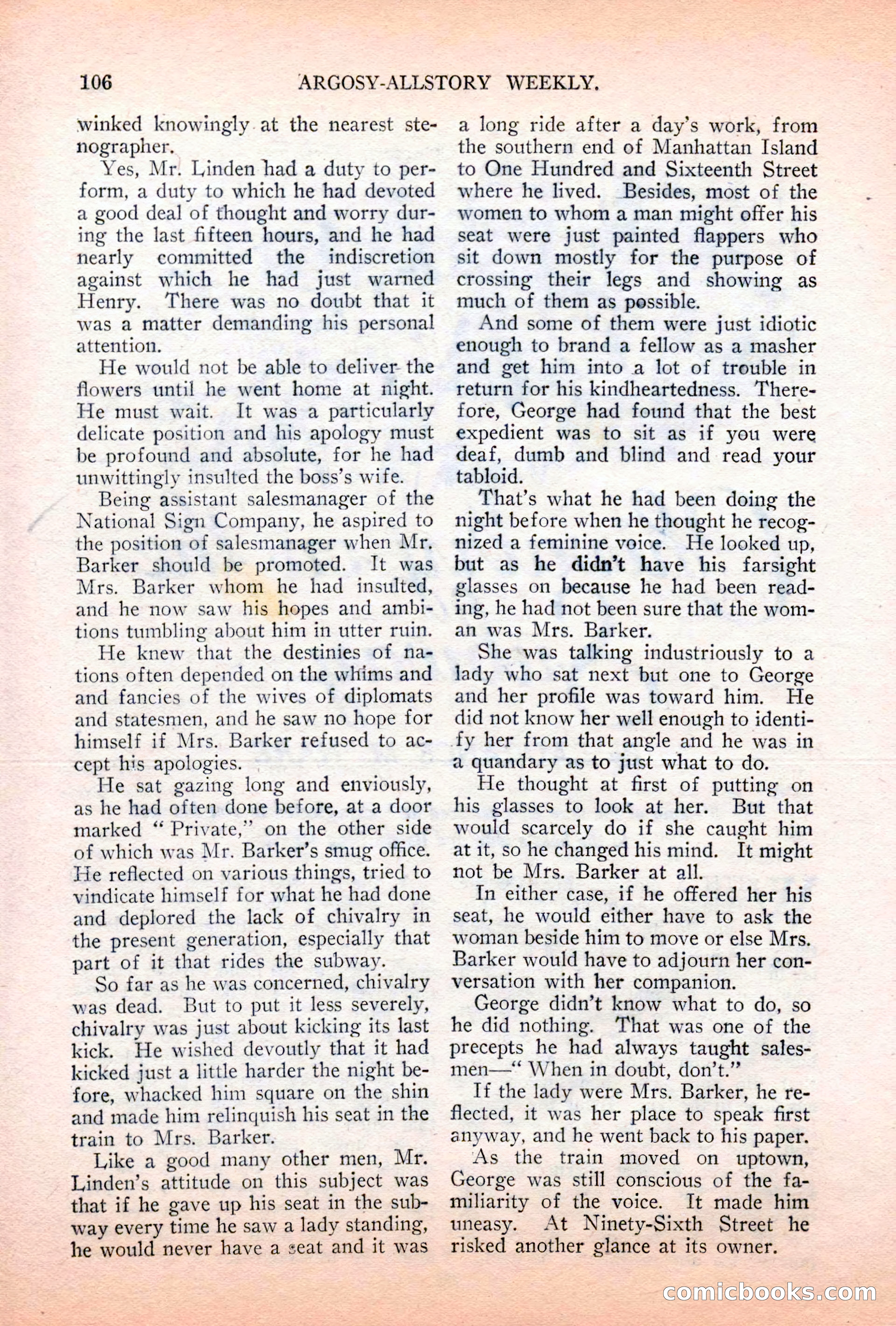
A restored page from Pulp Fiction, 1928. Page through the whole issue in the reader above.
📄 Transcribed text from this page (OCR, searchable)
Machine-transcribed from the original scan — historical spelling and the odd misread are preserved.
106 winked knowingly. at the nearest ste- nographer, Yes, Mr. Linden had a duty to per- form, a duty to which he had devoted a good deal of thought and worry dur- ing the last fifteen hours, and he had nearly committed the indiscretion against which he had just warned Henry. There was no doubt that it was a matter demanding his personal attention. He would not be able to deliver the flowers until he went home at night. He must wait. It was a particularly delicate position and his apology must be profound and absolute, for he had unwittingly insulted the boss’s wife. Being assistant salesmanager of the National Sign Company, he aspired to the position of salesmanager when Mr, Barker should be promoted. It was Mrs. Barker whom he had insulted, and he now saw his hopes and ambi- tions tumbling about him in utter ruin. He knew that the destinies of na- tions often depended on the whims and and fancies of the wives of diplomats and statesmen, and he saw no hope for himself if Mrs. Barker refused to ac- cept his apologies. He sat gazing long and enviously, as he had often done before, at a door marked “ Private,” on the other side of which was Mr. Barker’s smug office. He reflected on various things, tried to vindicate himself for what he had done and deplored the lack of chivalry in the present generation, especially that part of it that rides the subway. So far as he was concerned, chivalry was dead. But to put it less severely, chivalry was just about kicking its last kick. He wished devoutly that it had kicked just a little harder the night be- fore, whacked him square on the shin and made him relinquish his seat in the train to Mrs. Barker. Like a good many other men, Mr. Linden’s attitude on this subject was that if he gave up his seat in the sub- way every time he saw a lady standing, he would never have a seat and it was ARGOSY-ALLSTORY WEEKLY. a long ride after a day’s work, from the southern end of Manhattan Island to One Hundred and Sixteenth Street where he lived. Besides, most of the women to whom a man might offer his seat were just painted flappers who sit down mostly for the purpose of crossing their legs and showing as much of them as possible. And some of them were just idiotic enough to brand a fellow as a masher and get him into a lot of trouble in return for his kindheartedness. There- fore, George had found that the best expedient was to sit as if you were deaf, dumb and blind and read your tabloid. That’s what he had been doing the night before when he thought he recog- nized a feminine voice. He looked up, but as he didn’t have his farsight glasses on because he had been read- ing, he had not been sure that the wom- an was Mrs. Barker. She was talking industriously to a lady who sat next but one to George and her profile was toward him. He did not know her well enough to identi- fy her from that angle and he was in a quandary as to just what to do. He thought at first of putting on his glasses to look at her. But that would scarcely do if she caught him at it, so he changed his mind. It might not be Mrs. Barker at all. In either case, if he offered her his seat, he would either have to ask the woman beside him to move or else Mrs. Barker would have to adjourn her con- versation with her companion. George didn’t know what to do, so he did nothing. ‘That was one of the precepts he had always taught sales- men—*‘ When in doubt, don’t.” If the lady were Mrs. Barker, he re- flected, it was her place to speak first anyway, and he went back to his paper. As the train moved on uptown, George was still conscious of the fa- miliarity of the voice. It made him uneasy. At Ninety-Sixth Street he risked another glance at its owner. Gomichbooks (E@)