
Pulp Fiction, 1928 · page 51 of 160
Argosy All-Story Weekly, April 7, 1928 — page 51: what you’re looking at
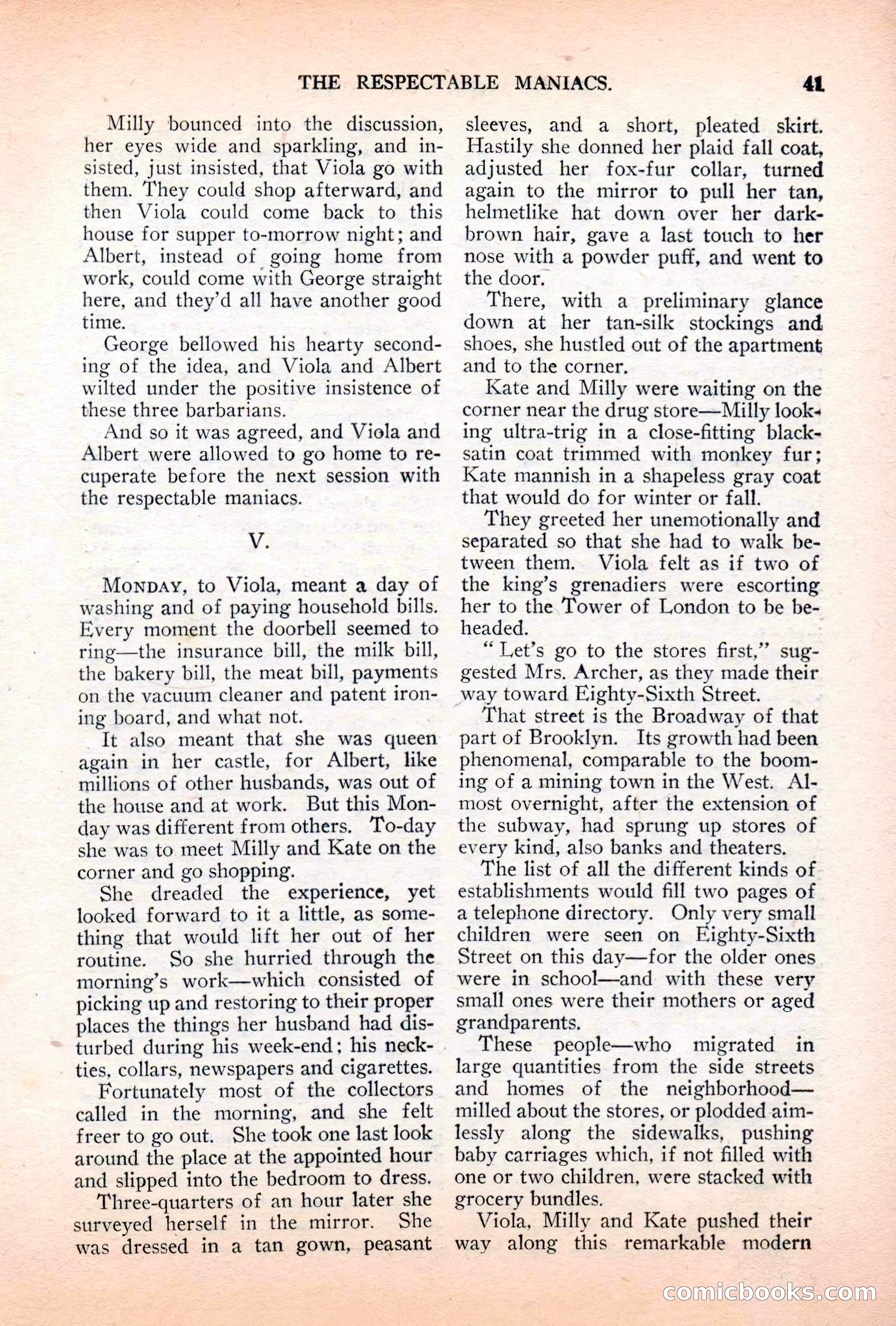
A restored page from Pulp Fiction, 1928. Page through the whole issue in the reader above.
📄 Transcribed text from this page (OCR, searchable)
Machine-transcribed from the original scan — historical spelling and the odd misread are preserved.
THE RESPECTABLE MANIACS. Milly bounced into the discussion, her eyes wide and sparkling, and in- sisted, just insisted, that Viola go with them. They could shop afterward, and then Viola could come back to this house for supper to-morrow night; and Albert, instead of going home from work, could come with George straight here, and they'd all have another good time. George bellowed his hearty second- ing of the idea, and Viola and Albert wilted under the positive insistence of these three barbarians. And so it was agreed, and Viola and Albert were allowed to go home to re- cuperate before the next session with the respectable maniacs. V. Monpay, to Viola, meant a day of washing and of paying household bills. Every moment the doorbell seemed to ring—the insurance bill, the milk bill, the bakery bill, the meat bill, payments on the vacuum cleaner and patent iron- ing board, and what not. It also meant that she was queen again in her castle, for Albert, like millions of other husbands, was out of the house and at work. But this Mon- day was different from others. To-day she was to meet Milly and Kate on the corner and go shopping. She dreaded the experience, yet looked forward to it a little, as some- thing that would lift her out of her routine. So she hurried through the morning’s work—which consisted of picking up and restoring to their proper places the things her husband had dis- turbed during his week-end; his neck- ties, collars, newspapers and cigarettes. Fortunately most of the collectors called in the morning, and she felt freer to go out. She took one last look around the place at the appointed hour and slipped into the bedroom to dress. Three-quarters of an hour later she surveyed herself in the mirror. She was dressed in a tan gown, peasant 41 sleeves, and a short, pleated skirt. Hastily she donned her plaid fall coat, adjusted her fox-fur collar, turned again to the mirror to pull her tan, helmetlike hat down over her dark- brown hair, gave a last touch to her nose with a powder puff, and went to the door, There, with a preliminary glance down at her tan-silk stockings and shoes, she hustled out of the apartment and to the corner, Kate and Milly were waiting on the corner near the drug store—Milly look- ing ultra-trig in a close-fitting black- satin coat trimmed with monkey fur; Kate mannish in a shapeless gray coat that would do for winter or fall. They greeted her unemotionally and separated so that she had to walk be- tween them. Viola felt as if two of the king’s grenadiers were escorting her to the Tower of London to be be- headed. “Let’s go to the stores first,” sug- gested Mrs. Archer, as they made their way toward Eighty-Sixth Street. That street is the Broadway of that part of Brooklyn. Its growth had been phenomenal, comparable to the boom- ing of a mining town in the West. AI- most overnight, after the extension of the subway, had sprung up stores of every kind, also banks and theaters. The list of all the different kinds of establishments would fill two pages of a telephone directory. Only very small children were seen on Ejighty-Sixth Street on this day—for the older ones were in school—and with these very small ones were their mothers or aged grandparents, These people—who migrated in large quantities from the side streets and homes of the neighborhood— milled about the stores, or plodded aim- lessly along the sidewalks, pushing baby carriages which, if not filled with one or two children, were stacked with grocery bundles. Viola, Milly and Kate pushed their way along this remarkable modern COPNICLOOKS (C@)