
Pulp Fiction, 1928 · page 62 of 160
Argosy All-Story Weekly, April 7, 1928 — page 62: what you’re looking at
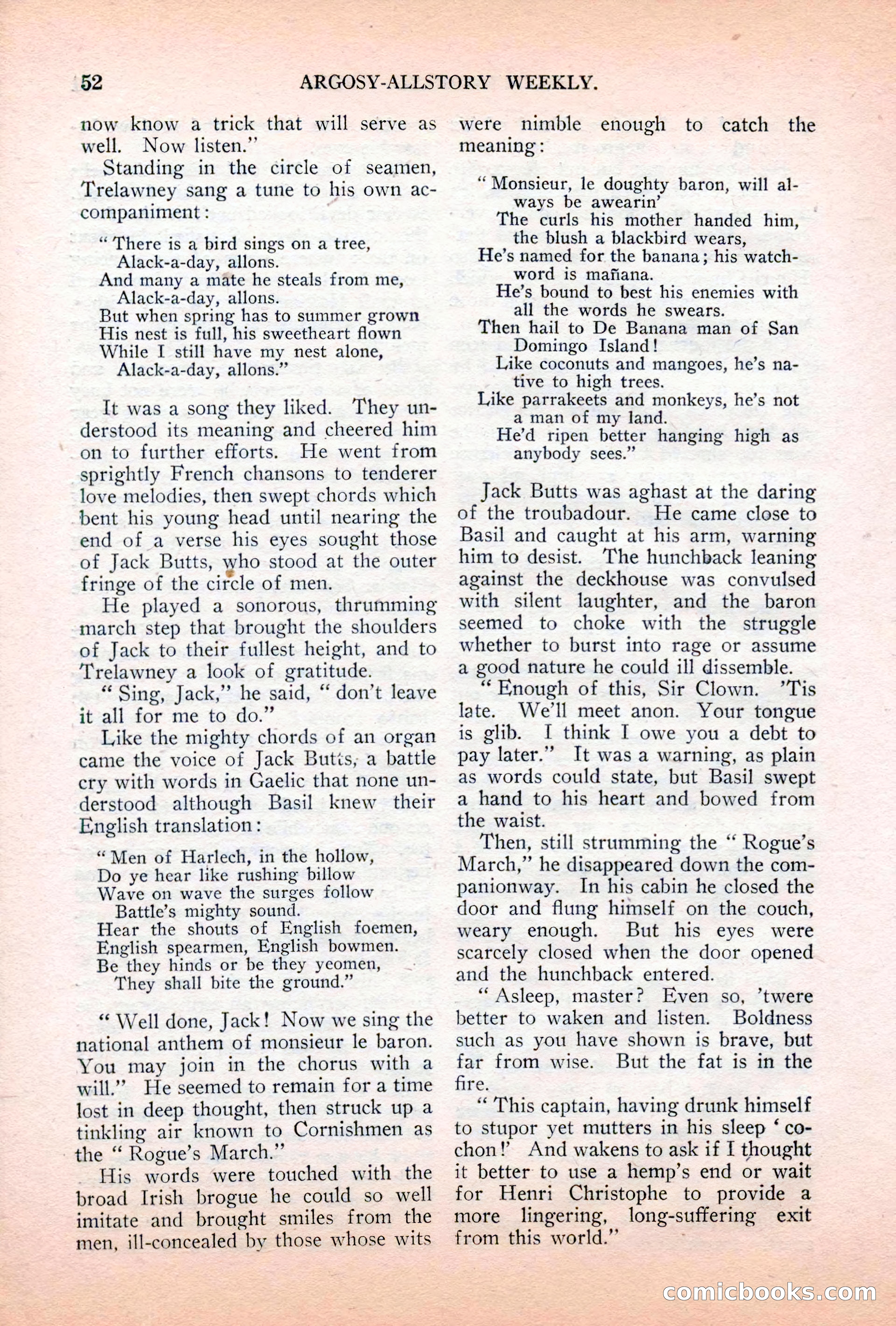
A restored page from Pulp Fiction, 1928. Page through the whole issue in the reader above.
📄 Transcribed text from this page (OCR, searchable)
Machine-transcribed from the original scan — historical spelling and the odd misread are preserved.
82 now know a trick that will serve as well. Now listen.” Standing in the circle of seamen, Trelawney sang a tune to his own ac- companiment : “There is a bird sings on a tree, Alack-a-day, allons. And many a mate he steals from me, Alack-a-day, allons. But when spring has to summer grown His nest is full, his sweetheart flown While I still have my nest alone, Alack-a-day, allons.”’ It was a song they liked. They un- derstood its meaning and cheered him on to further efforts. He went from sprightly French chansons to tenderer love melodies, then swept chords which bent his young head until nearing the end of a verse his eyes sought those of Jack Butts, who stood at the outer fringe of the circle of men. He played a sonorous, thrumming march step that brought the shoulders of Jack to their fullest height, and to Trelawney a look of gratitude. “Sing, Jack,” he said, “ don’t leave it all for me to do.” Like the mighty chords of an organ came the voice of Jack Butts, a battle ery with words in Gaelic that none un- derstood although Basil knew their English translation : “Men of Harlech, in the hollow, Do ye hear like rushing billow Wave on wave the surges follow Battle’s mighty sound. Hear the shouts of English foemen, English spearmen, English bowmen. Be they hinds or be they yeomen, They shall bite the ground.” “ Well done, Jack! Now we sing the national anthem of monsieur le baron. You may join in the chorus with a will.” He seemed to remain for a time lost in deep thought, then struck up a tinkling air known to Cornishmen as the “ Rogue’s March.” His words were touched with the broad Irish brogue he could so well imitate and brought smiles from the men, ill-concealed by those whose wits ARGOSY-ALLSTORY WEEKLY. were nimble enough to catch the meaning: “Monsieur, le doughty baron, will al- ways be awearin’ The curls his mother handed him, the blush a blackbird wears, He’s named for the banana; his watch- word is mafiana. He’s bound to best his enemies with all the words he swears. Then hail to De Banana man of San Domingo Island! Like coconuts and mangoes, he’s na- tive to high trees. Like parrakeets and monkeys, he’s not a man of my land. He’d ripen better hanging high as anybody sees.” Jack Butts was aghast at the daring of the troubadour. He came close to Basil and caught at his arm, warning him to desist. The hunchback leaning against the deckhouse was convulsed with silent laughter, and the baron seemed to choke with the struggle whether to burst into rage or assume a good nature he could ill dissemble. “Enough of this, Sir Clown. ’Tis late. We'll meet anon. Your tongue is glib. I think I owe you a debt to pay later.” It was a warning, as plain as words could state, but Basil swept a hand to his heart and bowed from the waist. Then, still strumming the ‘ Rogue’s March,” he disappeared down the com- panionway. In his cabin he closed the door and flung himself on the couch, weary enough. But his eyes were scarcely closed when the door opened and the hunchback entered. “Asleep, master? Even so, ’twere better to waken and listen. Boldness such as you have shown is brave, but far from wise. But the fat is in the fire. “This captain, having drunk himself to stupor yet mutters in his sleep ‘ co- chon! And wakens to ask if { thought it better to use a hemp’s end or wait for Henri Christophe to provide a more lingering, long-suffering exit from this world.” GEomichbooks (E@)