
Pulp Fiction, 1928 · page 15 of 152
Argosy All-Story Weekly, April 14, 1928 — page 15: what you’re looking at
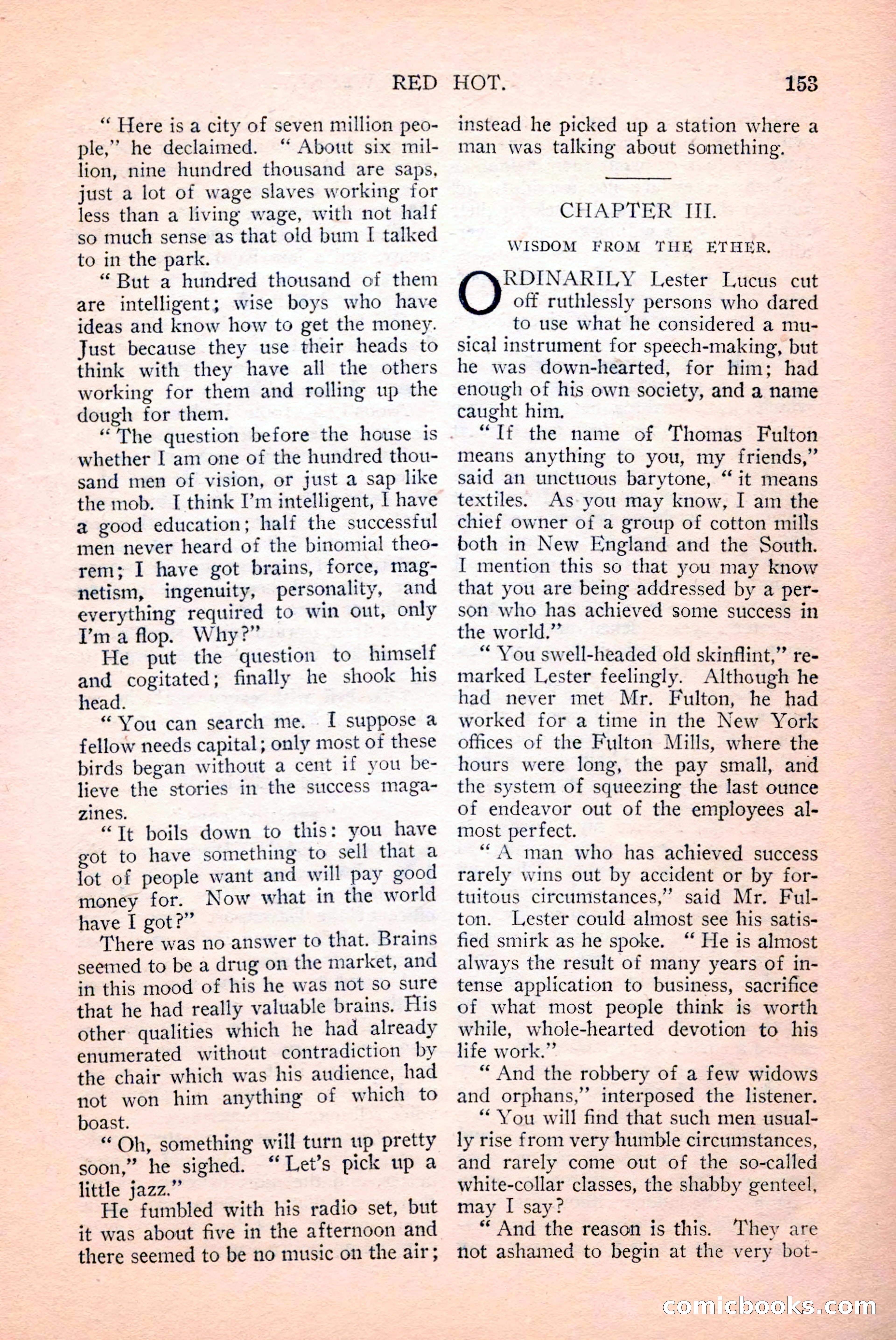
A restored page from Pulp Fiction, 1928. Page through the whole issue in the reader above.
📄 Transcribed text from this page (OCR, searchable)
Machine-transcribed from the original scan — historical spelling and the odd misread are preserved.
RED “ Here is a city of seven million peo- ple,” he declaimed. “ About six mil- lion, nine hundred thousand are saps, just a lot of wage slaves working for less than a living wage, with not half so much sense as that old bum I talked to in the park. “ But a hundred thousand of them are intelligent; wise boys who have ideas and know how to get the money. Just because they use their heads to think with they have all the others working for them and rolling up the dough for them. “The question before the house is . whether I am one of the hundred thou- sand men of vision, or just a sap like the mob. I think I’m intelligent, I have a good education; half the successful men never heard of the binomial theo- rem: I have got brains, force, mag- netism, ingenuity, personality, and everything required to win out, only I’m a flop. Why?” He put the question to himself and cogitated; finally he shook his head. “You can search me. I suppose a fellow needs capital; only most of these birds began without a cent if you be- lieve the stories in the success maga- zines. “Tt boils down to this: you have got to have something to sell that a lot of people want and will pay good money for. Now what in the world have I got?” here was no answer to that. Brains seeined to be a drug on the market, and in this mood of his he was not so sure that he had really valuable brains. His other qualities which he had already enumerated without contradiction by the chair which was his audience, had not won him anything of which to boast. “ Oh, something will turn up pretty soon,” he sighed. “ Let’s pick up a little jazz.” He fumbled with his radio set, but it was about five in the afternoon and there seemed to be no music on the air; HOT, 158 instead he picked up a station where a man was talking about something. CHAPTER III. WISDOM FROM THE ETHER, RDINARILY Lester Lucus cut off ruthlessly persons who dared to use what he considered a mu- sical instrument for speech-making, but he was down-hearted, for him: had enough of his own society, and a name caught him. “Tf the name of Thomas Fulton means anything to you, my friends,” said an unctuous barytone, “ it means textiles. As you may know, I am the chief owner of a group of cotton mills both in New England and the South. I mention this so that you may know that you are being addressed by a per- son who has achieved some success in the world.” * You swell-headed old skinflint,” re- marked Lester feelingly. Although he had never met Mr. Fulton, he had worked for a time in the New York offices of the Fulton Mills, where the hours were long, the pay small, and the system of squeezing the last ounce of endeavor out of the employees al- most perfect. “A man who has achieved success rarely wins out by accident or by for- tuitous circumstances,” said Mr. Ful- ton. Lester could almost see his satis- fied smirk as he spoke. “ He is almost always the result of many years of in- tense application to business, sacrifice of what most people think is worth while, whole-hearted devotion to his life work.” “And the robbery of a few widows and orphans,” interposed the listener. * You will find that such men usual- ly rise from very humble circumstances, and rarely come out of the so-called white-collar classes, the shabby genteel, may I say? “ And the reason is this. They are not ashamed to begin at the very bot- COMIC OOO (C <S) (E@)