
Pulp Fiction, 1928 · page 19 of 152
Argosy All-Story Weekly, April 14, 1928 — page 19: what you’re looking at
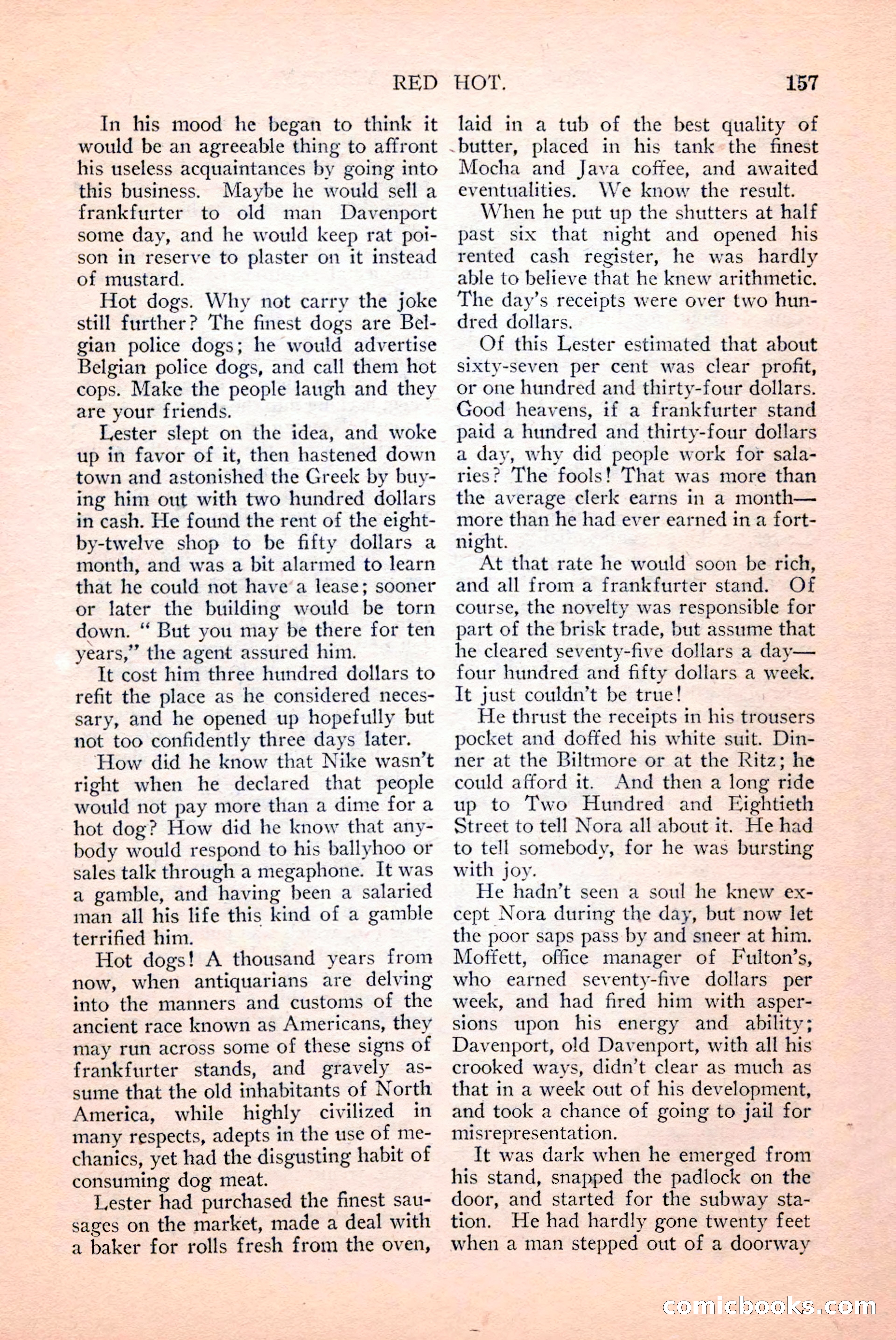
A restored page from Pulp Fiction, 1928. Page through the whole issue in the reader above.
📄 Transcribed text from this page (OCR, searchable)
Machine-transcribed from the original scan — historical spelling and the odd misread are preserved.
RED In his mood he began to think it would be an agreeable thing to affront his useless acquaintances by going into this business. Maybe he would sell a frankfurter to old man Davenport some day, and he would keep rat pot- son in reserve to plaster on it instead of mustard. Hot dogs. Why not carry the joke still further? The finest dogs are Bel- gian police dogs; he would advertise Belgian police dogs, and call them hot cops. Make the people laugh and they are your friends. Lester slept on the idea, and woke up in favor of it, then hastened down town and astonished the Greek by buy- ing him out with two hundred dollars in cash. He found the rent of the eight- by-twelve shop to be fifty dollars a month, and was a bit alarmed to learn that he could not havea lease; sooner or later the building would be torn down. “ But you may be there for ten years,” the agent assured him. It cost him three hundred dollars to refit the place as he considered neces- sary, and he opened up hopefully but not too confidently three days later. How did he know that Nike wasn’t right when he declared that people would not pay more than a dime for a hot dog? How did he know that any- body would respond to his ballyhoo or sales talk through a megaphone. It was a gamble, and having been a salaried man all his life this kind of a gamble terrified him. Hot dogs! A thousand years from now, when antiquarians are delving into the manners and customs of the ancient race known as Americans, they may run across some of these signs of frankfurter stands, and gravely as- sume that the old inhabitants of North America, while highly civilized in many respects, adepts in the use of me- chanics, yet had the disgusting habit of consuming dog meat. Lester had purchased the finest sau- sages on the market, made a deal with a baker for rolls fresh from the oven, HOT. 157 laid in a tub of the best quality of butter, placed in his tank the finest Mocha and Java coffee, and awaited eventualities. We know the result. When he put up the shutters at half past six that night and opened his rented cash register, he was hardly able to believe that he knew arithmetic. The day’s receipts were over two hun- dred dollars. Of this Lester estimated that about sixty-seven per cent was clear profit, or one hundred and thirty-four dollars. Good heavens, if a frankfurter stand paid a hundred and thirty-four dollars a day, why did people work for sala- ries? The fools! That was more than the average clerk earns in a month— more than he had ever earned in a fort- night. At that rate he would soon be rich, and all from a frankfurter stand. Of course, the novelty was responsible for part of the brisk trade, but assume that he cleared seventy-five dollars a day— four hundred and fifty dollars a week. It just couldn’t be true! He thrust the receipts 1n his trousers pocket and doffed his white suit. Din- ner at the Biltmore or at the Ritz; he could afford it. And then a long ride up to Two Hundred and Ejightieth Street to tell Nora all about it. He had to tell somebody, for he was bursting with joy. He hadn’t seen a soul he knew ex- cept Nora during the day, but now let the poor saps pass by and sneer at him. Moffett, office manager of Fulton’s, who earned seventy-five dollars per week, and had fired him with asper- sions upon his energy and ability; Davenport, old Davenport, with all his crooked ways, didn’t clear as much as that in a week out of his development, and took a chance of going to jail for misrepresentation. It was dark when he emerged from his stand, snapped the padlock on the door, and started for the subway sta- tion. He had hardly gone twenty feet when a man stepped out of a doorway COPMICGLOOKS (E@)