
Pulp Fiction, 1928 · page 79 of 152
Argosy All-Story Weekly, April 14, 1928 — page 79: what you’re looking at
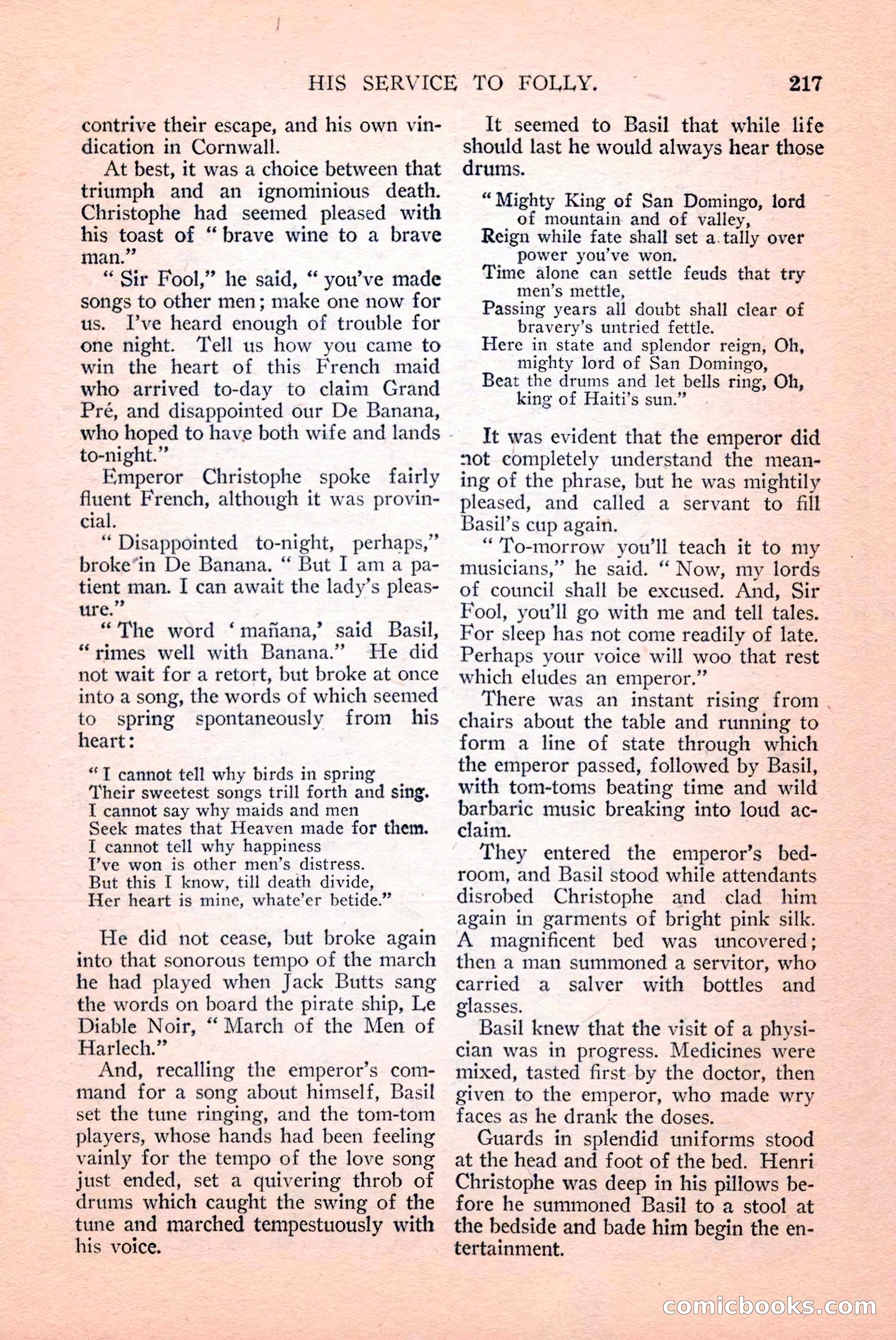
A restored page from Pulp Fiction, 1928. Page through the whole issue in the reader above.
📄 Transcribed text from this page (OCR, searchable)
Machine-transcribed from the original scan — historical spelling and the odd misread are preserved.
HIS SERVICE TO FOLLY. contrive their escape, and his own vin- dication in Cornwall. At best, it was a choice between that triumph and an ignominious death. Christophe had seemed pleased with his toast of “brave wine to a brave man.” “ Sir Fool,” he said, “ you’ve made songs to other men; make one now for us. Dve heard enough of trouble for one night. Tell us how you came to win the heart of this French maid who arrived to-day to claim Grand Pré, and disappointed our De Banana, who hoped to have both wife and lands - to-night.” Emperor Christophe spoke fairly fluent French, although it was provin- cial. ‘“ Disappointed to-night, perhaps,” broke*in De Banana. “ But I am a pa- tient man. [ can await the lady’s pleas- ure.” “The word ‘ mafiana,’ said Basil, “rimes well with Banana.” He did not wait for a retort, but broke at once into a song, the words of which seemed to spring spontaneously from his heart: *T cannot tell why birds in spring Their sweetest songs trill forth and sing. T cannot say why maids and men Seek mates that Heaven made for them. IT cannot tell why happiness I’ve won is other men’s distress. But this I know, till death divide, Her heart is mine, whate’er betide.” He did not cease, but broke again into that sonorous tempo of the march he had played when Jack Butts sang the words on board the pirate ship, Le Diable Noir, “ March of the Men of Harlech.” And, recalling the emperor’s com- mand for a song about himself, Basil set the tune ringing, and the tom-tom players, whose hands had been feeling vainly for the tempo of the love song just ended, set a quivering throb of drums which caught the swing of the tune and marched tempestuously with his voice. 217 It seemed to Basil that while life should last he would always hear those drums. “Mighty King of San Domingo, lord of mountain and of valley, Reign while fate shall set a.tally over power you’ve won. Time alone can settle feuds that try men’s mettle, Passing years all doubt shall clear of bravery’s untried fettle. Here in state and splendor reign, Oh, mighty lord of San Domingo, Beat the drums and let bells ring, Oh, king of Haiti’s sun.” It was evident that the emperor did 2ot completely understand the mean- ing of the phrase, but he was mightily pleased, and called a servant to fill Basil’s cup again. “To-morrow you'll teach it to my musicians,” he said. ‘ Now, my lords of council shall be excused. And, Sir Fool, you'll go with me and tell tales. For sleep has not come readily of late. Perhaps your voice will woo that rest which eludes an emperor.” There was an instant rising from . chairs about the table and running to form a line of state through which the emperor passed, followed by Basil, with tom-toms beating time and wild barbaric music breaking into loud ac- claim. They entered the emperor’s bed- room, and Basil stood while attendants disrobed Christophe and clad him again in garments of bright pink silk. A magnificent bed was uncovered; then a man summoned a servitor, who carried a salver with bottles and glasses. Basil knew that the visit of a physi- cian was in progress. Medicines were mixed, tasted first by the doctor, then given to the emperor, who made wry faces as he drank the doses. Guards in splendid uniforms stood at the head and foot of the bed. Henri Christophe was deep in his pillows be- fore he summoned Basil to a stool at the bedside and bade him begin the en- tertainment. EOPNICLOOOL< (@)