
Pulp Fiction, 1928 · page 107 of 148
Argosy All-Story Weekly, April 28, 1928 — page 107: what you’re looking at
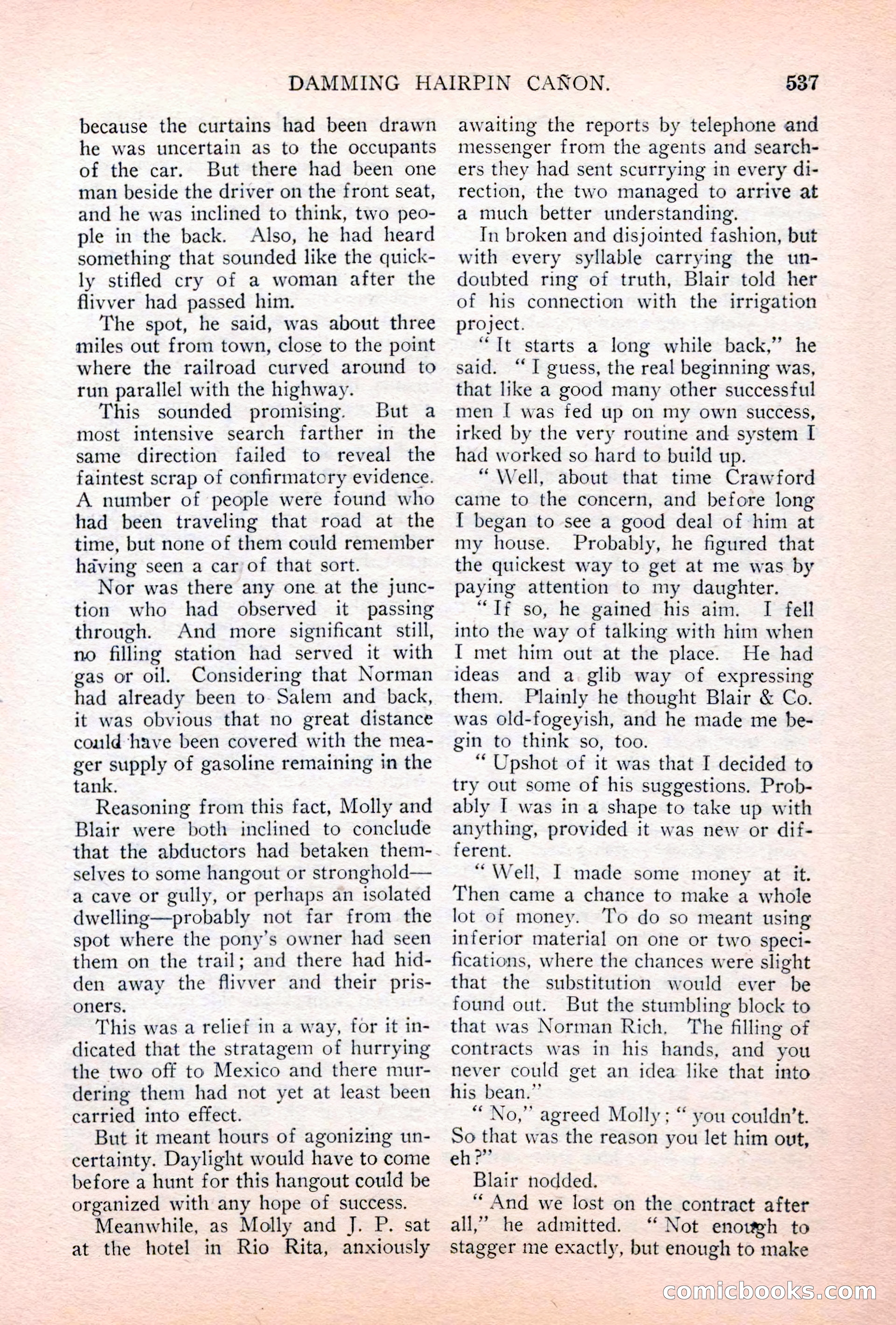
A restored page from Pulp Fiction, 1928. Page through the whole issue in the reader above.
📄 Transcribed text from this page (OCR, searchable)
Machine-transcribed from the original scan — historical spelling and the odd misread are preserved.
DAMMING HAIRPIN CANON, because the curtains had been drawn he was uncertain as to the occupants of the car. But there had been one man beside the driver on the front seat, and he was inclined to think, two peo- ple in the back. Also, he had heard something that sounded like the quick- ly stifled cry of a woman after the flivver had passed him. The spot, he said, was about three miles out from town, close to the point where the railroad curved around to run parallel with the highway. This sounded promising. But a most intensive search farther in the same direction failed to reveal the faintest scrap of confirmatory evidence. A number of people were found who had been traveling that road at the time, but none of them could remember having seen a car of that sort. Nor was there any one at the junc- tion who had observed it passing through. And more significant. still, no filling station had served it with gas or oil. Considering that Norman had already been to Salem and back, it was obvious that no great distance could have been covered with the mea- ger supply of gasoline remaining in the tank. Reasoning from this fact, Molly and Blair were both inclined to conclude that the abductors had betaken them- selves to some hangout or stronghold— a cave or gully, or perhaps an isolated dwelling—probably not far from the spot where the pony’s owner had seen them on the trail; and there had hid- den away the flivver and their pris- oners. This was a relief in a way, for it in- dicated that the stratagem of hurrying the two off to Mexico and there mur- dering them had not yet at least been carried into effect. But it meant hours of agonizing un- certainty. Daylight would have to come before a hunt for this hangout could be organized with any hope of success. Meanwhile, as Molly and J. P. sat at the hotel in Rio Rita, anxiously dot awaiting the reports by telephone and messenger from the agents and search- ers they had sent scurrying in every di- rection, the two managed to arrive at a much better understanding. In broken and disjointed fashion, but with every syllable carrying the un- doubted ring of truth, Blair told her of his connection with the irrigation project. “Tt starts a long while back,” he said. “I guess, the real beginning was, that like a good many other successful men [ was fed up on my own success, irked by the very routine and system I had worked so hard to build up. “Well, about that time Crawford came to the concern, and before long { began to see a good deal of him at my house. Probably, he figured that the quickest way to get at me was by paying attention to my daughter. “Tf so, he gained his aim. I fell into the way of talking with him when I met him out at the place. He had ideas and a glib way of expressing them. Plainly he thought Blair & Co. was old-fogeyish, and he made me be- gin to think so, too. ““ Upshot of it was that I decided to try out some of his suggestions. Prob- ably I was in a shape to take up with anything, provided it was new or dif- ferent. “Well, I made some money at it. Then came a chance to make a whole lot of money. To do so meant using inferior material on one or two speci- fications, where the chances were slight that the substitution would ever be found out. But the stumbling block to that was Norman Rich, The filling of contracts was in his hands, and you never could get an idea like that into his bean.”’ “No,” agreed Molly; “ you couldn’t. oo was the reason you let him out, eh?” | Blair nodded. ‘And we lost on the contract after all,’ he admitted. ‘ Not enoweh to stagger me exactly, but enough to make CORNICLOOKS (F@