
Pulp Fiction, 1928 · page 113 of 148
Argosy All-Story Weekly, April 28, 1928 — page 113: what you’re looking at
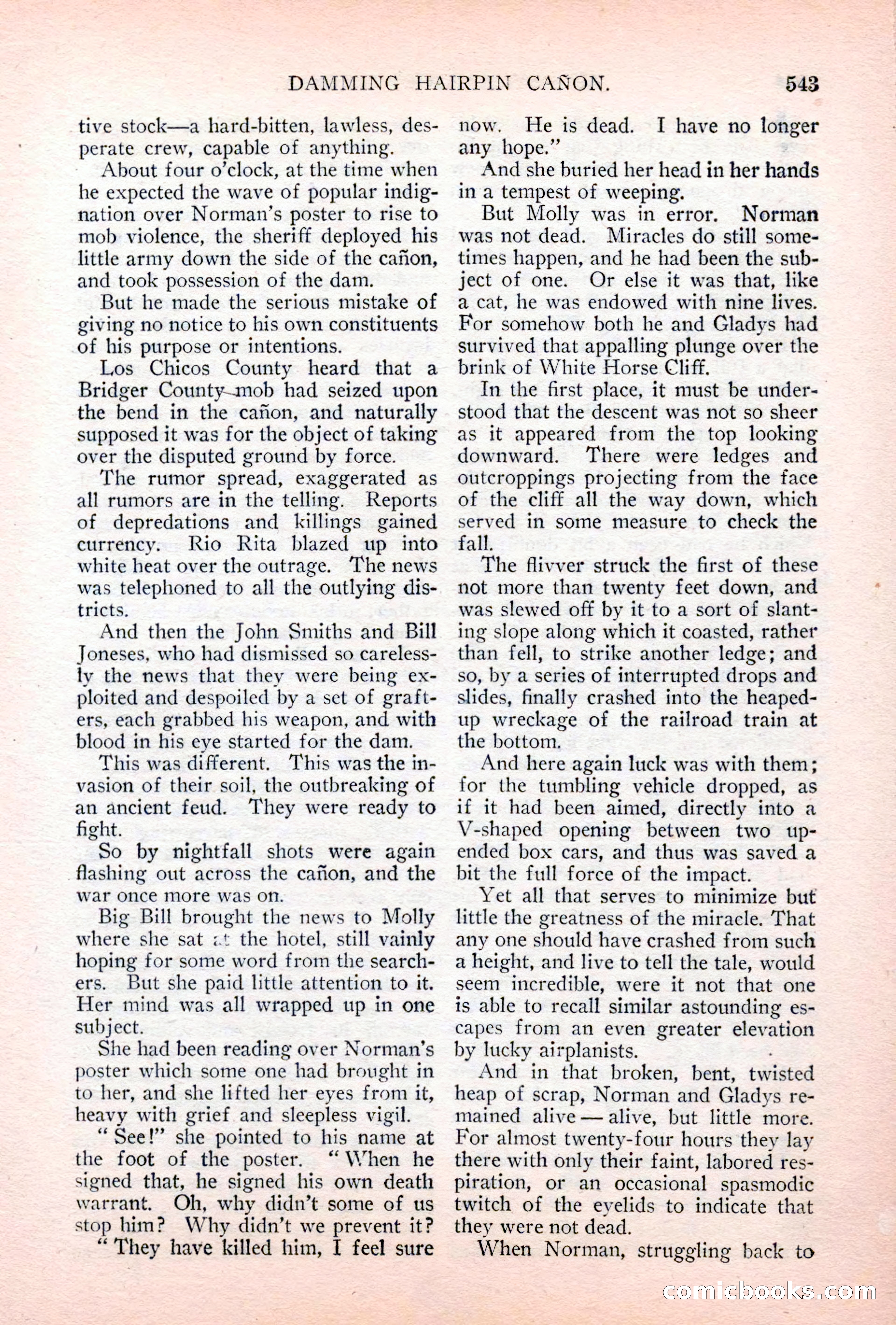
A restored page from Pulp Fiction, 1928. Page through the whole issue in the reader above.
📄 Transcribed text from this page (OCR, searchable)
Machine-transcribed from the original scan — historical spelling and the odd misread are preserved.
DAMMING HAIRPIN CANON. tive stock—a hard-bitten, lawless, des- perate crew, capable of anything. About four o’clock, at the time when he expected the wave of popular indig- nation over Norman’s poster to rise to mob violence, the sheriff deployed his little army down the side of the cafion, and took possession of the dam. But he made the serious mistake of giving no notice to his own constituents of his purpose or intentions. Los Chicos County heard that a Bridger County—mob had seized upon the bend in the canon, and naturally supposed it was for the object of taking over the disputed ground by force. The rumor spread, exaggerated as all rumors are in the telling. Reports of depredations and killings gained currency. Rio Rita blazed up into white heat over the outrage. The news was telephoned to all the outlying dis- tricts. And then the John Smiths and Bill Joneses, who had dismissed so careless- ly the news that they were being ex- ploited and despoiled by a set of graft- ers, each grabbed his weapon, and with blood in his eye started for the dam. This was different. This was the in- vasion of their soil, the outbreaking of an ancient feud. They were ready to fight. So by nightfall shots were again flashing out across the cafion, and the war once more was on. Big Bill brought the news to Molly where she sat «t the hotel, still vainly hoping for some word from the search- ers. But she paid little attention to it. Her mind was all wrapped up in one subject. She had been reading over Norman’s poster which some one had brought in to her, and she lifted her eyes from it, heavy with grief and sleepless vigil. “See!” she pointed to his name at the foot of the poster. “When he signed that, he signed his own death warrant. Oh, why didn’t some of us stop him? Why didn’t we prevent it? “They have killed him, I feel sure 543 now. He is dead. any hope.” And she buried her head in her hands in a tempest of weeping. But Molly was in error. Norman was not dead. Miracles do still some- times happen, and he had been the sub- ject of one. Or else it was that, like a cat, he was endowed with nine lives. For somehow both he and Gladys had survived that appalling plunge over the brink of White Horse Cliff. I have no longer In the first place, it must be under- stood that the descent was not so sheer as it appeared from the top looking downward. There were ledges and outcroppings projecting from the face of the cliff all the way down, which served in some measure to check the fall. The flivver struck the first of these not more than twenty feet down, and was slewed off by it to a sort of slant- ing slope along which it coasted, rather than fell, to strike another ledge; and so, by a series of interrupted drops and slides, finally crashed into the heaped- up wreckage of the railroad train at the bottom. And here again luck was with them; for the tumbling vehicle dropped, as if it had been aimed, directly into a V-shaped opening between two up- ended box cars, and thus was saved a bit the full force of the impact. Yet all that serves to minimize but little the greatness of the miracle. That any one should have crashed from such a height, and live to tell the tale, would seem incredible, were it not that one is able to recall similar astounding es- capes from an even greater elevation by lucky airplanists. And in that broken, bent, twisted heap of scrap, Norman and Gladys re- mained alive — alive, but little more. For almost twenty-four hours they lay there with only their faint, labored res- piration, or an occasional spasmodic twitch of the eyelids to indicate that they were not dead. When Norman, struggling back to COMMUC VOOKS (C@