
Pulp Fiction, 1928 · page 118 of 148
Argosy All-Story Weekly, April 28, 1928 — page 118: what you’re looking at
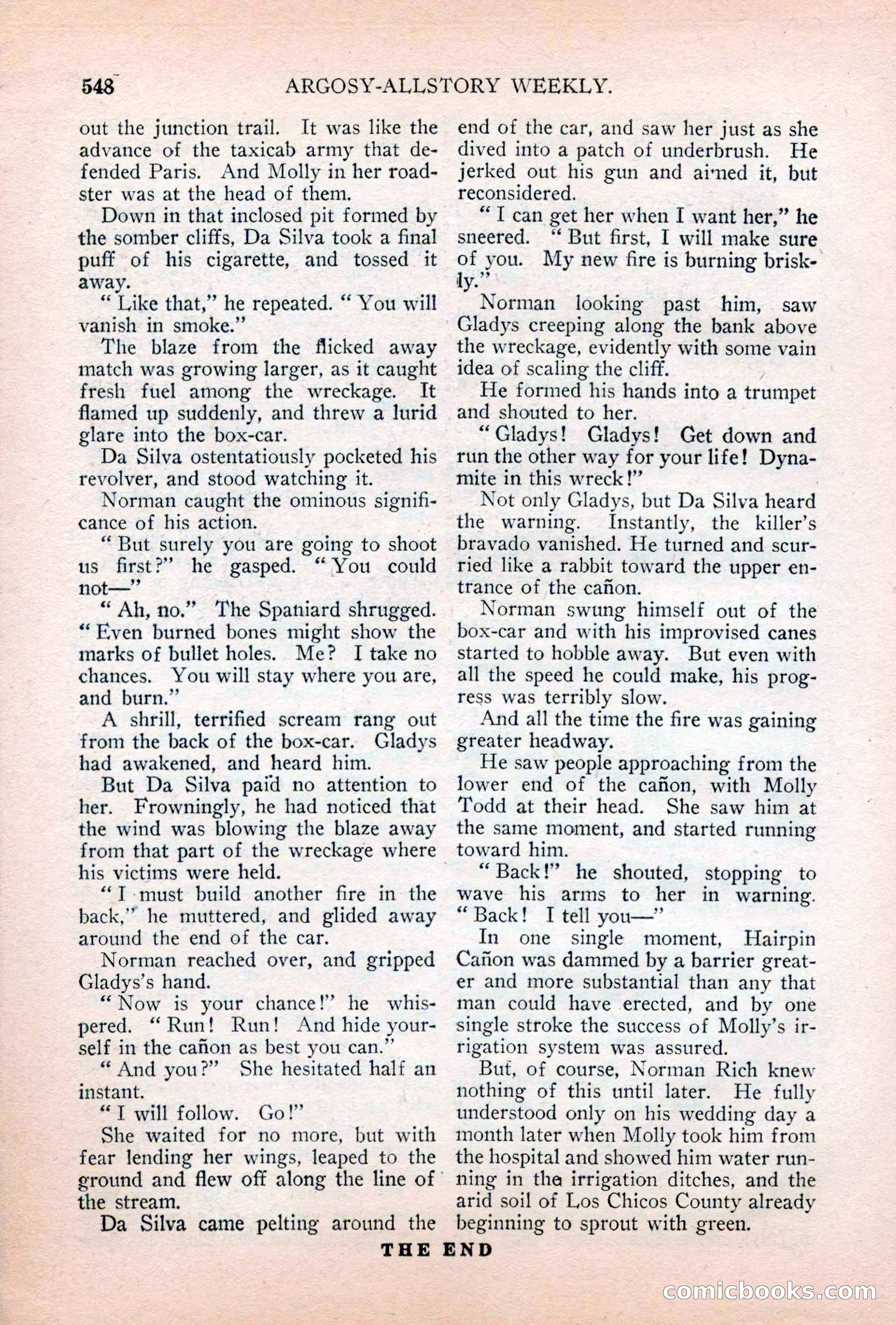
A restored page from Pulp Fiction, 1928. Page through the whole issue in the reader above.
📄 Transcribed text from this page (OCR, searchable)
Machine-transcribed from the original scan — historical spelling and the odd misread are preserved.
548 out the junction trail. It was like the advance of the taxicab army that de- fended Paris. And Molly in her road- ster was at the head of them. Down in that inclosed pit formed by the somber cliffs, Da Silva took a final puff of his cigarette, and tossed it away. “ Like that,” he repeated. “ You will vanish in smoke.” The blaze from the flicked away match was growing larger, as it caught fresh fuel among the wreckage. It flamed up suddenly, and threw a lurid glare into the box-car. Da Silva ostentatiously pocketed his revolver, and stood watching it. Norman caught the ominous signifi- cance of his action. “But surely you are going to shoot us first?’ he gasped. “ You could not—”’ “ Ah, no.” The Spaniard shrugged. “Even burned bones might show the marks of bullet holes. Me? I take no chances. You will stay where you are, and burn.” A shrill, terrified scream rang out from the back of the box-car. Gladys had awakened, and heard him. But Da Silva paid no attention to her. Frowningly, he had noticed that the wind was blowing the blaze away from that part of the wreckage where his victims were held. “T-must build another fire in the back,” he muttered, and glided away around the end of the car. Norman reached over, and gripped Gladys’s hand. “Now is your chance!” he whis- pered. “Run! Run! And hide your- self in the cafion as best you can.”’ “ And you?” She hesitated half an instant. “T will follow. Go!” She waited for no more, but with fear lending her wings, leaped to the ground and flew off along the line of the stream. Da Silva came pelting around the ARGOSY-ALLSTORY WEEKLY. end of the car, and saw her just as she dived into a patch of underbrush. He jerked out his gun and aimed it, but reconsidered. “TI can get her when I want her,” he sneered. “‘ But first, I will make sure of you. My new fire is burning brisk- ly.” Norman looking past him, saw Gladys creeping along the bank above the wreckage, evidently with some vain idea of scaling the cliff. He formed his hands into a trumpet and shouted to her. “Gladys! Gladys! Get down and run the other way for your life! Dyna- mite in this wreck!” . Not only Gladys, but Da Silva heard the warning. Instantly, the killer’s bravado vanished. He turned and scur- ried like a rabbit toward the upper en- trance of the canon. Norman swung himself out of the box-car and with his improvised canes started to hobble away. But even with all the speed he could make, his prog- ress was terribly slow. And all the time the fire was gaining greater headway. He saw people approaching from the lower end of the cafion, with Molly Todd at their head. She saw him at the same moment, and started running toward him. “Back!” he shouted, stopping to wave his arms to her in warning. “Back! I tell you—” In one single moment, Hairpin Cafion was dammed by a barrier great- er and more substantial than any that man could have erected, and by one single stroke the success of Molly’s ir- rigation system was assured. But, of course, Norman Rich knew nothing of this until later. He fully understood only on his wedding day a month later when Molly took him from the hospital and showed him water run- ning in the irrigation ditches, and the arid soil of Los Chicos County already beginning to sprout with green. THE END COPMIG LOOKS (F@)