
Pulp Fiction, 1928 · page 135 of 148
Argosy All-Story Weekly, April 28, 1928 — page 135: what you’re looking at
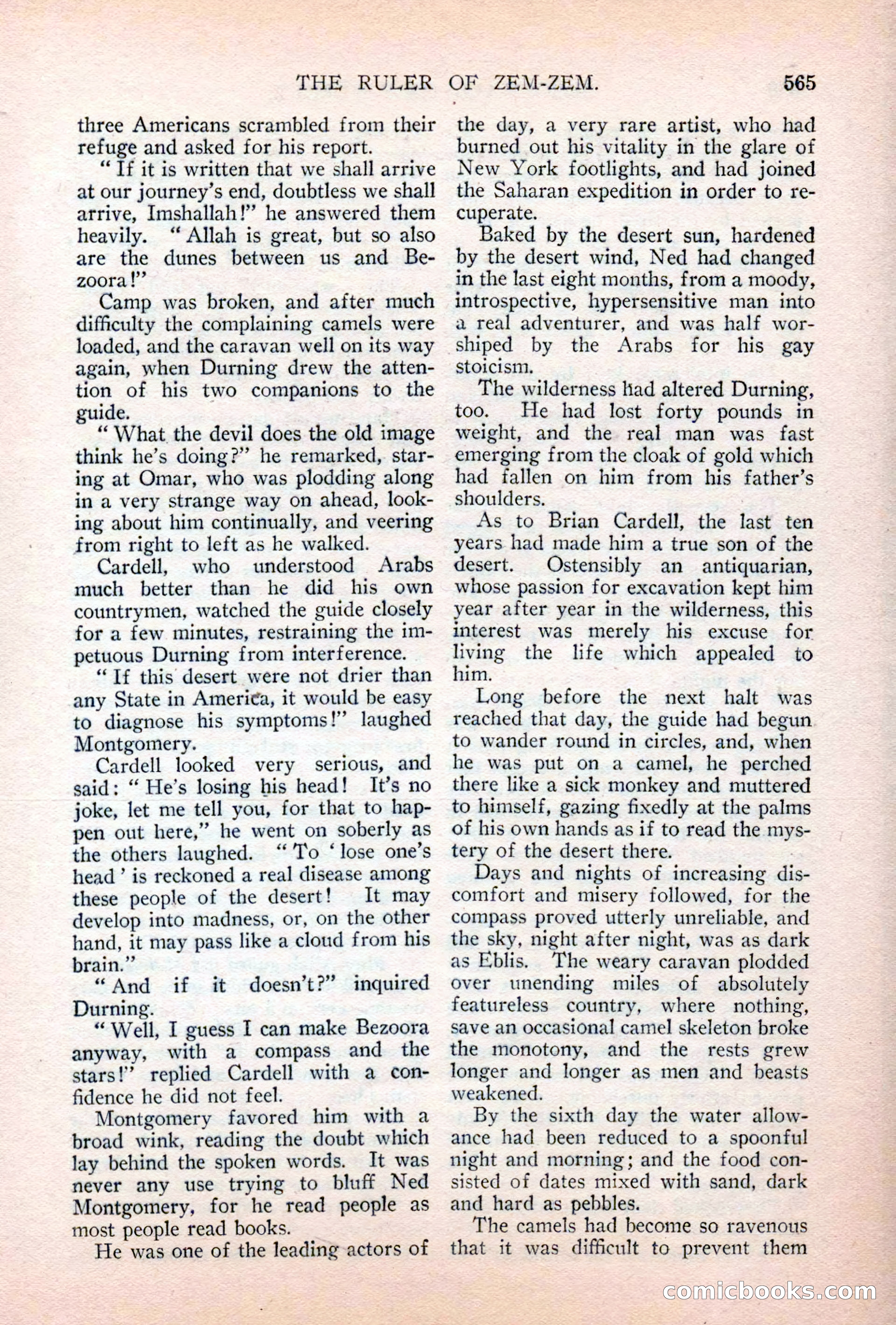
A restored page from Pulp Fiction, 1928. Page through the whole issue in the reader above.
📄 Transcribed text from this page (OCR, searchable)
Machine-transcribed from the original scan — historical spelling and the odd misread are preserved.
THE RULER three Americans scrambled from their refuge and asked for his report. “Tf it is written that we shall arrive at our journey’s end, doubtless we shall atrive, Imshallah!’’ he answered them heavily. “ Allah is great, but so also are the dunes between us and Be- zoora!”’ Camp was broken, and after much difficulty the complaining camels were loaded, and the caravan well on its way again, when Durning drew the atten- tion of his two companions to the guide. “What the devil does the old image think he’s doing?” he remarked, star- ing at Omar, who was plodding along in a very strange way on ahead, look- ing about him continually, and veering from right to left as he walked. Cardell, who understood Arabs much better than he did his own countrymen, watched the guide closely for a few minutes, restraining the im- petuous Durning from interference. “Tf this desert were not drier than any State in Amerita, it would be easy to diagnose his symptoms!” laughed Montgomery. Cardell looked very serious, and said: “ He’s losing his head! It’s no joke, let me tell you, for that to hap- pen out here,” he went on soberly as the others laughed. “‘ To ‘lose one’s head’ is reckoned a real disease among these people of the desert! It may develop into madness, or, on the other hand, it may pass like a cloud from his brain.” * And Durning. “ Well, I guess I can make Bezoora anyway, with a compass and the stars!’ replied Cardell with a con- fidence he did not feel. Montgomery favored him with a broad wink, reading the doubt which lay behind the spoken words. It was never any use trying to bluff Ned Montgomery, for he read people as most people read books. He was one of the leading actors of if it doesn’t?” inquired OF ZEM-ZEM. 565 the day, a very rare artist, who had burned out his vitality in the glare of New York footlights, and had joined the Saharan expedition in order to re- cuperate. Baked by the desert sun, hardened by the desert wind, Ned had changed in the last eight months, from a moody, introspective, hypersensitive man into a real adventurer, and was half wor- shiped by the Arabs for his gay stoicism. The wilderness had altered Durning, too. He had lost forty pounds in weight, and the real man was fast emerging from the cloak of gold which had fallen on him from his father’s shoulders. As to Brian Cardell, the last ten years had made him a true son of the desert. Ostensibly an antiquarian, whose passion for excavation kept him year after year in the wilderness, this interest was merely his excuse for living the life which appealed to him. Long before the next halt was reached that day, the guide had begun to wander round in circles, and, when he was put on a camel, he perched there like a sick monkey and muttered to himself, gazing fixedly at the palms of his own hands as if to read the mys- tery of the desert there. Days and nights of increasing dis- comfort and misery followed, for the compass proved utterly unreliable, and the sky, night after night, was as dark as Eblis. The weary caravan plodded over unending miles of absolutely featureless country, where nothing, save an occasional camel skeleton broke the monotony, and the rests grew longer and longer as men and beasts weakened. By the sixth day the water allow- ance had been reduced to a spoonful night and morning; and the food con- sisted of dates mixed with sand, dark and hard as pebbles. The camels had become so ravenous that it was difficult to prevent them Gomichboo S (E@